

6.4 Mass-Transfer-Controlled Amperometric Biosensing
109
concentration. In addition, the upper limit of the linear range exceeded the BQ
concentration. This means that quite fast MET-type bioelectrocatalysis occurred
near the electrode surface. The response of the sensor agreed with the calculated
value for the hemispherical diffusion of glucose at the ME. Therefore, the sensitivity
of the sensor became reproducible and independent of any change in the enzyme
activity [18].
The analysis of the diffusion-limited MET-type bioelectrocatalysis at an ME based
on the diffusion reaction equations of mediator and enzyme shows that the enzymatic
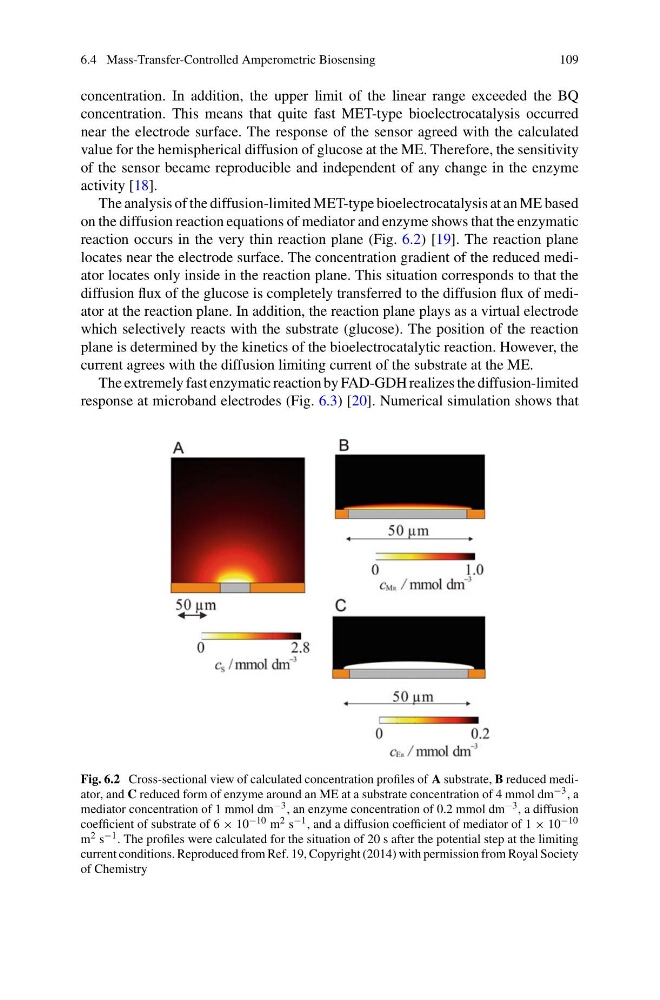
reaction occurs in the very thin reaction plane (Fig. 6.2) [19]. The reaction plane
locates near the electrode surface. The concentration gradient of the reduced mediator locates only inside in the reaction plane. This situation corresponds to that the
diffusion flux of the glucose is completely transferred to the diffusion flux of mediator at the reaction plane. In addition, the reaction plane plays as a virtual electrode
which selectively reacts with the substrate (glucose). The position of the reaction
plane is determined by the kinetics of the bioelectrocatalytic reaction. However, the
current agrees with the diffusion limiting current of the substrate at the ME.
The extremely fast enzymatic reaction by FAD-GDH realizes the diffusion-limited
response at microband electrodes (Fig. 6.3) [20]. Numerical simulation shows that
Fig. 6.2 Cross-sectional view of calculated concentration profiles of A substrate, B reduced mediator, and C reduced form of enzyme around an ME at a substrate concentration of 4 mmol dm −3 , a
mediator concentration of 1 mmol dm −3 , an enzyme concentration of 0.2 mmol dm −3 , a diffusion
coefficient of substrate of 6 × 10 −10 m 2 s −1 , and a diffusion coefficient of mediator of 1 × 10 −10
m 2 s −1 . The profiles were calculated for the situation of 20 s after the potential step at the limiting
current conditions. Reproduced from Ref. 19, Copyright (2014) with permission from Royal Society
of Chemistry
109
concentration. In addition, the upper limit of the linear range exceeded the BQ
concentration. This means that quite fast MET-type bioelectrocatalysis occurred
near the electrode surface. The response of the sensor agreed with the calculated
value for the hemispherical diffusion of glucose at the ME. Therefore, the sensitivity
of the sensor became reproducible and independent of any change in the enzyme
activity [18].
The analysis of the diffusion-limited MET-type bioelectrocatalysis at an ME based
on the diffusion reaction equations of mediator and enzyme shows that the enzymatic
reaction occurs in the very thin reaction plane (Fig. 6.2) [19]. The reaction plane
locates near the electrode surface. The concentration gradient of the reduced mediator locates only inside in the reaction plane. This situation corresponds to that the
diffusion flux of the glucose is completely transferred to the diffusion flux of mediator at the reaction plane. In addition, the reaction plane plays as a virtual electrode
which selectively reacts with the substrate (glucose). The position of the reaction
plane is determined by the kinetics of the bioelectrocatalytic reaction. However, the
current agrees with the diffusion limiting current of the substrate at the ME.
The extremely fast enzymatic reaction by FAD-GDH realizes the diffusion-limited
response at microband electrodes (Fig. 6.3) [20]. Numerical simulation shows that
Fig. 6.2 Cross-sectional view of calculated concentration profiles of A substrate, B reduced mediator, and C reduced form of enzyme around an ME at a substrate concentration of 4 mmol dm −3 , a
mediator concentration of 1 mmol dm −3 , an enzyme concentration of 0.2 mmol dm −3 , a diffusion
coefficient of substrate of 6 × 10 −10 m 2 s −1 , and a diffusion coefficient of mediator of 1 × 10 −10
m 2 s −1 . The profiles were calculated for the situation of 20 s after the potential step at the limiting
current conditions. Reproduced from Ref. 19, Copyright (2014) with permission from Royal Society
of Chemistry