

108
6 Applications to Biosensors
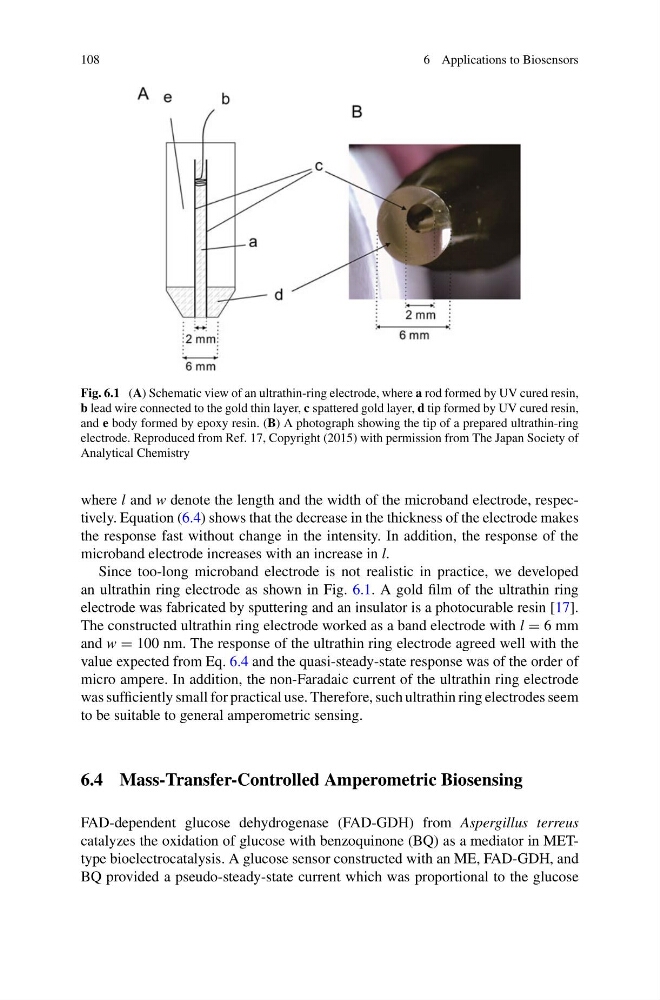
Fig. 6.1 (A) Schematic view of an ultrathin-ring electrode, where a rod formed by UV cured resin,
b lead wire connected to the gold thin layer, c spattered gold layer, d tip formed by UV cured resin,
and e body formed by epoxy resin. (B) A photograph showing the tip of a prepared ultrathin-ring
electrode. Reproduced from Ref. 17, Copyright (2015) with permission from The Japan Society of
Analytical Chemistry
where l and w denote the length and the width of the microband electrode, respectively. Equation (6.4) shows that the decrease in the thickness of the electrode makes
the response fast without change in the intensity. In addition, the response of the
microband electrode increases with an increase in l.
Since too-long microband electrode is not realistic in practice, we developed
an ultrathin ring electrode as shown in Fig. 6.1. A gold film of the ultrathin ring
electrode was fabricated by sputtering and an insulator is a photocurable resin [17].
The constructed ultrathin ring electrode worked as a band electrode with l = 6 mm
and w = 100 nm. The response of the ultrathin ring electrode agreed well with the
value expected from Eq. 6.4 and the quasi-steady-state response was of the order of
micro ampere. In addition, the non-Faradaic current of the ultrathin ring electrode
was sufficiently small for practical use. Therefore, such ultrathin ring electrodes seem
to be suitable to general amperometric sensing.
6.4 Mass-Transfer-Controlled Amperometric Biosensing
FAD-dependent glucose dehydrogenase (FAD-GDH) from Aspergillus terreus
catalyzes the oxidation of glucose with benzoquinone (BQ) as a mediator in METtype bioelectrocatalysis. A glucose sensor constructed with an ME, FAD-GDH, and
BQ provided a pseudo-steady-state current which was proportional to the glucose
6 Applications to Biosensors
Fig. 6.1 (A) Schematic view of an ultrathin-ring electrode, where a rod formed by UV cured resin,
b lead wire connected to the gold thin layer, c spattered gold layer, d tip formed by UV cured resin,
and e body formed by epoxy resin. (B) A photograph showing the tip of a prepared ultrathin-ring
electrode. Reproduced from Ref. 17, Copyright (2015) with permission from The Japan Society of
Analytical Chemistry
where l and w denote the length and the width of the microband electrode, respectively. Equation (6.4) shows that the decrease in the thickness of the electrode makes
the response fast without change in the intensity. In addition, the response of the
microband electrode increases with an increase in l.
Since too-long microband electrode is not realistic in practice, we developed
an ultrathin ring electrode as shown in Fig. 6.1. A gold film of the ultrathin ring
electrode was fabricated by sputtering and an insulator is a photocurable resin [17].
The constructed ultrathin ring electrode worked as a band electrode with l = 6 mm
and w = 100 nm. The response of the ultrathin ring electrode agreed well with the
value expected from Eq. 6.4 and the quasi-steady-state response was of the order of
micro ampere. In addition, the non-Faradaic current of the ultrathin ring electrode
was sufficiently small for practical use. Therefore, such ultrathin ring electrodes seem
to be suitable to general amperometric sensing.
6.4 Mass-Transfer-Controlled Amperometric Biosensing
FAD-dependent glucose dehydrogenase (FAD-GDH) from Aspergillus terreus
catalyzes the oxidation of glucose with benzoquinone (BQ) as a mediator in METtype bioelectrocatalysis. A glucose sensor constructed with an ME, FAD-GDH, and
BQ provided a pseudo-steady-state current which was proportional to the glucose