

6.3 Electrodes for Amperometric Biosensing
107
where i s,elec , i s,enz , i s,perm, and i s,mt are the limiting current controlled by the electron
transfer, the enzymatic reaction, the permeation of membrane, and the mass transfer
of substrate, respectively. The term 1/i s,elec can be ignored by setting the detection
potential at the limiting current conditions (sufficiently positive or negative compared
with E
◦
M for the oxidative or reductive detection of analyte, respectively). The value
of i s,enz is directly affected by a change in the enzyme activity which is inherently
unstable and more or less decreases with time. The i s,perm value is not constant for
biosensors with an outer membrane. Therefore, the diffusion-controlled steady-state
response is required to construct stable and reliable amperometric biosensors, i.e.,
i s,mt i s,perm , i s,enz , i s,elec .
The requirement that i s,mt i s,perm , i s,enz can be satisfied by using sufficiently high concentrations of a redox enzyme near an electrode without any outer
membrane. In order to realize the steady-state mass transfer of substrate, hydrodynamic technique using a rotating disk electrode (RDE) or non-linear diffusion at
a microdisk electrode (ME) may be used as typical electrochemical methods. The
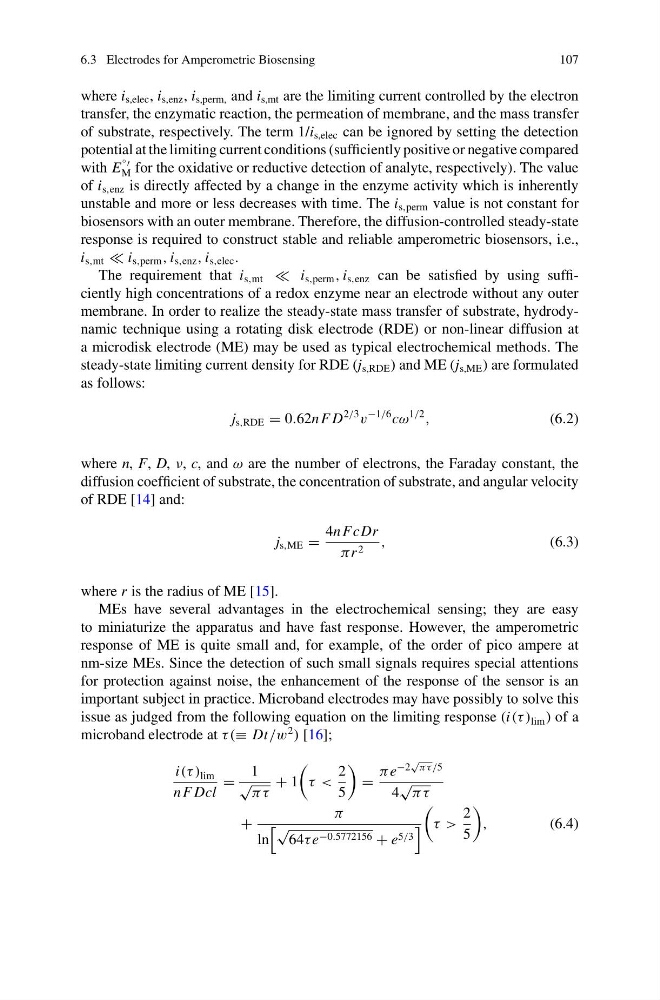
steady-state limiting current density for RDE (j s,RDE ) and ME (j s,ME ) are formulated
as follows:
j s,RDE = 0.62n F D
2/3
v
−1/6 cω
1/2
,
(6.2)
where n, F, D, ν, c, and ω are the number of electrons, the Faraday constant, the
diffusion coefficient of substrate, the concentration of substrate, and angular velocity
of RDE [14] and:
j s,ME =
4n FcDr
πr 2 ,
(6.3)
where r is the radius of ME [15].
MEs have several advantages in the electrochemical sensing; they are easy
to miniaturize the apparatus and have fast response. However, the amperometric
response of ME is quite small and, for example, of the order of pico ampere at
nm-size MEs. Since the detection of such small signals requires special attentions
for protection against noise, the enhancement of the response of the sensor is an
important subject in practice. Microband electrodes may have possibly to solve this
issue as judged from the following equation on the limiting response (i(τ ) lim ) of a
microband electrode at τ (≡ Dt/w
2
) [16];
i(τ ) lim
n F Dcl
=
1
√
πτ
+ 1
τ <
2
5
=
π e
−2
√ πτ /5
4
√ πτ
+
π
ln
√
64τ e −0.5772156 + e 5/3
τ >
2
5
,
(6.4)
107
where i s,elec , i s,enz , i s,perm, and i s,mt are the limiting current controlled by the electron
transfer, the enzymatic reaction, the permeation of membrane, and the mass transfer
of substrate, respectively. The term 1/i s,elec can be ignored by setting the detection
potential at the limiting current conditions (sufficiently positive or negative compared
with E
◦
M for the oxidative or reductive detection of analyte, respectively). The value
of i s,enz is directly affected by a change in the enzyme activity which is inherently
unstable and more or less decreases with time. The i s,perm value is not constant for
biosensors with an outer membrane. Therefore, the diffusion-controlled steady-state
response is required to construct stable and reliable amperometric biosensors, i.e.,
i s,mt i s,perm , i s,enz , i s,elec .
The requirement that i s,mt i s,perm , i s,enz can be satisfied by using sufficiently high concentrations of a redox enzyme near an electrode without any outer
membrane. In order to realize the steady-state mass transfer of substrate, hydrodynamic technique using a rotating disk electrode (RDE) or non-linear diffusion at
a microdisk electrode (ME) may be used as typical electrochemical methods. The
steady-state limiting current density for RDE (j s,RDE ) and ME (j s,ME ) are formulated
as follows:
j s,RDE = 0.62n F D
2/3
v
−1/6 cω
1/2
,
(6.2)
where n, F, D, ν, c, and ω are the number of electrons, the Faraday constant, the
diffusion coefficient of substrate, the concentration of substrate, and angular velocity
of RDE [14] and:
j s,ME =
4n FcDr
πr 2 ,
(6.3)
where r is the radius of ME [15].
MEs have several advantages in the electrochemical sensing; they are easy
to miniaturize the apparatus and have fast response. However, the amperometric
response of ME is quite small and, for example, of the order of pico ampere at
nm-size MEs. Since the detection of such small signals requires special attentions
for protection against noise, the enhancement of the response of the sensor is an
important subject in practice. Microband electrodes may have possibly to solve this
issue as judged from the following equation on the limiting response (i(τ ) lim ) of a
microband electrode at τ (≡ Dt/w
2
) [16];
i(τ ) lim
n F Dcl
=
1
√
πτ
+ 1
τ <
2
5
=
π e
−2
√ πτ /5
4
√ πτ
+
π
ln
√
64τ e −0.5772156 + e 5/3
τ >
2
5
,
(6.4)