

G.3 Hamilton’s Equations
669
G.3.1 The Hamiltonian and Energy Conservation
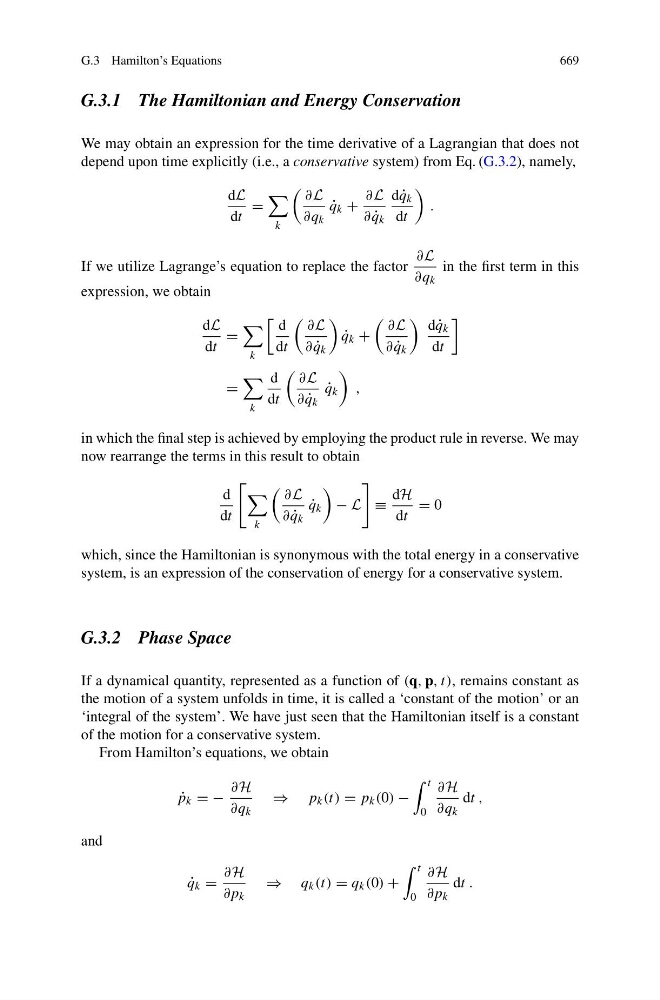
We may obtain an expression for the time derivative of a Lagrangian that does not
depend upon time explicitly (i.e., a conservative system) from Eq. (G.3.2), namely,
dL
dt
=
k
∂L
∂q k
˙
q k +
∂L
∂ ˙
q k
d ˙
q k
dt
.
If we utilize Lagrange’s equation to replace the factor
∂L
∂q k
in the first term in this
expression, we obtain
dL
dt
=
k
d
dt
∂L
∂ ˙
q k
˙
q k +
∂L
∂ ˙
q k
d ˙
q k
dt
=
k
d
dt
∂L
∂ ˙
q k
˙
q k
,
in which the final step is achieved by employing the product rule in reverse. We may
now rearrange the terms in this result to obtain
d
dt
k
∂L
∂ ˙
q k
˙
q k
− L
≡
dH
dt
= 0
which, since the Hamiltonian is synonymous with the total energy in a conservative
system, is an expression of the conservation of energy for a conservative system.
G.3.2 Phase Space
If a dynamical quantity, represented as a function of (q, p, t), remains constant as
the motion of a system unfolds in time, it is called a ‘constant of the motion’ or an
‘integral of the system’. We have just seen that the Hamiltonian itself is a constant
of the motion for a conservative system.
From Hamilton’s equations, we obtain
˙
p k = −
∂H
∂q k
⇒ p k (t) = p k (0) −
t
0
∂H
∂q k
dt ,
and
˙
q k =
∂H
∂p k
⇒ q k (t) = q k (0) +
t
0
∂H
∂p k
dt .