

668
G Hamiltonian Mechanics
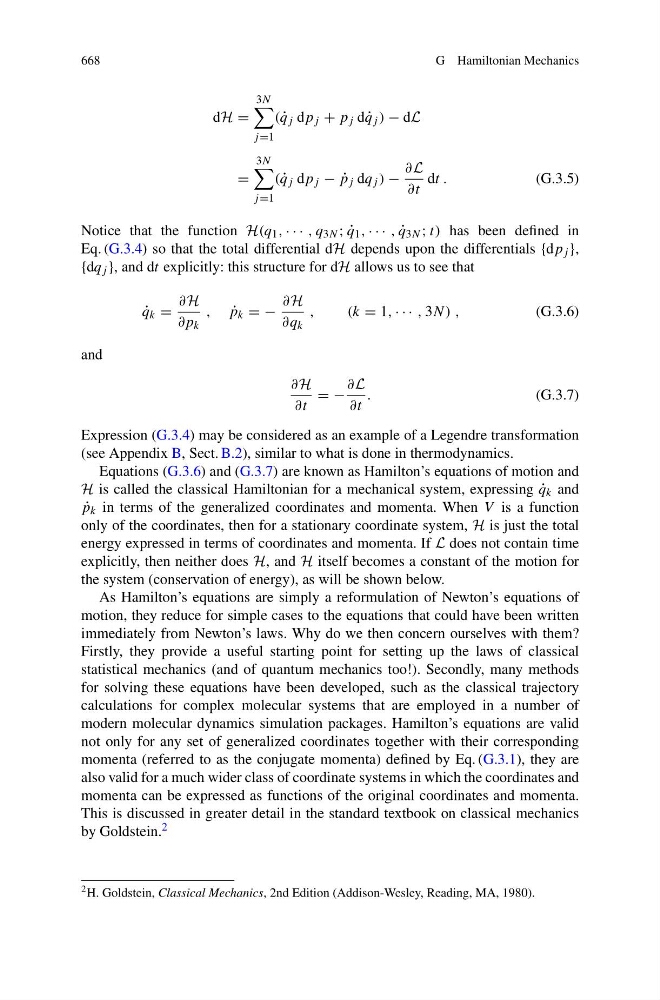
dH =
3N
j =1
( ˙
q j dp j + p j d ˙
q j ) − dL
=
3N
j =1
( ˙
q j dp j − ˙
p j dq j ) −
∂L
∂t
dt .
(G.3.5)
Notice that the function H(q 1 , · · · , q 3N ; ˙
q 1 , · · · , ˙
q 3N ; t) has been defined in
Eq. (G.3.4) so that the total differential dH depends upon the differentials {dp j },
{dq j }, and dt explicitly: this structure for dH allows us to see that
˙
q k =
∂H
∂p k
, ˙
p k = −
∂H
∂q k
,
(k = 1, · · · , 3N) ,
(G.3.6)
and
∂H
∂t
= −
∂L
∂t
.
(G.3.7)
Expression (G.3.4) may be considered as an example of a Legendre transformation
(see Appendix B, Sect. B.2), similar to what is done in thermodynamics.
Equations (G.3.6) and (G.3.7) are known as Hamilton’s equations of motion and
H is called the classical Hamiltonian for a mechanical system, expressing ˙
q k and
˙
p k in terms of the generalized coordinates and momenta. When V is a function
only of the coordinates, then for a stationary coordinate system, H is just the total
energy expressed in terms of coordinates and momenta. If L does not contain time
explicitly, then neither does H, and H itself becomes a constant of the motion for
the system (conservation of energy), as will be shown below.
As Hamilton’s equations are simply a reformulation of Newton’s equations of
motion, they reduce for simple cases to the equations that could have been written
immediately from Newton’s laws. Why do we then concern ourselves with them?
Firstly, they provide a useful starting point for setting up the laws of classical
statistical mechanics (and of quantum mechanics too!). Secondly, many methods
for solving these equations have been developed, such as the classical trajectory
calculations for complex molecular systems that are employed in a number of
modern molecular dynamics simulation packages. Hamilton’s equations are valid
not only for any set of generalized coordinates together with their corresponding
momenta (referred to as the conjugate momenta) defined by Eq. (G.3.1), they are
also valid for a much wider class of coordinate systems in which the coordinates and
momenta can be expressed as functions of the original coordinates and momenta.
This is discussed in greater detail in the standard textbook on classical mechanics
by Goldstein. 2
2 H. Goldstein, Classical Mechanics, 2nd Edition (Addison-Wesley, Reading, MA, 1980).