

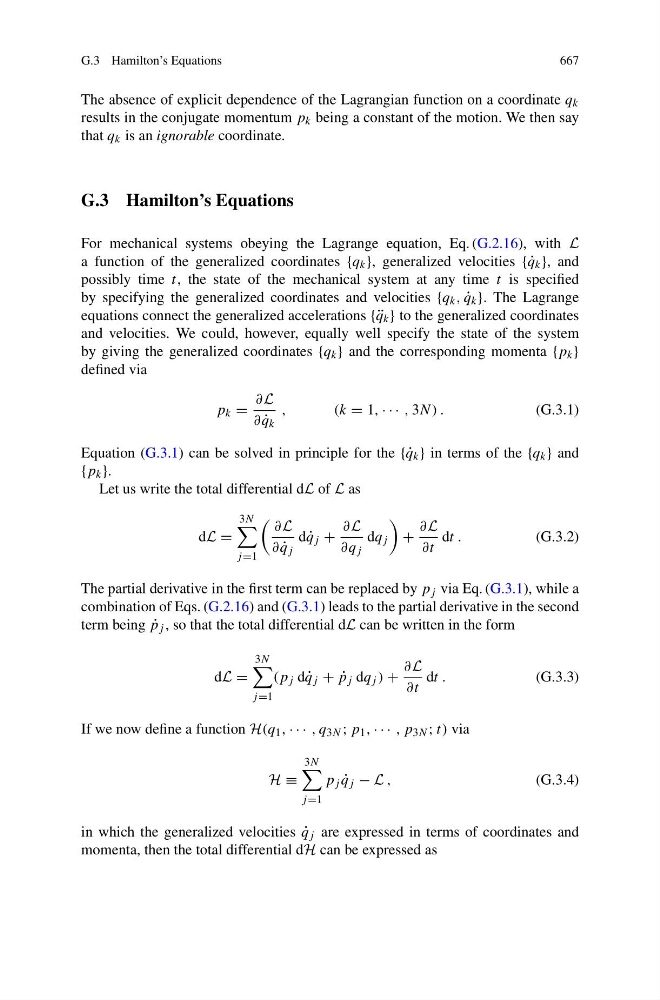
G.3 Hamilton’s Equations
667
The absence of explicit dependence of the Lagrangian function on a coordinate q k
results in the conjugate momentum p k being a constant of the motion. We then say
that q k is an ignorable coordinate.
G.3 Hamilton’s Equations
For mechanical systems obeying the Lagrange equation, Eq. (G.2.16), with L
a function of the generalized coordinates {q k }, generalized velocities { ˙
q k }, and
possibly time t, the state of the mechanical system at any time t is specified
by specifying the generalized coordinates and velocities {q k , ˙
q k }. The Lagrange
equations connect the generalized accelerations { ¨
q k } to the generalized coordinates
and velocities. We could, however, equally well specify the state of the system
by giving the generalized coordinates {q k } and the corresponding momenta {p k }
defined via
p k =
∂L
∂ ˙
q k
,
( k= 1, · · · , 3N) .
(G.3.1)
Equation (G.3.1) can be solved in principle for the { ˙
q k } in terms of the {q k } and
{p k }.
Let us write the total differential dL of L as
dL =
3N
j =1
∂L
∂ ˙
q j
d ˙
q j +
∂L
∂q j
dq j
+
∂L
∂t
dt .
(G.3.2)
The partial derivative in the first term can be replaced by p j via Eq. (G.3.1), while a
combination of Eqs. (G.2.16) and (G.3.1) leads to the partial derivative in the second
term being ˙
p j , so that the total differential dL can be written in the form
dL =
3N
j =1
(p j d ˙
q j + ˙
p j dq j ) +
∂L
∂t
dt .
(G.3.3)
If we now define a function H(q 1 , · · · , q 3N ; p 1 , · · · , p 3N ; t) via
H ≡
3N
j =1
p j ˙
q j − L ,
(G.3.4)
in which the generalized velocities ˙
q j are expressed in terms of coordinates and
momenta, then the total differential dH can be expressed as