

G.2 Lagrangian Formulation
661
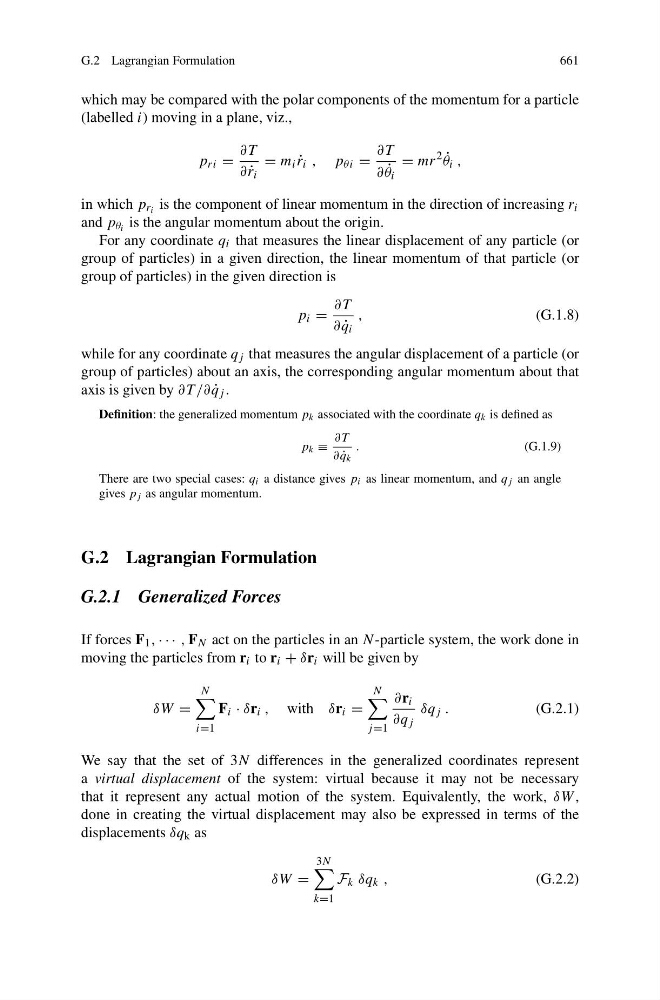
which may be compared with the polar components of the momentum for a particle
(labelled i) moving in a plane, viz.,
p ri =
∂T
∂ ˙
r i
= m i ˙
r i , p θi =
∂T
∂ ˙
θ i
= mr
2 ˙
θ i ,
in which p r i is the component of linear momentum in the direction of increasing r i
and p θ i is the angular momentum about the origin.
For any coordinate q i that measures the linear displacement of any particle (or
group of particles) in a given direction, the linear momentum of that particle (or
group of particles) in the given direction is
p i =
∂T
∂ ˙
q i
,
(G.1.8)
while for any coordinate q j that measures the angular displacement of a particle (or
group of particles) about an axis, the corresponding angular momentum about that
axis is given by ∂T /∂ ˙
q j .
Definition: the generalized momentum p k associated with the coordinate q k is defined as
p k ≡
∂T
∂ ˙
q k
.
(G.1.9)
There are two special cases: q i a distance gives p i as linear momentum, and q j an angle
gives p j as angular momentum.
G.2 Lagrangian Formulation
G.2.1 Generalized Forces
If forces F 1 , · · · , F N act on the particles in an N-particle system, the work done in
moving the particles from r i to r i + δr i will be given by
δW =
N
i=1
F i · δr i , with δr i =
N
j =1
∂r i
∂q j
δq j .
(G.2.1)
We say that the set of 3N differences in the generalized coordinates represent
a virtual displacement of the system: virtual because it may not be necessary
that it represent any actual motion of the system. Equivalently, the work, δW ,
done in creating the virtual displacement may also be expressed in terms of the
displacements δq k as
δW =
3N
k=1
F k δq k ,
(G.2.2)