

662
G Hamiltonian Mechanics
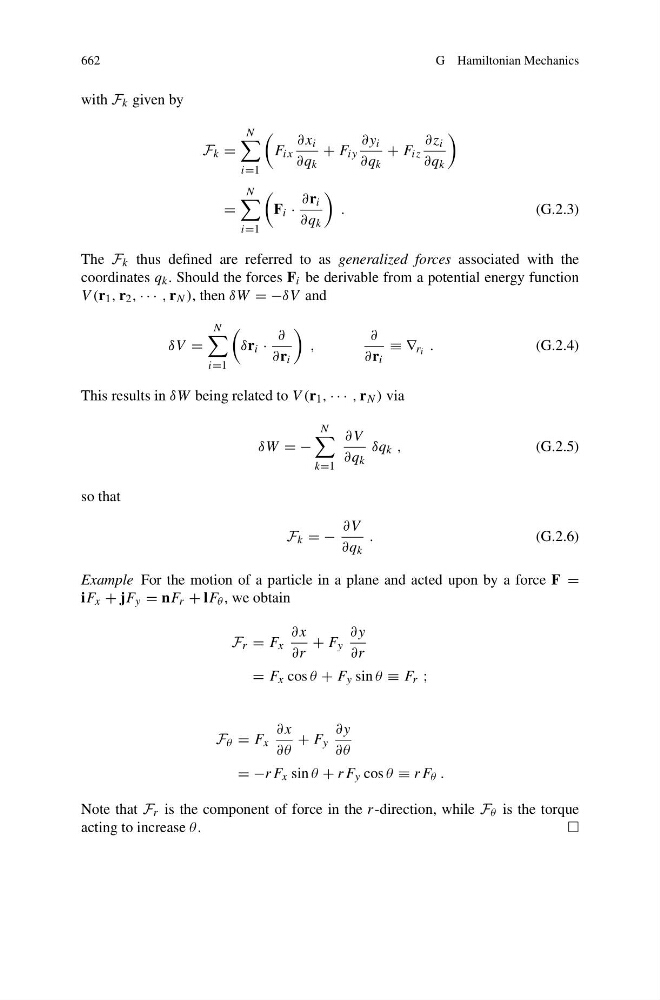
with F k given by
F k =
N
i=1
F ix
∂x i
∂q k
+ F iy
∂y i
∂q k
+ F iz
∂z i
∂q k
=
N
i=1
F i ·
∂r i
∂q k
.
(G.2.3)
The F k thus defined are referred to as generalized forces associated with the
coordinates q k . Should the forces F i be derivable from a potential energy function
V (r 1 , r 2 , · · · , r N ), then δW = −δV and
δV =
N
i=1
δr i ·
∂
∂r i
,
∂
∂r i
≡ ∇ r i .
(G.2.4)
This results in δW being related to V (r 1 , · · · , r N ) via
δW = −
N
k=1
∂V
∂q k
δq k ,
(G.2.5)
so that
F k = −
∂V
∂q k
.
(G.2.6)
Example For the motion of a particle in a plane and acted upon by a force F =
iF x + jF y = nF r + lF θ , we obtain
F r = F x
∂x
∂r
+ F y
∂y
∂r
= F x cos θ + F y sin θ ≡ F r ;
F θ = F x
∂x
∂θ
+ F y
∂y
∂θ
= −rF x sin θ + rF y cos θ ≡ rF θ .
Note that F r is the component of force in the r-direction, while F θ is the torque
acting to increase θ .