

660
G Hamiltonian Mechanics
˙
x i ≡
dx i
dt
=
3N
j =1
∂x i
∂q j
˙
q j +
∂x i
∂t
(G.1.3)
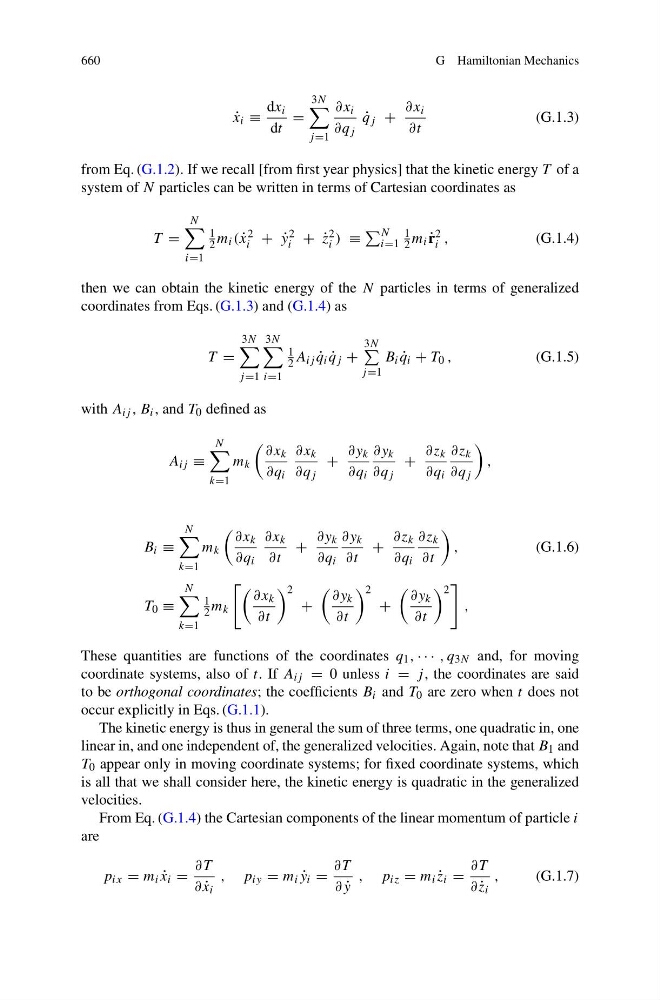
from Eq. (G.1.2). If we recall [from first year physics] that the kinetic energy T of a
system of N particles can be written in terms of Cartesian coordinates as
T =
N
i=1
1
2 m i ( ˙
x 2
i + ˙
y 2
i + ˙
z 2
i ) ≡
N
i=1
1
2 m i ˙
r 2
i ,
(G.1.4)
then we can obtain the kinetic energy of the N particles in terms of generalized
coordinates from Eqs. (G.1.3) and (G.1.4) as
T =
3N
j =1
3N
i=1
1
2 A ij ˙
q i ˙
q j +
3N
j =1
B i ˙
q i + T 0 ,
(G.1.5)
with A ij , B i , and T 0 defined as
A ij ≡
N
k=1
m k
∂x k
∂q i
∂x k
∂q j
+
∂y k
∂q i
∂y k
∂q j
+
∂z k
∂q i
∂z k
∂q j
,
B i ≡
N
k=1
m k
∂x k
∂q i
∂x k
∂t
+
∂y k
∂q i
∂y k
∂t
+
∂z k
∂q i
∂z k
∂t
,
(G.1.6)
T 0 ≡
N
k=1
1
2 m k
∂x k
∂t
2
+
∂y k
∂t
2
+
∂y k
∂t
2
,
These quantities are functions of the coordinates q 1 , · · · , q 3N and, for moving
coordinate systems, also of t. If A ij = 0 unless i = j , the coordinates are said
to be orthogonal coordinates; the coefficients B i and T 0 are zero when t does not
occur explicitly in Eqs. (G.1.1).
The kinetic energy is thus in general the sum of three terms, one quadratic in, one
linear in, and one independent of, the generalized velocities. Again, note that B 1 and
T 0 appear only in moving coordinate systems; for fixed coordinate systems, which
is all that we shall consider here, the kinetic energy is quadratic in the generalized
velocities.
From Eq. (G.1.4) the Cartesian components of the linear momentum of particle i
are
p ix = m i ˙
x i =
∂T
∂ ˙
x i
, p iy = m i ˙
y i =
∂T
∂ ˙
y
, p iz = m i ˙
z i =
∂T
∂ ˙
z i
,
(G.1.7)