

G.1 Generalized Coordinates and Momenta
659
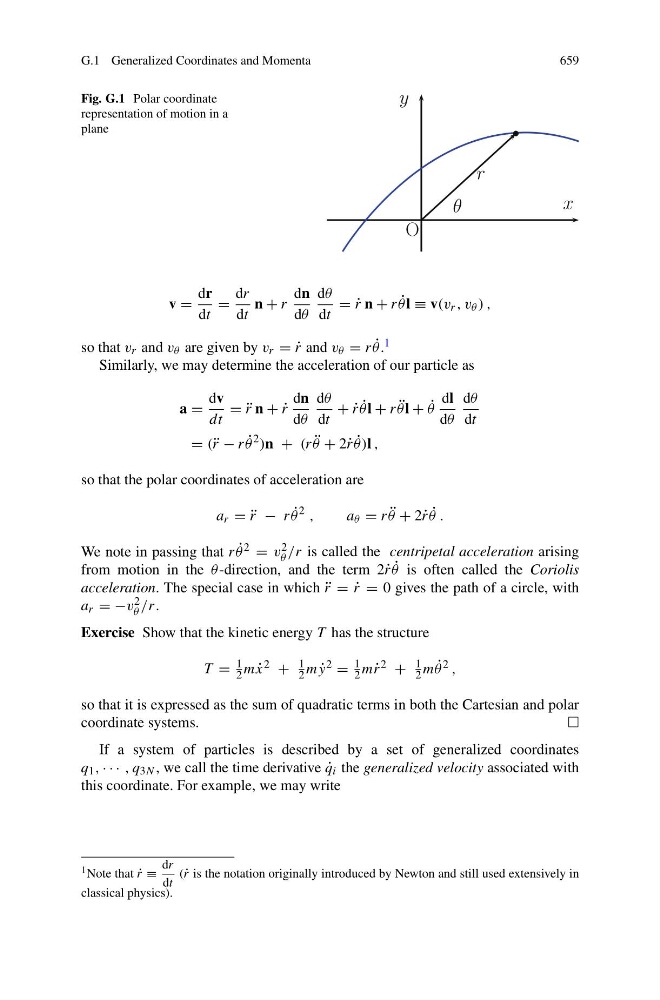
Fig. G.1 Polar coordinate
representation of motion in a
plane
v =
dr
dt
=
dr
dt
n + r
dn
dθ
dθ
dt
= ˙
r n + r ˙
θl ≡ v(v r , v θ ) ,
so that v r and v θ are given by v r = ˙
r and v θ = r ˙
θ. 1
Similarly, we may determine the acceleration of our particle as
a =
dv
dt
= ¨
r n + ˙
r
dn
dθ
dθ
dt
+ ˙
r ˙
θl + r ¨
θl + ˙
θ
dl
dθ
dθ
dt
= (¨ r − r ˙
θ
2 )n + (r ¨
θ + 2˙ r ˙
θ)l ,
so that the polar coordinates of acceleration are
a r = ¨
r − r ˙
θ
2 ,
a θ = r ¨
θ + 2˙ r ˙
θ .
We note in passing that r ˙
θ 2 = v 2
θ /r is called the centripetal acceleration arising
from motion in the θ -direction, and the term 2˙ r ˙
θ is often called the Coriolis
acceleration. The special case in which ¨
r = ˙
r = 0 gives the path of a circle, with
a r = −v 2
θ /r.
Exercise Show that the kinetic energy T has the structure
T =
1
2 m ˙
x 2 +
1
2 m ˙
y 2 =
1
2 m˙ r 2 +
1
2 m ˙
θ 2 ,
so that it is expressed as the sum of quadratic terms in both the Cartesian and polar
coordinate systems.
If a system of particles is described by a set of generalized coordinates
q 1 , · · · , q 3N , we call the time derivative ˙
q i the generalized velocity associated with
this coordinate. For example, we may write
1 Note that ˙
r ≡
dr
dt
(˙ r is the notation originally introduced by Newton and still used extensively in
classical physics).