

D.3 Term Symbols for Linear Molecules
635
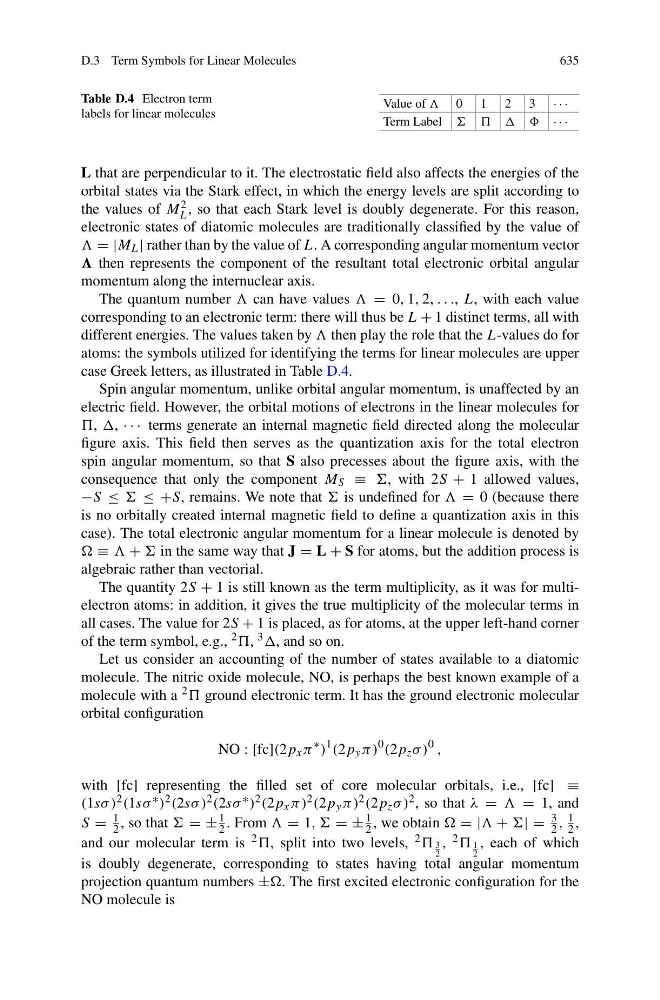
Table D.4 Electron term
labels for linear molecules
Value of 0 1 2 3 · · ·
Term Label · · ·
L that are perpendicular to it. The electrostatic field also affects the energies of the
orbital states via the Stark effect, in which the energy levels are split according to
the values of M 2
L , so that each Stark level is doubly degenerate. For this reason,
electronic states of diatomic molecules are traditionally classified by the value of
= |M L | rather than by the value of L. A corresponding angular momentum vector
then represents the component of the resultant total electronic orbital angular
momentum along the internuclear axis.
The quantum number can have values = 0, 1, 2, . . ., L, with each value
corresponding to an electronic term: there will thus be L + 1 distinct terms, all with
different energies. The values taken by then play the role that the L-values do for
atoms: the symbols utilized for identifying the terms for linear molecules are upper
case Greek letters, as illustrated in Table D.4.
Spin angular momentum, unlike orbital angular momentum, is unaffected by an
electric field. However, the orbital motions of electrons in the linear molecules for
, , · · · terms generate an internal magnetic field directed along the molecular
figure axis. This field then serves as the quantization axis for the total electron
spin angular momentum, so that S also precesses about the figure axis, with the
consequence that only the component M S ≡ , with 2S + 1 allowed values,
−S ≤ ≤ +S, remains. We note that is undefined for = 0 (because there
is no orbitally created internal magnetic field to define a quantization axis in this
case). The total electronic angular momentum for a linear molecule is denoted by
≡ + in the same way that J = L + S for atoms, but the addition process is
algebraic rather than vectorial.
The quantity 2S + 1 is still known as the term multiplicity, as it was for multielectron atoms: in addition, it gives the true multiplicity of the molecular terms in
all cases. The value for 2S + 1 is placed, as for atoms, at the upper left-hand corner
of the term symbol, e.g., 2 , 3 , and so on.
Let us consider an accounting of the number of states available to a diatomic
molecule. The nitric oxide molecule, NO, is perhaps the best known example of a
molecule with a 2 ground electronic term. It has the ground electronic molecular
orbital configuration
NO : [fc](2p x π
∗ )
1 (2p y π)
0 (2p z σ )
0 ,
with [fc] representing the filled set of core molecular orbitals, i.e., [fc] ≡
(1sσ ) 2 (1sσ ∗ ) 2 (2sσ ) 2 (2sσ ∗ ) 2 (2p x π) 2 (2p y π) 2 (2p z σ ) 2 , so that λ = = 1, and
S =
1
2 , so that = ±
1
2 . From = 1, , = ±
1
2 , we obtain = | + | =
3
2 ,
1
2 ,
and our molecular term is 2 , split into two levels, 2 3
2
, 2 1
2
, each of which
is doubly degenerate, corresponding to states having total angular momentum
projection quantum numbers ±. The first excited electronic configuration for the
NO molecule is