

636
D Atomic and Molecular Term Symbols
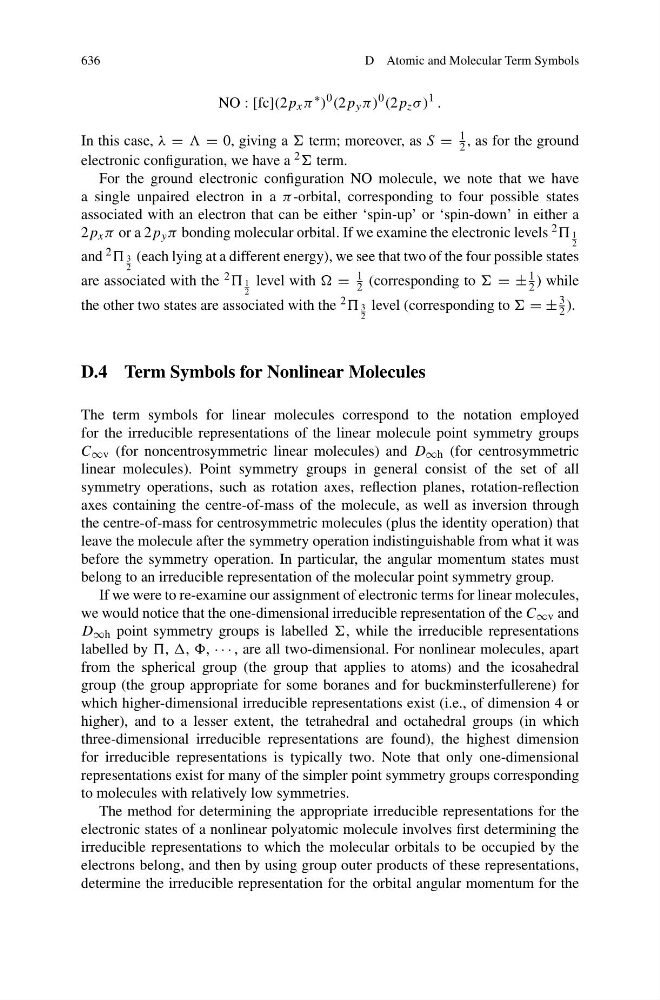
NO : [fc](2p x π
∗ )
0 (2p y π)
0 (2p z σ )
1 .
In this case, λ = = 0, giving a term; moreover, as S =
1
2 , as for the ground
electronic configuration, we have a 2 term.
For the ground electronic configuration NO molecule, we note that we have
a single unpaired electron in a π -orbital, corresponding to four possible states
associated with an electron that can be either ‘spin-up’ or ‘spin-down’ in either a
2p x π or a 2p y π bonding molecular orbital. If we examine the electronic levels 2 1
2
and 2 3
2
(each lying at a different energy), we see that two of the four possible states
are associated with the 2 1
2
level with =
1
2 (corresponding to = ±
1
2 ) while
the other two states are associated with the 2 3
2
level (corresponding to = ±
3
2 ).
D.4 Term Symbols for Nonlinear Molecules
The term symbols for linear molecules correspond to the notation employed
for the irreducible representations of the linear molecule point symmetry groups
C ∞v (for noncentrosymmetric linear molecules) and D ∞h (for centrosymmetric
linear molecules). Point symmetry groups in general consist of the set of all
symmetry operations, such as rotation axes, reflection planes, rotation-reflection
axes containing the centre-of-mass of the molecule, as well as inversion through
the centre-of-mass for centrosymmetric molecules (plus the identity operation) that
leave the molecule after the symmetry operation indistinguishable from what it was
before the symmetry operation. In particular, the angular momentum states must
belong to an irreducible representation of the molecular point symmetry group.
If we were to re-examine our assignment of electronic terms for linear molecules,
we would notice that the one-dimensional irreducible representation of the C ∞v and
D ∞h point symmetry groups is labelled , while the irreducible representations
labelled by , , , · · · , are all two-dimensional. For nonlinear molecules, apart
from the spherical group (the group that applies to atoms) and the icosahedral
group (the group appropriate for some boranes and for buckminsterfullerene) for
which higher-dimensional irreducible representations exist (i.e., of dimension 4 or
higher), and to a lesser extent, the tetrahedral and octahedral groups (in which
three-dimensional irreducible representations are found), the highest dimension
for irreducible representations is typically two. Note that only one-dimensional
representations exist for many of the simpler point symmetry groups corresponding
to molecules with relatively low symmetries.
The method for determining the appropriate irreducible representations for the
electronic states of a nonlinear polyatomic molecule involves first determining the
irreducible representations to which the molecular orbitals to be occupied by the
electrons belong, and then by using group outer products of these representations,
determine the irreducible representation for the orbital angular momentum for the