

50
2 Macroscopic Thermodynamics
C P − C V = −T
∂V
∂T
2
P
∂P
∂V
T
.
(2.4.1c)
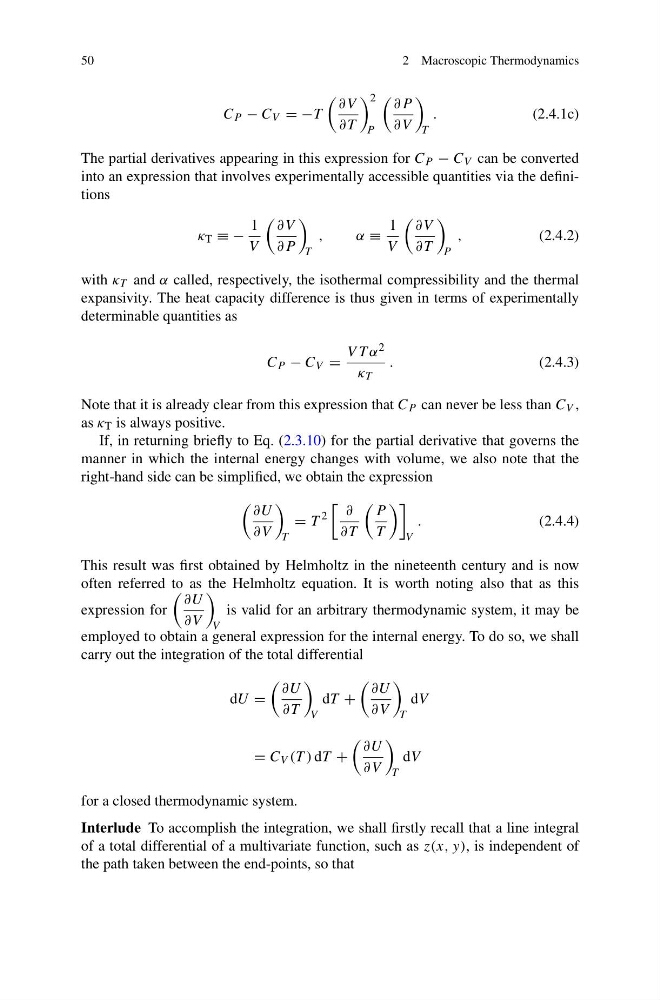
The partial derivatives appearing in this expression for C P − C V can be converted
into an expression that involves experimentally accessible quantities via the definitions
κ T ≡ −
1
V
∂V
∂P
T
,
α ≡
1
V
∂V
∂T
P
,
(2.4.2)
with κ T and α called, respectively, the isothermal compressibility and the thermal
expansivity. The heat capacity difference is thus given in terms of experimentally
determinable quantities as
C P − C V =
V T α 2
κ T
.
(2.4.3)
Note that it is already clear from this expression that C P can never be less than C V ,
as κ T is always positive.
If, in returning briefly to Eq. (2.3.10) for the partial derivative that governs the
manner in which the internal energy changes with volume, we also note that the
right-hand side can be simplified, we obtain the expression
∂U
∂V
T
= T
2
∂
∂T
P
T
V
.
(2.4.4)
This result was first obtained by Helmholtz in the nineteenth century and is now
often referred to as the Helmholtz equation. It is worth noting also that as this
expression for
∂U
∂V
V
is valid for an arbitrary thermodynamic system, it may be
employed to obtain a general expression for the internal energy. To do so, we shall
carry out the integration of the total differential
dU =
∂U
∂T
V
dT +
∂U
∂V
T
dV
= C V (T ) dT +
∂U
∂V
T
dV
for a closed thermodynamic system.
Interlude To accomplish the integration, we shall firstly recall that a line integral
of a total differential of a multivariate function, such as z(x, y), is independent of
the path taken between the end-points, so that
2 Macroscopic Thermodynamics
C P − C V = −T
∂V
∂T
2
P
∂P
∂V
T
.
(2.4.1c)
The partial derivatives appearing in this expression for C P − C V can be converted
into an expression that involves experimentally accessible quantities via the definitions
κ T ≡ −
1
V
∂V
∂P
T
,
α ≡
1
V
∂V
∂T
P
,
(2.4.2)
with κ T and α called, respectively, the isothermal compressibility and the thermal
expansivity. The heat capacity difference is thus given in terms of experimentally
determinable quantities as
C P − C V =
V T α 2
κ T
.
(2.4.3)
Note that it is already clear from this expression that C P can never be less than C V ,
as κ T is always positive.
If, in returning briefly to Eq. (2.3.10) for the partial derivative that governs the
manner in which the internal energy changes with volume, we also note that the
right-hand side can be simplified, we obtain the expression
∂U
∂V
T
= T
2
∂
∂T
P
T
V
.
(2.4.4)
This result was first obtained by Helmholtz in the nineteenth century and is now
often referred to as the Helmholtz equation. It is worth noting also that as this
expression for
∂U
∂V
V
is valid for an arbitrary thermodynamic system, it may be
employed to obtain a general expression for the internal energy. To do so, we shall
carry out the integration of the total differential
dU =
∂U
∂T
V
dT +
∂U
∂V
T
dV
= C V (T ) dT +
∂U
∂V
T
dV
for a closed thermodynamic system.
Interlude To accomplish the integration, we shall firstly recall that a line integral
of a total differential of a multivariate function, such as z(x, y), is independent of
the path taken between the end-points, so that