

2.4 Expression for Heat Capacity Difference
49
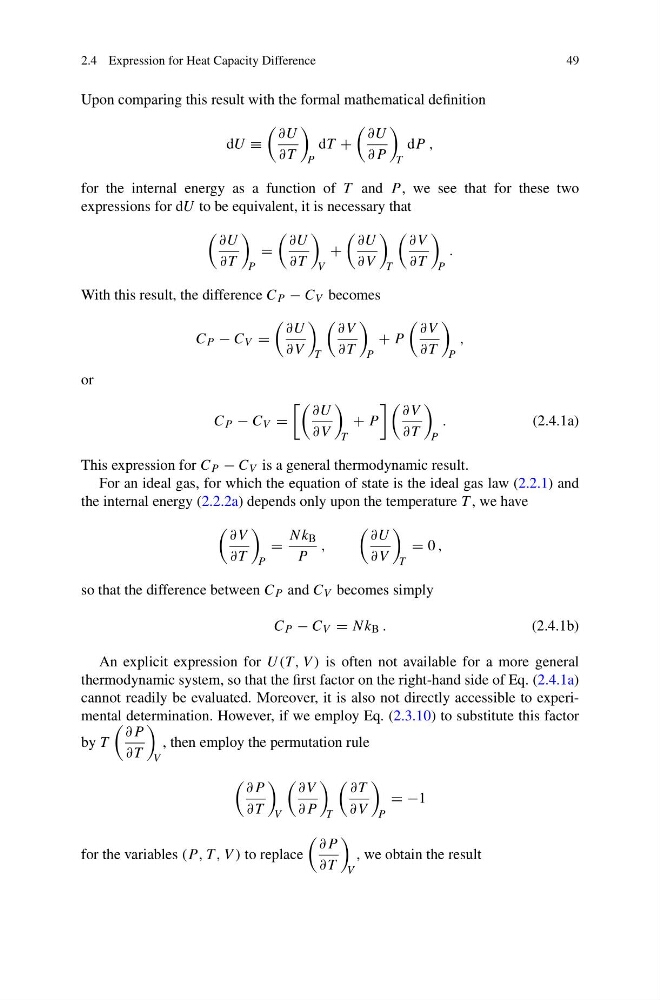
Upon comparing this result with the formal mathematical definition
dU ≡
∂U
∂T
P
dT +
∂U
∂P
T
dP ,
for the internal energy as a function of T and P , we see that for these two
expressions for dU to be equivalent, it is necessary that
∂U
∂T
P
=
∂U
∂T
V
+
∂U
∂V
T
∂V
∂T
P
.
With this result, the difference C P − C V becomes
C P − C V =
∂U
∂V
T
∂V
∂T
P
+ P
∂V
∂T
P
,
or
C P − C V =
∂U
∂V
T
+ P
∂V
∂T
P
.
(2.4.1a)
This expression for C P − C V is a general thermodynamic result.
For an ideal gas, for which the equation of state is the ideal gas law (2.2.1) and
the internal energy (2.2.2a) depends only upon the temperature T , we have
∂V
∂T
P
=
Nk B
P
,
∂U
∂V
T
= 0 ,
so that the difference between C P and C V becomes simply
C P − C V = Nk B .
(2.4.1b)
An explicit expression for U(T , V ) is often not available for a more general
thermodynamic system, so that the first factor on the right-hand side of Eq. (2.4.1a)
cannot readily be evaluated. Moreover, it is also not directly accessible to experimental determination. However, if we employ Eq. (2.3.10) to substitute this factor
by T
∂P
∂T
V
, then employ the permutation rule
∂P
∂T
V
∂V
∂P
T
∂T
∂V
P
= −1
for the variables (P , T , V ) to replace
∂P
∂T
V
, we obtain the result
49
Upon comparing this result with the formal mathematical definition
dU ≡
∂U
∂T
P
dT +
∂U
∂P
T
dP ,
for the internal energy as a function of T and P , we see that for these two
expressions for dU to be equivalent, it is necessary that
∂U
∂T
P
=
∂U
∂T
V
+
∂U
∂V
T
∂V
∂T
P
.
With this result, the difference C P − C V becomes
C P − C V =
∂U
∂V
T
∂V
∂T
P
+ P
∂V
∂T
P
,
or
C P − C V =
∂U
∂V
T
+ P
∂V
∂T
P
.
(2.4.1a)
This expression for C P − C V is a general thermodynamic result.
For an ideal gas, for which the equation of state is the ideal gas law (2.2.1) and
the internal energy (2.2.2a) depends only upon the temperature T , we have
∂V
∂T
P
=
Nk B
P
,
∂U
∂V
T
= 0 ,
so that the difference between C P and C V becomes simply
C P − C V = Nk B .
(2.4.1b)
An explicit expression for U(T , V ) is often not available for a more general
thermodynamic system, so that the first factor on the right-hand side of Eq. (2.4.1a)
cannot readily be evaluated. Moreover, it is also not directly accessible to experimental determination. However, if we employ Eq. (2.3.10) to substitute this factor
by T
∂P
∂T
V
, then employ the permutation rule
∂P
∂T
V
∂V
∂P
T
∂T
∂V
P
= −1
for the variables (P , T , V ) to replace
∂P
∂T
V
, we obtain the result