

2.4 Expression for Heat Capacity Difference
51
(x f ,y f )
(x i ,y i )
dz(x, y) = z(x f , y f ) − z(x i , y i ) .
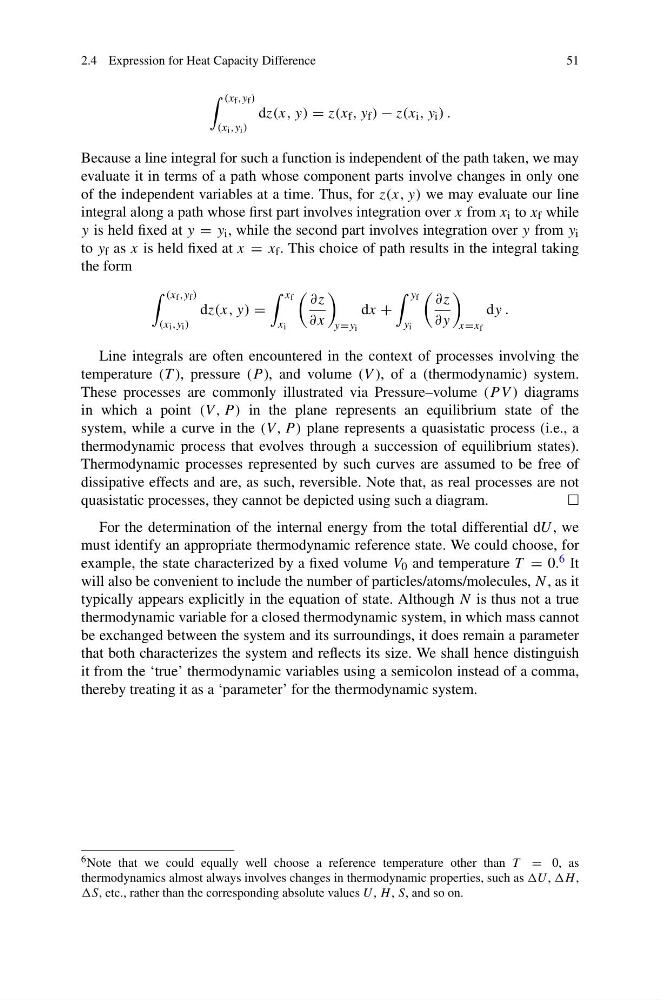
Because a line integral for such a function is independent of the path taken, we may
evaluate it in terms of a path whose component parts involve changes in only one
of the independent variables at a time. Thus, for z(x, y) we may evaluate our line
integral along a path whose first part involves integration over x from x i to x f while
y is held fixed at y = y i , while the second part involves integration over y from y i
to y f as x is held fixed at x = x f . This choice of path results in the integral taking
the form
(x f ,y f )
(x i ,y i )
dz(x, y) =
x f
x i
∂z
∂x
y=y i
dx +
y f
y i
∂z
∂y
x=x f
dy .
Line integrals are often encountered in the context of processes involving the
temperature (T ), pressure (P ), and volume (V ), of a (thermodynamic) system.
These processes are commonly illustrated via Pressure–volume (P V ) diagrams
in which a point (V , P ) in the plane represents an equilibrium state of the
system, while a curve in the (V , P ) plane represents a quasistatic process (i.e., a
thermodynamic process that evolves through a succession of equilibrium states).
Thermodynamic processes represented by such curves are assumed to be free of
dissipative effects and are, as such, reversible. Note that, as real processes are not
quasistatic processes, they cannot be depicted using such a diagram.
For the determination of the internal energy from the total differential dU , we
must identify an appropriate thermodynamic reference state. We could choose, for
example, the state characterized by a fixed volume V 0 and temperature T = 0. 6 It
will also be convenient to include the number of particles/atoms/molecules, N, as it
typically appears explicitly in the equation of state. Although N is thus not a true
thermodynamic variable for a closed thermodynamic system, in which mass cannot
be exchanged between the system and its surroundings, it does remain a parameter
that both characterizes the system and reflects its size. We shall hence distinguish
it from the ‘true’ thermodynamic variables using a semicolon instead of a comma,
thereby treating it as a ‘parameter’ for the thermodynamic system.
6 Note that we could equally well choose a reference temperature other than T = 0, as
thermodynamics almost always involves changes in thermodynamic properties, such as U , H ,
S, etc., rather than the corresponding absolute values U , H , S, and so on.
51
(x f ,y f )
(x i ,y i )
dz(x, y) = z(x f , y f ) − z(x i , y i ) .
Because a line integral for such a function is independent of the path taken, we may
evaluate it in terms of a path whose component parts involve changes in only one
of the independent variables at a time. Thus, for z(x, y) we may evaluate our line
integral along a path whose first part involves integration over x from x i to x f while
y is held fixed at y = y i , while the second part involves integration over y from y i
to y f as x is held fixed at x = x f . This choice of path results in the integral taking
the form
(x f ,y f )
(x i ,y i )
dz(x, y) =
x f
x i
∂z
∂x
y=y i
dx +
y f
y i
∂z
∂y
x=x f
dy .
Line integrals are often encountered in the context of processes involving the
temperature (T ), pressure (P ), and volume (V ), of a (thermodynamic) system.
These processes are commonly illustrated via Pressure–volume (P V ) diagrams
in which a point (V , P ) in the plane represents an equilibrium state of the
system, while a curve in the (V , P ) plane represents a quasistatic process (i.e., a
thermodynamic process that evolves through a succession of equilibrium states).
Thermodynamic processes represented by such curves are assumed to be free of
dissipative effects and are, as such, reversible. Note that, as real processes are not
quasistatic processes, they cannot be depicted using such a diagram.
For the determination of the internal energy from the total differential dU , we
must identify an appropriate thermodynamic reference state. We could choose, for
example, the state characterized by a fixed volume V 0 and temperature T = 0. 6 It
will also be convenient to include the number of particles/atoms/molecules, N, as it
typically appears explicitly in the equation of state. Although N is thus not a true
thermodynamic variable for a closed thermodynamic system, in which mass cannot
be exchanged between the system and its surroundings, it does remain a parameter
that both characterizes the system and reflects its size. We shall hence distinguish
it from the ‘true’ thermodynamic variables using a semicolon instead of a comma,
thereby treating it as a ‘parameter’ for the thermodynamic system.
6 Note that we could equally well choose a reference temperature other than T = 0, as
thermodynamics almost always involves changes in thermodynamic properties, such as U , H ,
S, etc., rather than the corresponding absolute values U , H , S, and so on.