

600
B Review of Traditional Calculus
or
∂x
∂y
z
∂y
∂z
y
= −
∂x
∂z
y
,
which is often written in the equivalent form
∂x
∂y
z
∂y
∂z
x
∂z
∂x
y
= −1 .
(B.1.13)
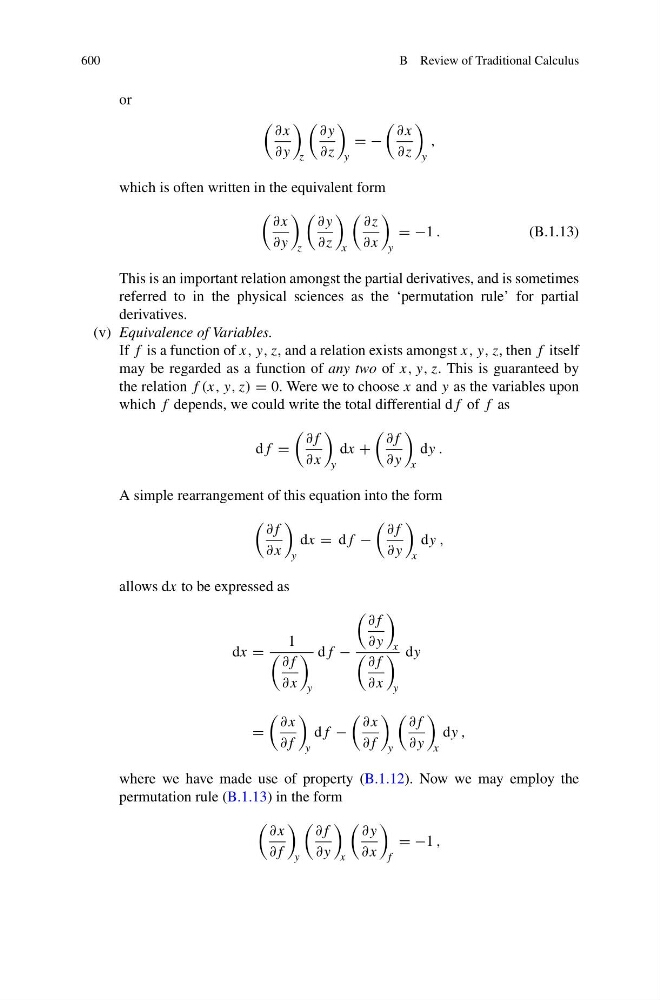
This is an important relation amongst the partial derivatives, and is sometimes
referred to in the physical sciences as the ‘permutation rule’ for partial
derivatives.
(v) Equivalence of Variables.
If f is a function of x, y, z, and a relation exists amongst x, y, z, then f itself
may be regarded as a function of any two of x, y, z. This is guaranteed by
the relation f (x, y, z) = 0. Were we to choose x and y as the variables upon
which f depends, we could write the total differential df of f as
df =
∂f
∂x
y
dx +
∂f
∂y
x
dy .
A simple rearrangement of this equation into the form
∂f
∂x
y
dx = df −
∂f
∂y
x
dy ,
allows dx to be expressed as
dx =
1
∂f
∂x
y
df −
∂f
∂y
x
∂f
∂x
y
dy
=
∂x
∂f
y
df −
∂x
∂f
y
∂f
∂y
x
dy ,
where we have made use of property (B.1.12). Now we may employ the
permutation rule (B.1.13) in the form
∂x
∂f
y
∂f
∂y
x
∂y
∂x
f
= −1 ,