

B.1 Derivatives
599
one of the three variables explicitly in terms of the other two variables, we
may, because of the implicit function relation f (x, y, z) = 0, consider any
one of the variables x, y, z as a function of the other two.
(iv) Two Important Relations for Partial Derivatives.
If we consider x as a function of y and z, we may write the total differential
dx for x as
dx =
∂x
∂y
z
dy +
∂x
∂z
y
dz .
(B.1.10a)
If, equivalently, we consider y to be a function of x and z, then we may write
a total differential dy of y as
dy =
∂y
∂x
z
dx +
∂y
∂z
x
dz .
(B.1.10b)
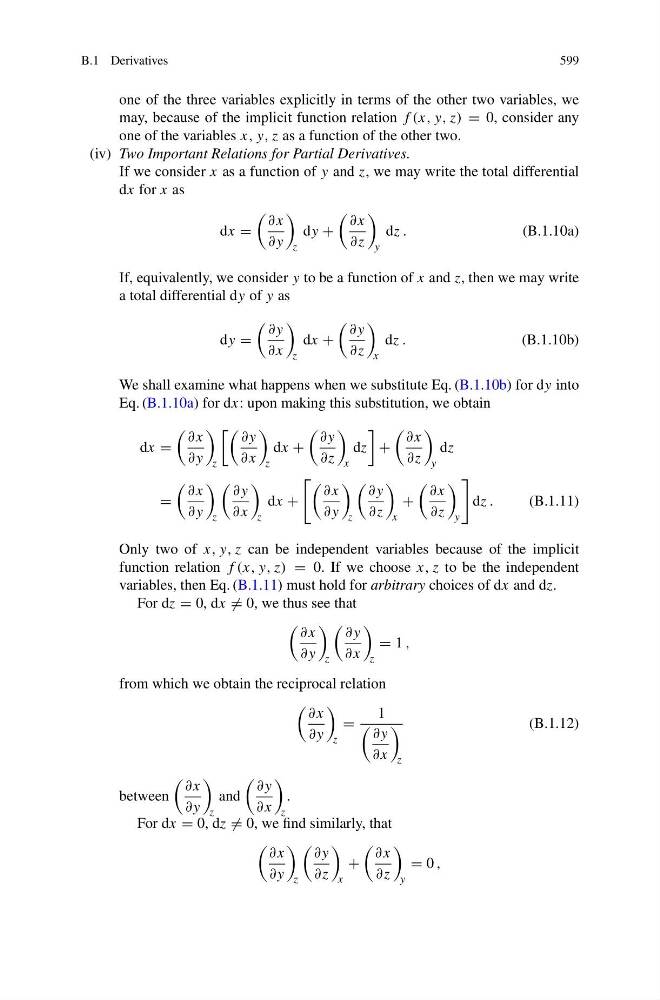
We shall examine what happens when we substitute Eq. (B.1.10b) for dy into
Eq. (B.1.10a) for dx: upon making this substitution, we obtain
dx =
∂x
∂y
z
∂y
∂x
z
dx +
∂y
∂z
x
dz
+
∂x
∂z
y
dz
=
∂x
∂y
z
∂y
∂x
z
dx +
∂x
∂y
z
∂y
∂z
x
+
∂x
∂z
y
dz .
(B.1.11)
Only two of x, y, z can be independent variables because of the implicit
function relation f (x, y, z) = 0. If we choose x, z to be the independent
variables, then Eq. (B.1.11) must hold for arbitrary choices of dx and dz.
For dz = 0, dx = 0, we thus see that
∂x
∂y
z
∂y
∂x
z
= 1 ,
from which we obtain the reciprocal relation
∂x
∂y
z
=
1
∂y
∂x
z
(B.1.12)
between
∂x
∂y
z
and
∂y
∂x
z
.
For dx = 0, dz = 0, we find similarly, that
∂x
∂y
z
∂y
∂z
x
+
∂x
∂z
y
= 0 ,