

B.1 Derivatives
601
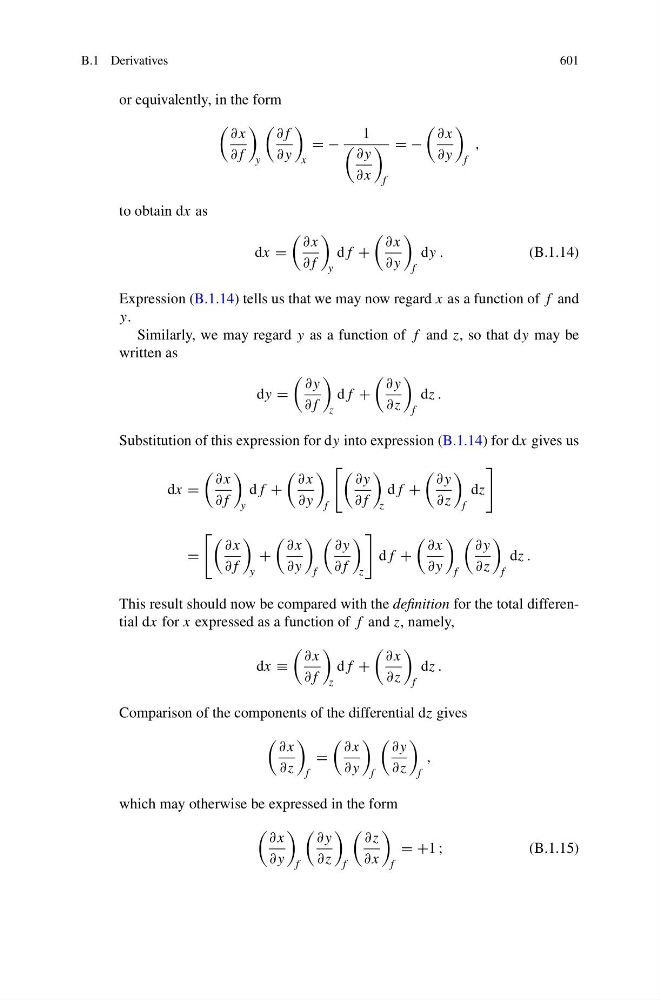
or equivalently, in the form
∂x
∂f
y
∂f
∂y
x
= −
1
∂y
∂x
f
= −
∂x
∂y
f
,
to obtain dx as
dx =
∂x
∂f
y
df +
∂x
∂y
f
dy .
(B.1.14)
Expression (B.1.14) tells us that we may now regard x as a function of f and
y.
Similarly, we may regard y as a function of f and z, so that dy may be
written as
dy =
∂y
∂f
z
df +
∂y
∂z
f
dz .
Substitution of this expression for dy into expression (B.1.14) for dx gives us
dx =
∂x
∂f
y
df +
∂x
∂y
f
∂y
∂f
z
df +
∂y
∂z
f
dz
=
∂x
∂f
y
+
∂x
∂y
f
∂y
∂f
z
df +
∂x
∂y
f
∂y
∂z
f
dz .
This result should now be compared with the definition for the total differential dx for x expressed as a function of f and z, namely,
dx ≡
∂x
∂f
z
df +
∂x
∂z
f
dz .
Comparison of the components of the differential dz gives
∂x
∂z
f
=
∂x
∂y
f
∂y
∂z
f
,
which may otherwise be expressed in the form
∂x
∂y
f
∂y
∂z
f
∂z
∂x
f
= +1 ;
(B.1.15)