

570
10 Quantum Statistics
V −1 ln(1 − λ) becomes V −1 ln(n 0 + 1), so that in the thermodynamic limit it is at
most of order N −1 ln N, and may therefore be neglected for all values of λ.
Two temperature regimes must be considered separately, namely those temperature regimes that lie either above or below the critical temperature, T c .
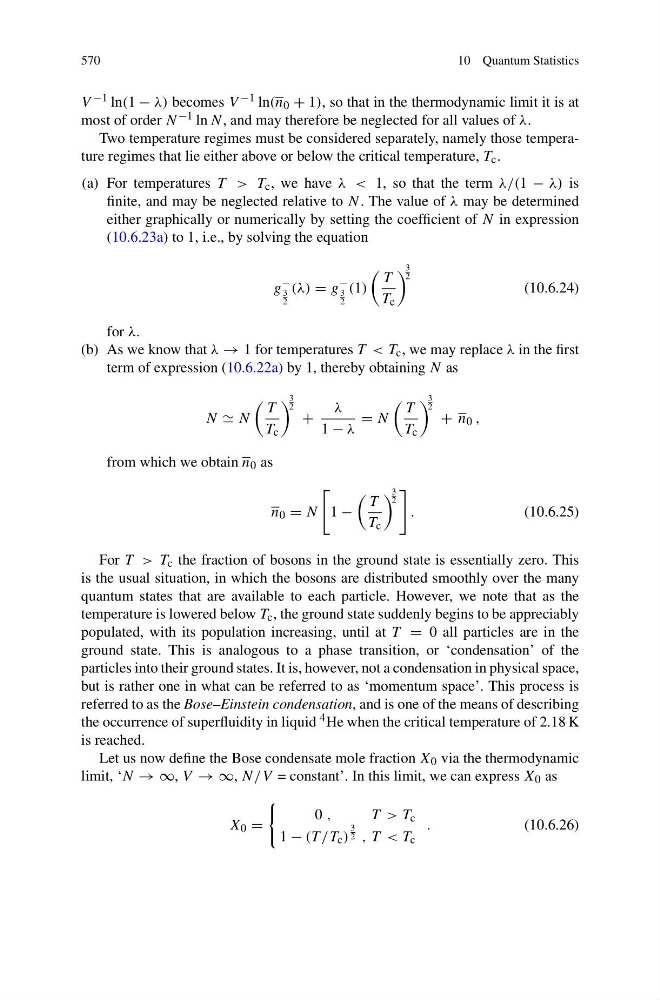
(a) For temperatures T > T c , we have λ < 1, so that the term λ/(1 − λ) is
finite, and may be neglected relative to N. The value of λ may be determined
either graphically or numerically by setting the coefficient of N in expression
(10.6.23a) to 1, i.e., by solving the equation
g
−
3
2
(λ) = g
−
3
2
(1)
T
T c
3
2
(10.6.24)
for λ.
(b) As we know that λ → 1 for temperatures T < T c , we may replace λ in the first
term of expression (10.6.22a) by 1, thereby obtaining N as
N N
T
T c
3
2 +
λ
1 − λ
= N
T
T c
3
2 + n 0 ,
from which we obtain n 0 as
n 0 = N
1 −
T
T c
3
2
.
(10.6.25)
For T > T c the fraction of bosons in the ground state is essentially zero. This
is the usual situation, in which the bosons are distributed smoothly over the many
quantum states that are available to each particle. However, we note that as the
temperature is lowered below T c , the ground state suddenly begins to be appreciably
populated, with its population increasing, until at T = 0 all particles are in the
ground state. This is analogous to a phase transition, or ‘condensation’ of the
particles into their ground states. It is, however, not a condensation in physical space,
but is rather one in what can be referred to as ‘momentum space’. This process is
referred to as the Bose–Einstein condensation, and is one of the means of describing
the occurrence of superfluidity in liquid 4 He when the critical temperature of 2.18 K
is reached.
Let us now define the Bose condensate mole fraction X 0 via the thermodynamic
limit, ‘N → ∞, V → ∞, N/V = constant’. In this limit, we can express X 0 as
X 0 =
0 ,
T >T c
1 − (T /T c )
3
2 , T < T c
.
(10.6.26)
10 Quantum Statistics
V −1 ln(1 − λ) becomes V −1 ln(n 0 + 1), so that in the thermodynamic limit it is at
most of order N −1 ln N, and may therefore be neglected for all values of λ.
Two temperature regimes must be considered separately, namely those temperature regimes that lie either above or below the critical temperature, T c .
(a) For temperatures T > T c , we have λ < 1, so that the term λ/(1 − λ) is
finite, and may be neglected relative to N. The value of λ may be determined
either graphically or numerically by setting the coefficient of N in expression
(10.6.23a) to 1, i.e., by solving the equation
g
−
3
2
(λ) = g
−
3
2
(1)
T
T c
3
2
(10.6.24)
for λ.
(b) As we know that λ → 1 for temperatures T < T c , we may replace λ in the first
term of expression (10.6.22a) by 1, thereby obtaining N as
N N
T
T c
3
2 +
λ
1 − λ
= N
T
T c
3
2 + n 0 ,
from which we obtain n 0 as
n 0 = N
1 −
T
T c
3
2
.
(10.6.25)
For T > T c the fraction of bosons in the ground state is essentially zero. This
is the usual situation, in which the bosons are distributed smoothly over the many
quantum states that are available to each particle. However, we note that as the
temperature is lowered below T c , the ground state suddenly begins to be appreciably
populated, with its population increasing, until at T = 0 all particles are in the
ground state. This is analogous to a phase transition, or ‘condensation’ of the
particles into their ground states. It is, however, not a condensation in physical space,
but is rather one in what can be referred to as ‘momentum space’. This process is
referred to as the Bose–Einstein condensation, and is one of the means of describing
the occurrence of superfluidity in liquid 4 He when the critical temperature of 2.18 K
is reached.
Let us now define the Bose condensate mole fraction X 0 via the thermodynamic
limit, ‘N → ∞, V → ∞, N/V = constant’. In this limit, we can express X 0 as
X 0 =
0 ,
T >T c
1 − (T /T c )
3
2 , T < T c
.
(10.6.26)