

10.6 Bose–Einstein Statistics
569
ρ =
g
−
3
2
(1)
3 (T c )
.
(10.6.20)
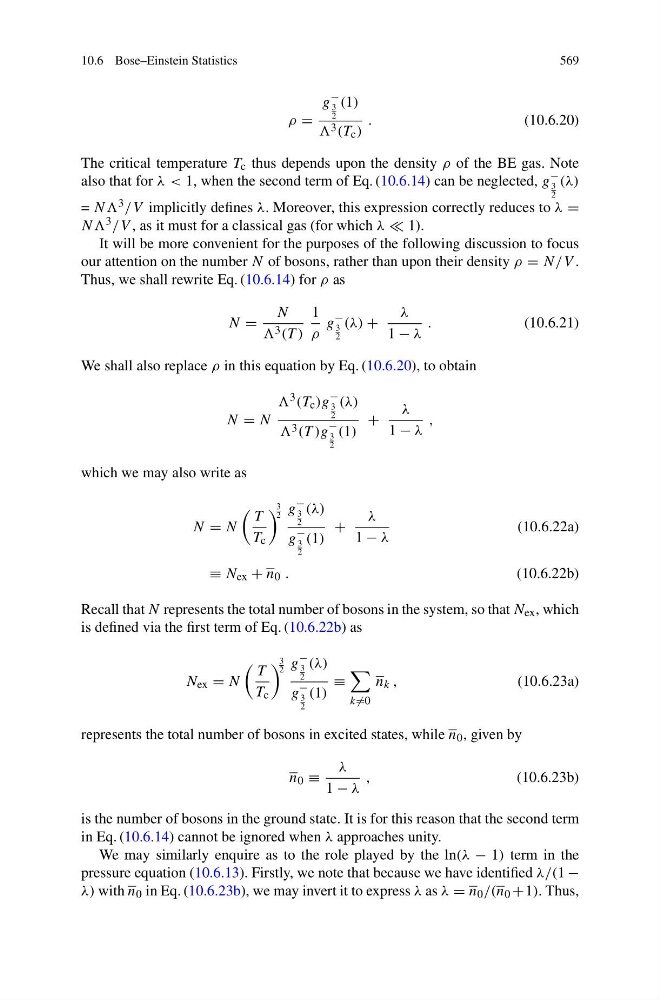
The critical temperature T c thus depends upon the density ρ of the BE gas. Note
also that for λ < 1, when the second term of Eq. (10.6.14) can be neglected, g
−
3
2
(λ)
= NN 3 /V implicitly defines λ. Moreover, this expression correctly reduces to λ =
NN 3 /V , as it must for a classical gas (for which λ 1).
It will be more convenient for the purposes of the following discussion to focus
our attention on the number N of bosons, rather than upon their density ρ = N/V .
Thus, we shall rewrite Eq. (10.6.14) for ρ as
N =
N
3 (T )
1
ρ
g
−
3
2
(λ) +
λ
1 − λ
.
(10.6.21)
We shall also replace ρ in this equation by Eq. (10.6.20), to obtain
N = N
3 (T c )g
−
3
2
(λ)
3 (T )g
−
3
2
(1)
+
λ
1 − λ
,
which we may also write as
N = N
T
T c
3
2
g
−
3
2
(λ)
g
−
3
2
(1)
+
λ
1 − λ
(10.6.22a)
≡ N ex + n 0 .
(10.6.22b)
Recall that N represents the total number of bosons in the system, so that N ex , which
is defined via the first term of Eq. (10.6.22b) as
N ex = N
T
T c
3
2
g
−
3
2
(λ)
g
−
3
2
(1)
≡
k =0
n k ,
(10.6.23a)
represents the total number of bosons in excited states, while n 0 , given by
n 0 ≡
λ
1 − λ
,
(10.6.23b)
is the number of bosons in the ground state. It is for this reason that the second term
in Eq. (10.6.14) cannot be ignored when λ approaches unity.
We may similarly enquire as to the role played by the ln(λ − 1) term in the
pressure equation (10.6.13). Firstly, we note that because we have identified λ/(1 −
λ) with n 0 in Eq. (10.6.23b), we may invert it to express λ as λ = n 0 /(n 0 +1). Thus,
569
ρ =
g
−
3
2
(1)
3 (T c )
.
(10.6.20)
The critical temperature T c thus depends upon the density ρ of the BE gas. Note
also that for λ < 1, when the second term of Eq. (10.6.14) can be neglected, g
−
3
2
(λ)
= NN 3 /V implicitly defines λ. Moreover, this expression correctly reduces to λ =
NN 3 /V , as it must for a classical gas (for which λ 1).
It will be more convenient for the purposes of the following discussion to focus
our attention on the number N of bosons, rather than upon their density ρ = N/V .
Thus, we shall rewrite Eq. (10.6.14) for ρ as
N =
N
3 (T )
1
ρ
g
−
3
2
(λ) +
λ
1 − λ
.
(10.6.21)
We shall also replace ρ in this equation by Eq. (10.6.20), to obtain
N = N
3 (T c )g
−
3
2
(λ)
3 (T )g
−
3
2
(1)
+
λ
1 − λ
,
which we may also write as
N = N
T
T c
3
2
g
−
3
2
(λ)
g
−
3
2
(1)
+
λ
1 − λ
(10.6.22a)
≡ N ex + n 0 .
(10.6.22b)
Recall that N represents the total number of bosons in the system, so that N ex , which
is defined via the first term of Eq. (10.6.22b) as
N ex = N
T
T c
3
2
g
−
3
2
(λ)
g
−
3
2
(1)
≡
k =0
n k ,
(10.6.23a)
represents the total number of bosons in excited states, while n 0 , given by
n 0 ≡
λ
1 − λ
,
(10.6.23b)
is the number of bosons in the ground state. It is for this reason that the second term
in Eq. (10.6.14) cannot be ignored when λ approaches unity.
We may similarly enquire as to the role played by the ln(λ − 1) term in the
pressure equation (10.6.13). Firstly, we note that because we have identified λ/(1 −
λ) with n 0 in Eq. (10.6.23b), we may invert it to express λ as λ = n 0 /(n 0 +1). Thus,