

568
10 Quantum Statistics
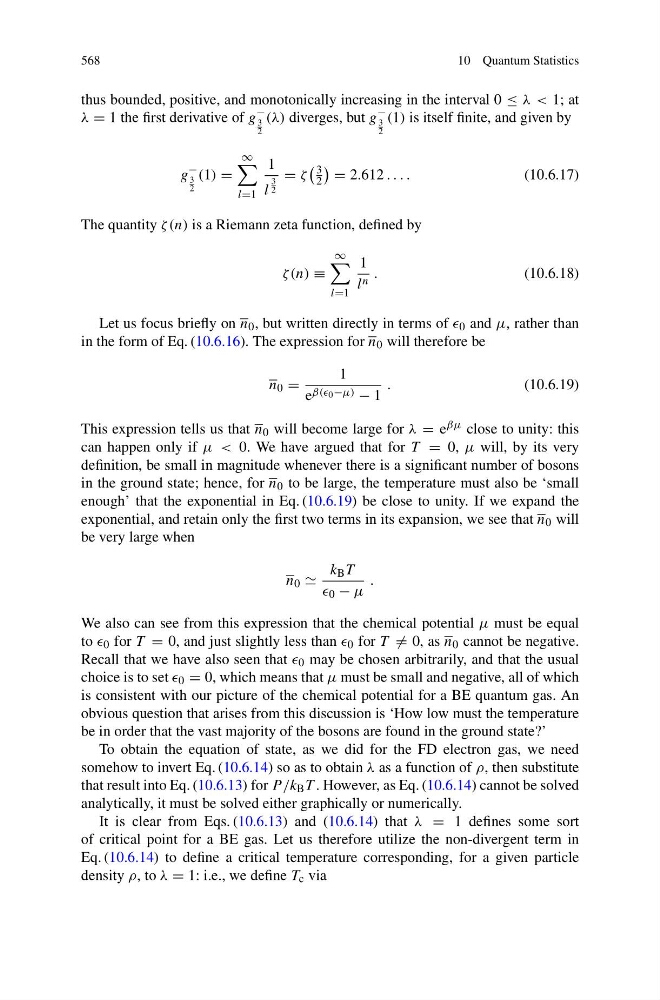
thus bounded, positive, and monotonically increasing in the interval 0 ≤ λ < 1; at
λ = 1 the first derivative of g
−
3
2
(λ) diverges, but g
−
3
2
(1) is itself finite, and given by
g
−
3
2
(1) =
∞
l=1
1
l
3
2
= ζ
3
2
= 2.612 . . . .
(10.6.17)
The quantity ζ(n) is a Riemann zeta function, defined by
ζ(n) ≡
∞
l=1
1
l n .
(10.6.18)
Let us focus briefly on n 0 , but written directly in terms of 0 and μ, rather than
in the form of Eq. (10.6.16). The expression for n 0 will therefore be
n 0 =
1
e β(( 0 −μ) − 1
.
(10.6.19)
This expression tells us that n 0 will become large for λ = e βμ close to unity: this
can happen only if μ < 0. We have argued that for T = 0, μ will, by its very
definition, be small in magnitude whenever there is a significant number of bosons
in the ground state; hence, for n 0 to be large, the temperature must also be ‘small
enough’ that the exponential in Eq. (10.6.19) be close to unity. If we expand the
exponential, and retain only the first two terms in its expansion, we see that n 0 will
be very large when
n 0
k B T
0 − μ
.
We also can see from this expression that the chemical potential μ must be equal
to 0 for T = 0, and just slightly less than 0 for T = 0, as n 0 cannot be negative.
Recall that we have also seen that 0 may be chosen arbitrarily, and that the usual
choice is to set 0 = 0, which means that μ must be small and negative, all of which
is consistent with our picture of the chemical potential for a BE quantum gas. An
obvious question that arises from this discussion is ‘How low must the temperature
be in order that the vast majority of the bosons are found in the ground state?’
To obtain the equation of state, as we did for the FD electron gas, we need
somehow to invert Eq. (10.6.14) so as to obtain λ as a function of ρ, then substitute
that result into Eq. (10.6.13) for P /k B T . However, as Eq. (10.6.14) cannot be solved
analytically, it must be solved either graphically or numerically.
It is clear from Eqs. (10.6.13) and (10.6.14) that λ = 1 defines some sort
of critical point for a BE gas. Let us therefore utilize the non-divergent term in
Eq. (10.6.14) to define a critical temperature corresponding, for a given particle
density ρ, to λ = 1: i.e., we define T c via
10 Quantum Statistics
thus bounded, positive, and monotonically increasing in the interval 0 ≤ λ < 1; at
λ = 1 the first derivative of g
−
3
2
(λ) diverges, but g
−
3
2
(1) is itself finite, and given by
g
−
3
2
(1) =
∞
l=1
1
l
3
2
= ζ
3
2
= 2.612 . . . .
(10.6.17)
The quantity ζ(n) is a Riemann zeta function, defined by
ζ(n) ≡
∞
l=1
1
l n .
(10.6.18)
Let us focus briefly on n 0 , but written directly in terms of 0 and μ, rather than
in the form of Eq. (10.6.16). The expression for n 0 will therefore be
n 0 =
1
e β(( 0 −μ) − 1
.
(10.6.19)
This expression tells us that n 0 will become large for λ = e βμ close to unity: this
can happen only if μ < 0. We have argued that for T = 0, μ will, by its very
definition, be small in magnitude whenever there is a significant number of bosons
in the ground state; hence, for n 0 to be large, the temperature must also be ‘small
enough’ that the exponential in Eq. (10.6.19) be close to unity. If we expand the
exponential, and retain only the first two terms in its expansion, we see that n 0 will
be very large when
n 0
k B T
0 − μ
.
We also can see from this expression that the chemical potential μ must be equal
to 0 for T = 0, and just slightly less than 0 for T = 0, as n 0 cannot be negative.
Recall that we have also seen that 0 may be chosen arbitrarily, and that the usual
choice is to set 0 = 0, which means that μ must be small and negative, all of which
is consistent with our picture of the chemical potential for a BE quantum gas. An
obvious question that arises from this discussion is ‘How low must the temperature
be in order that the vast majority of the bosons are found in the ground state?’
To obtain the equation of state, as we did for the FD electron gas, we need
somehow to invert Eq. (10.6.14) so as to obtain λ as a function of ρ, then substitute
that result into Eq. (10.6.13) for P /k B T . However, as Eq. (10.6.14) cannot be solved
analytically, it must be solved either graphically or numerically.
It is clear from Eqs. (10.6.13) and (10.6.14) that λ = 1 defines some sort
of critical point for a BE gas. Let us therefore utilize the non-divergent term in
Eq. (10.6.14) to define a critical temperature corresponding, for a given particle
density ρ, to λ = 1: i.e., we define T c via