

10.6 Bose–Einstein Statistics
571
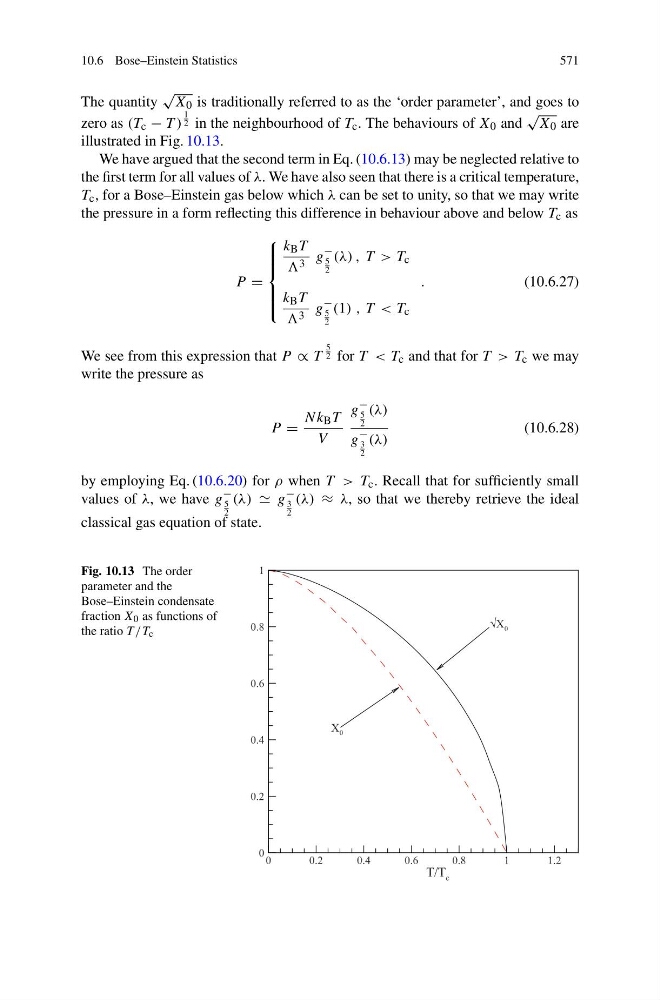
The quantity
√
X 0 is traditionally referred to as the ‘order parameter’, and goes to
zero as (T c − T )
1
2 in the neighbourhood of T c . The behaviours of X 0 and
√
X 0 are
illustrated in Fig. 10.13.
We have argued that the second term in Eq. (10.6.13) may be neglected relative to
the first term for all values of λ. We have also seen that there is a critical temperature,
T c , for a Bose–Einstein gas below which λ can be set to unity, so that we may write
the pressure in a form reflecting this difference in behaviour above and below T c as
P =
⎧
⎪ ⎪ ⎪ ⎨
⎪ ⎪ ⎪ ⎩
k B T
3 g
−
5
2
(λ) , T > T c
k B T
3 g
−
5
2
(1) , T < T c
.
(10.6.27)
We see from this expression that P ∝ T
5
2 for T < T c and that for T > T c we may
write the pressure as
P =
Nk B T
V
g
−
5
2
(λ)
g
−
3
2
(λ)
(10.6.28)
by employing Eq. (10.6.20) for ρ when T > T c . Recall that for sufficiently small
values of λ, we have g
−
5
2
(λ) g
−
3
2
(λ) ≈ λ, so that we thereby retrieve the ideal
classical gas equation of state.
Fig. 10.13 The order
parameter and the
Bose–Einstein condensate
fraction X 0 as functions of
the ratio T /T c
√
571
The quantity
√
X 0 is traditionally referred to as the ‘order parameter’, and goes to
zero as (T c − T )
1
2 in the neighbourhood of T c . The behaviours of X 0 and
√
X 0 are
illustrated in Fig. 10.13.
We have argued that the second term in Eq. (10.6.13) may be neglected relative to
the first term for all values of λ. We have also seen that there is a critical temperature,
T c , for a Bose–Einstein gas below which λ can be set to unity, so that we may write
the pressure in a form reflecting this difference in behaviour above and below T c as
P =
⎧
⎪ ⎪ ⎪ ⎨
⎪ ⎪ ⎪ ⎩
k B T
3 g
−
5
2
(λ) , T > T c
k B T
3 g
−
5
2
(1) , T < T c
.
(10.6.27)
We see from this expression that P ∝ T
5
2 for T < T c and that for T > T c we may
write the pressure as
P =
Nk B T
V
g
−
5
2
(λ)
g
−
3
2
(λ)
(10.6.28)
by employing Eq. (10.6.20) for ρ when T > T c . Recall that for sufficiently small
values of λ, we have g
−
5
2
(λ) g
−
3
2
(λ) ≈ λ, so that we thereby retrieve the ideal
classical gas equation of state.
Fig. 10.13 The order
parameter and the
Bose–Einstein condensate
fraction X 0 as functions of
the ratio T /T c
√