

10.5 Electrons in Semiconductors
553
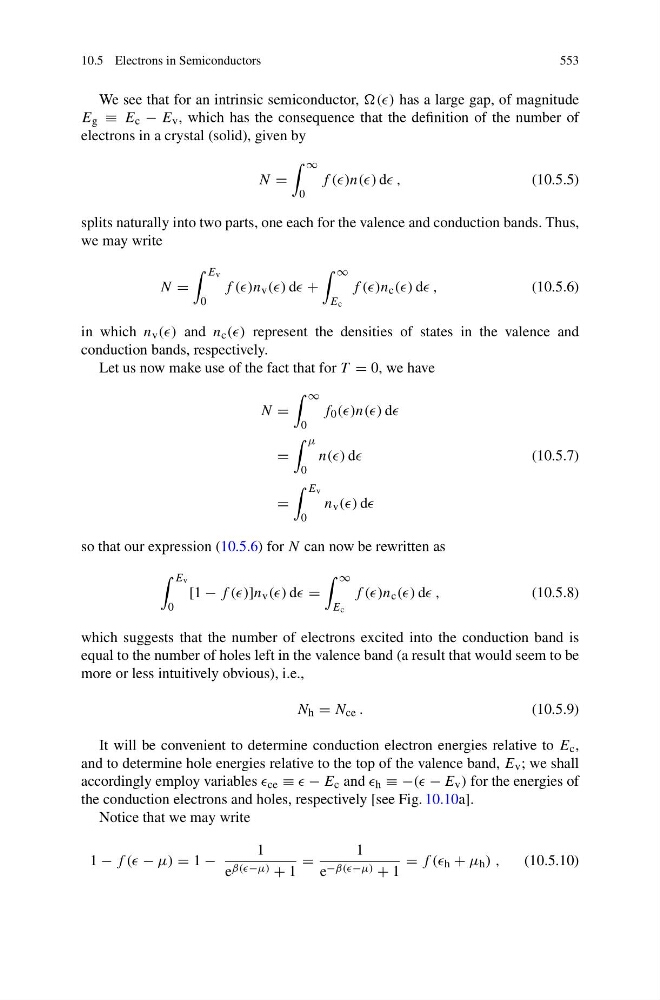
We see that for an intrinsic semiconductor, has a large gap, of magnitude
E g ≡ E c − E v , which has the consequence that the definition of the number of
electrons in a crystal (solid), given by
N =
∞
0
f (()n(() d ,
(10.5.5)
splits naturally into two parts, one each for the valence and conduction bands. Thus,
we may write
N =
E v
0
f (()n v (() d +
∞
E c
f (()n c (() d ,
(10.5.6)
in which n v (() and n c (() represent the densities of states in the valence and
conduction bands, respectively.
Let us now make use of the fact that for T = 0, we have
N =
∞
0
f 0 (()n(() d
=
μ
0
n(() d
(10.5.7)
=
E v
0
n v (() d
so that our expression (10.5.6) for N can now be rewritten as
E v
0
[1 − f (()]n v (() d =
∞
E c
f (()n c (() d ,
(10.5.8)
which suggests that the number of electrons excited into the conduction band is
equal to the number of holes left in the valence band (a result that would seem to be
more or less intuitively obvious), i.e.,
N h = N ce .
(10.5.9)
It will be convenient to determine conduction electron energies relative to E c ,
and to determine hole energies relative to the top of the valence band, E v ; we shall
accordingly employ variables ce ≡ − E c and h ≡ −(( − E v ) for the energies of
the conduction electrons and holes, respectively [see Fig. 10.10a].
Notice that we may write
1 − f (( − μ) = 1 −
1
e β((−μ) + 1
=
1
e −β((−μ) + 1
= f (( h + μ h ) ,
(10.5.10)
553
We see that for an intrinsic semiconductor, has a large gap, of magnitude
E g ≡ E c − E v , which has the consequence that the definition of the number of
electrons in a crystal (solid), given by
N =
∞
0
f (()n(() d ,
(10.5.5)
splits naturally into two parts, one each for the valence and conduction bands. Thus,
we may write
N =
E v
0
f (()n v (() d +
∞
E c
f (()n c (() d ,
(10.5.6)
in which n v (() and n c (() represent the densities of states in the valence and
conduction bands, respectively.
Let us now make use of the fact that for T = 0, we have
N =
∞
0
f 0 (()n(() d
=
μ
0
n(() d
(10.5.7)
=
E v
0
n v (() d
so that our expression (10.5.6) for N can now be rewritten as
E v
0
[1 − f (()]n v (() d =
∞
E c
f (()n c (() d ,
(10.5.8)
which suggests that the number of electrons excited into the conduction band is
equal to the number of holes left in the valence band (a result that would seem to be
more or less intuitively obvious), i.e.,
N h = N ce .
(10.5.9)
It will be convenient to determine conduction electron energies relative to E c ,
and to determine hole energies relative to the top of the valence band, E v ; we shall
accordingly employ variables ce ≡ − E c and h ≡ −(( − E v ) for the energies of
the conduction electrons and holes, respectively [see Fig. 10.10a].
Notice that we may write
1 − f (( − μ) = 1 −
1
e β((−μ) + 1
=
1
e −β((−μ) + 1
= f (( h + μ h ) ,
(10.5.10)