

546
10 Quantum Statistics
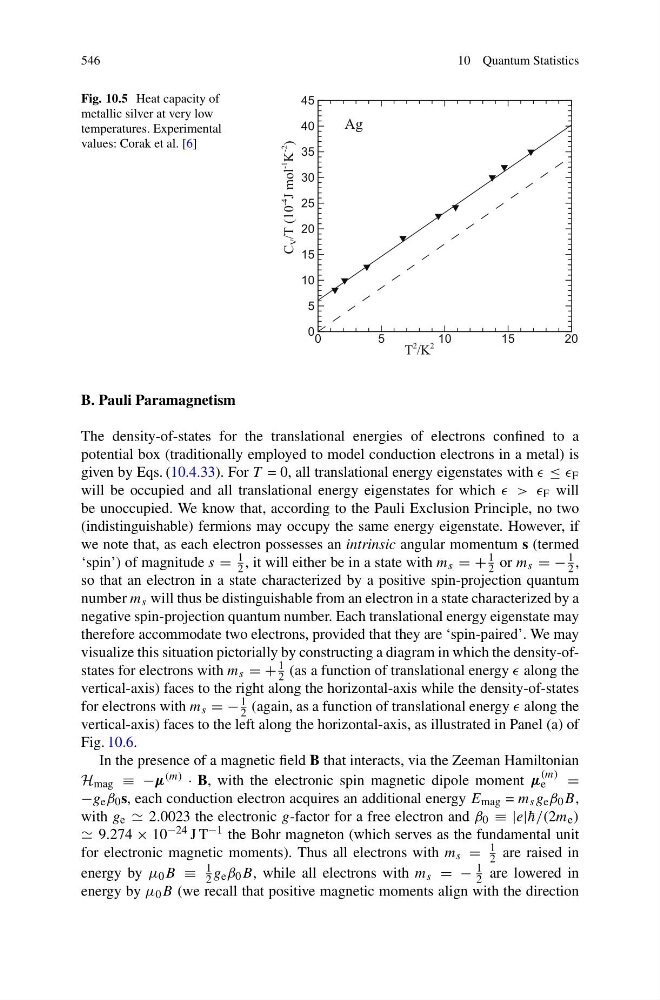
Fig. 10.5 Heat capacity of
metallic silver at very low
temperatures. Experimental
values: Corak et al. [6]
0
5
10
15
20
0
5
10
15
20
25
30
35
40
45
T
2
/K
2
C
V /T (10
-4
J mol
-1
K
-2
)
Ag
B. Pauli Paramagnetism
The density-of-states for the translational energies of electrons confined to a
potential box (traditionally employed to model conduction electrons in a metal) is
given by Eqs. (10.4.33). For T = 0, all translational energy eigenstates with ≤ F
will be occupied and all translational energy eigenstates for which > > F will
be unoccupied. We know that, according to the Pauli Exclusion Principle, no two
(indistinguishable) fermions may occupy the same energy eigenstate. However, if
we note that, as each electron possesses an intrinsic angular momentum s (termed
‘spin’) of magnitude s =
1
2 , it will either be in a state with m s = +
1
2 or m s = −
1
2 ,
so that an electron in a state characterized by a positive spin-projection quantum
number m s will thus be distinguishable from an electron in a state characterized by a
negative spin-projection quantum number. Each translational energy eigenstate may
therefore accommodate two electrons, provided that they are ‘spin-paired’. We may
visualize this situation pictorially by constructing a diagram in which the density-ofstates for electrons with m s = +
1
2 (as a function of translational energy along the
vertical-axis) faces to the right along the horizontal-axis while the density-of-states
for electrons with m s = −
1
2 (again, as a function of translational energy along the
vertical-axis) faces to the left along the horizontal-axis, as illustrated in Panel (a) of
Fig. 10.6.
In the presence of a magnetic field B that interacts, via the Zeeman Hamiltonian
H mag ≡ −μ (m) · B, with the electronic spin magnetic dipole moment μ
(m)
e
=
−g e β 0 s, each conduction electron acquires an additional energy E mag = m s g e β 0 B,
with g e 2.0023 the electronic g-factor for a free electron and β 0 ≡ |e| ¯
h/(2m e )
9.274 × 10 −24 J T −1 the Bohr magneton (which serves as the fundamental unit
for electronic magnetic moments). Thus all electrons with m s =
1
2 are raised in
energy by μ 0 B ≡
1
2 g e β 0 B, while all electrons with m s = −
1
2 are lowered in
energy by μ 0 B (we recall that positive magnetic moments align with the direction
10 Quantum Statistics
Fig. 10.5 Heat capacity of
metallic silver at very low
temperatures. Experimental
values: Corak et al. [6]
0
5
10
15
20
0
5
10
15
20
25
30
35
40
45
T
2
/K
2
C
V /T (10
-4
J mol
-1
K
-2
)
Ag
B. Pauli Paramagnetism
The density-of-states for the translational energies of electrons confined to a
potential box (traditionally employed to model conduction electrons in a metal) is
given by Eqs. (10.4.33). For T = 0, all translational energy eigenstates with ≤ F
will be occupied and all translational energy eigenstates for which > > F will
be unoccupied. We know that, according to the Pauli Exclusion Principle, no two
(indistinguishable) fermions may occupy the same energy eigenstate. However, if
we note that, as each electron possesses an intrinsic angular momentum s (termed
‘spin’) of magnitude s =
1
2 , it will either be in a state with m s = +
1
2 or m s = −
1
2 ,
so that an electron in a state characterized by a positive spin-projection quantum
number m s will thus be distinguishable from an electron in a state characterized by a
negative spin-projection quantum number. Each translational energy eigenstate may
therefore accommodate two electrons, provided that they are ‘spin-paired’. We may
visualize this situation pictorially by constructing a diagram in which the density-ofstates for electrons with m s = +
1
2 (as a function of translational energy along the
vertical-axis) faces to the right along the horizontal-axis while the density-of-states
for electrons with m s = −
1
2 (again, as a function of translational energy along the
vertical-axis) faces to the left along the horizontal-axis, as illustrated in Panel (a) of
Fig. 10.6.
In the presence of a magnetic field B that interacts, via the Zeeman Hamiltonian
H mag ≡ −μ (m) · B, with the electronic spin magnetic dipole moment μ
(m)
e
=
−g e β 0 s, each conduction electron acquires an additional energy E mag = m s g e β 0 B,
with g e 2.0023 the electronic g-factor for a free electron and β 0 ≡ |e| ¯
h/(2m e )
9.274 × 10 −24 J T −1 the Bohr magneton (which serves as the fundamental unit
for electronic magnetic moments). Thus all electrons with m s =
1
2 are raised in
energy by μ 0 B ≡
1
2 g e β 0 B, while all electrons with m s = −
1
2 are lowered in
energy by μ 0 B (we recall that positive magnetic moments align with the direction