

10.4 Fermi–Dirac Statistics
545
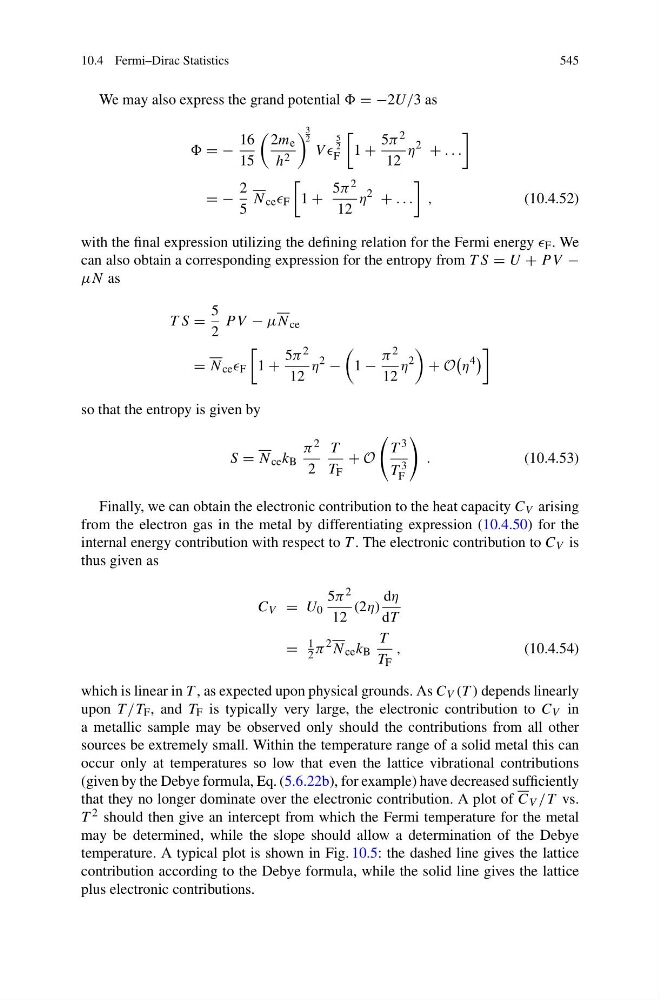
We may also express the grand potential = −2U/3 as
= −
16
15
2m e
h 2
3
2
V V
5
2
F
1 +
5π 2
12
η
2
+ . . .
= −
2
5
N ce F
1 +
5π 2
12
η
2
+ . . .
,
(10.4.52)
with the final expression utilizing the defining relation for the Fermi energy F . We
can also obtain a corresponding expression for the entropy from T S = U + P V −
μN as
T S =
5
2
P V − μN ce
= N ce F
1 +
5π 2
12
η
2
−
1 −
π 2
12
η
2
+ O
η
4
so that the entropy is given by
S = N ce k B
π 2
2
T
T F
+ O
T 3
T 3
F
.
(10.4.53)
Finally, we can obtain the electronic contribution to the heat capacity C V arising
from the electron gas in the metal by differentiating expression (10.4.50) for the
internal energy contribution with respect to T . The electronic contribution to C V is
thus given as
C V = U 0
5π 2
12
(2η)
dη
dT
=
1
2 π
2 N ce k B
T
T F
,
(10.4.54)
which is linear in T , as expected upon physical grounds. As C V (T ) depends linearly
upon T /T F , and T F is typically very large, the electronic contribution to C V in
a metallic sample may be observed only should the contributions from all other
sources be extremely small. Within the temperature range of a solid metal this can
occur only at temperatures so low that even the lattice vibrational contributions
(given by the Debye formula, Eq. (5.6.22b), for example) have decreased sufficiently
that they no longer dominate over the electronic contribution. A plot of C V /T vs.
T 2 should then give an intercept from which the Fermi temperature for the metal
may be determined, while the slope should allow a determination of the Debye
temperature. A typical plot is shown in Fig. 10.5: the dashed line gives the lattice
contribution according to the Debye formula, while the solid line gives the lattice
plus electronic contributions.
545
We may also express the grand potential = −2U/3 as
= −
16
15
2m e
h 2
3
2
V V
5
2
F
1 +
5π 2
12
η
2
+ . . .
= −
2
5
N ce F
1 +
5π 2
12
η
2
+ . . .
,
(10.4.52)
with the final expression utilizing the defining relation for the Fermi energy F . We
can also obtain a corresponding expression for the entropy from T S = U + P V −
μN as
T S =
5
2
P V − μN ce
= N ce F
1 +
5π 2
12
η
2
−
1 −
π 2
12
η
2
+ O
η
4
so that the entropy is given by
S = N ce k B
π 2
2
T
T F
+ O
T 3
T 3
F
.
(10.4.53)
Finally, we can obtain the electronic contribution to the heat capacity C V arising
from the electron gas in the metal by differentiating expression (10.4.50) for the
internal energy contribution with respect to T . The electronic contribution to C V is
thus given as
C V = U 0
5π 2
12
(2η)
dη
dT
=
1
2 π
2 N ce k B
T
T F
,
(10.4.54)
which is linear in T , as expected upon physical grounds. As C V (T ) depends linearly
upon T /T F , and T F is typically very large, the electronic contribution to C V in
a metallic sample may be observed only should the contributions from all other
sources be extremely small. Within the temperature range of a solid metal this can
occur only at temperatures so low that even the lattice vibrational contributions
(given by the Debye formula, Eq. (5.6.22b), for example) have decreased sufficiently
that they no longer dominate over the electronic contribution. A plot of C V /T vs.
T 2 should then give an intercept from which the Fermi temperature for the metal
may be determined, while the slope should allow a determination of the Debye
temperature. A typical plot is shown in Fig. 10.5: the dashed line gives the lattice
contribution according to the Debye formula, while the solid line gives the lattice
plus electronic contributions.