

532
10 Quantum Statistics
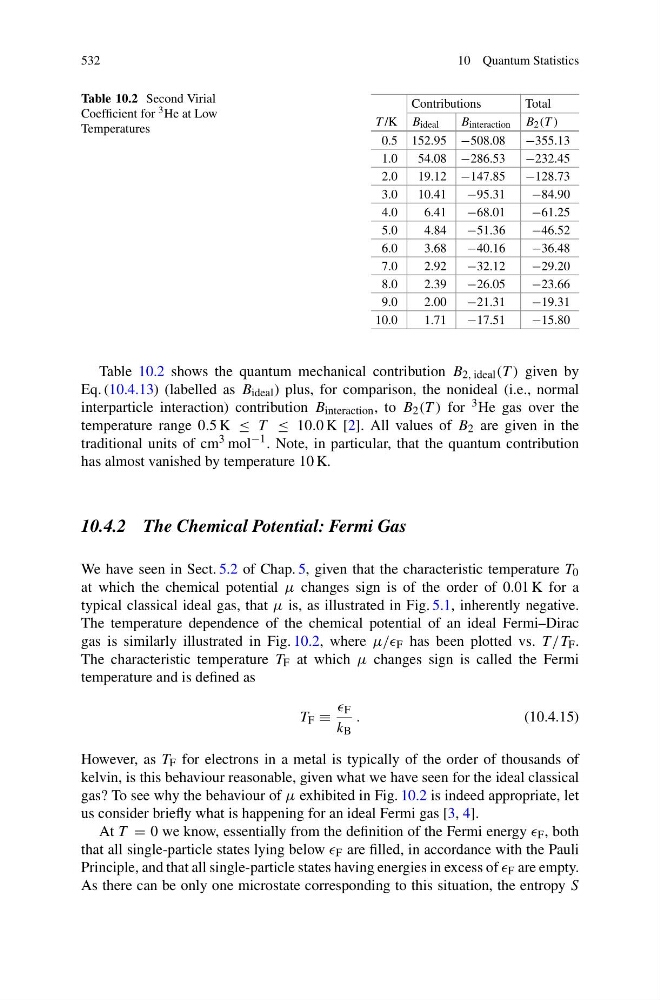
Table 10.2 Second Virial
Coefficient for 3 He at Low
Temperatures
Contributions
Total
T /K B ideal
B interaction B 2 (T )
0.5 152.95 −508.08
−355.13
1.0
54.08 −286.53
−232.45
2.0
19.12 −147.85
−128.73
3.0
10.41
−95.31
−84.90
4.0
6.41
−68.01
−61.25
5.0
4.84
−51.36
−46.52
6.0
3.68
−40.16
−36.48
7.0
2.92
−32.12
−29.20
8.0
2.39
−26.05
−23.66
9.0
2.00
−21.31
−19.31
10.0
1.71
−17.51
−15.80
Table 10.2 shows the quantum mechanical contribution B 2, ideal (T ) given by
Eq. (10.4.13) (labelled as B ideal ) plus, for comparison, the nonideal (i.e., normal
interparticle interaction) contribution B interaction , to B 2 (T ) for 3 He gas over the
temperature range 0.5 K ≤ T ≤ 10.0 K [2]. All values of B 2 are given in the
traditional units of cm 3 mol
−1 . Note, in particular, that the quantum contribution
has almost vanished by temperature 10 K.
10.4.2 The Chemical Potential: Fermi Gas
We have seen in Sect. 5.2 of Chap. 5, given that the characteristic temperature T 0
at which the chemical potential μ changes sign is of the order of 0.01 K for a
typical classical ideal gas, that μ is, as illustrated in Fig. 5.1, inherently negative.
The temperature dependence of the chemical potential of an ideal Fermi–Dirac
gas is similarly illustrated in Fig. 10.2, where μ// F has been plotted vs. T /T F .
The characteristic temperature T F at which μ changes sign is called the Fermi
temperature and is defined as
T F ≡
F
k B
.
(10.4.15)
However, as T F for electrons in a metal is typically of the order of thousands of
kelvin, is this behaviour reasonable, given what we have seen for the ideal classical
gas? To see why the behaviour of μ exhibited in Fig. 10.2 is indeed appropriate, let
us consider briefly what is happening for an ideal Fermi gas [3, 4].
At T = 0 we know, essentially from the definition of the Fermi energy F , both
that all single-particle states lying below F are filled, in accordance with the Pauli
Principle, and that all single-particle states having energies in excess of F are empty.
As there can be only one microstate corresponding to this situation, the entropy S
10 Quantum Statistics
Table 10.2 Second Virial
Coefficient for 3 He at Low
Temperatures
Contributions
Total
T /K B ideal
B interaction B 2 (T )
0.5 152.95 −508.08
−355.13
1.0
54.08 −286.53
−232.45
2.0
19.12 −147.85
−128.73
3.0
10.41
−95.31
−84.90
4.0
6.41
−68.01
−61.25
5.0
4.84
−51.36
−46.52
6.0
3.68
−40.16
−36.48
7.0
2.92
−32.12
−29.20
8.0
2.39
−26.05
−23.66
9.0
2.00
−21.31
−19.31
10.0
1.71
−17.51
−15.80
Table 10.2 shows the quantum mechanical contribution B 2, ideal (T ) given by
Eq. (10.4.13) (labelled as B ideal ) plus, for comparison, the nonideal (i.e., normal
interparticle interaction) contribution B interaction , to B 2 (T ) for 3 He gas over the
temperature range 0.5 K ≤ T ≤ 10.0 K [2]. All values of B 2 are given in the
traditional units of cm 3 mol
−1 . Note, in particular, that the quantum contribution
has almost vanished by temperature 10 K.
10.4.2 The Chemical Potential: Fermi Gas
We have seen in Sect. 5.2 of Chap. 5, given that the characteristic temperature T 0
at which the chemical potential μ changes sign is of the order of 0.01 K for a
typical classical ideal gas, that μ is, as illustrated in Fig. 5.1, inherently negative.
The temperature dependence of the chemical potential of an ideal Fermi–Dirac
gas is similarly illustrated in Fig. 10.2, where μ// F has been plotted vs. T /T F .
The characteristic temperature T F at which μ changes sign is called the Fermi
temperature and is defined as
T F ≡
F
k B
.
(10.4.15)
However, as T F for electrons in a metal is typically of the order of thousands of
kelvin, is this behaviour reasonable, given what we have seen for the ideal classical
gas? To see why the behaviour of μ exhibited in Fig. 10.2 is indeed appropriate, let
us consider briefly what is happening for an ideal Fermi gas [3, 4].
At T = 0 we know, essentially from the definition of the Fermi energy F , both
that all single-particle states lying below F are filled, in accordance with the Pauli
Principle, and that all single-particle states having energies in excess of F are empty.
As there can be only one microstate corresponding to this situation, the entropy S