

10.4 Fermi–Dirac Statistics
533
0
1
2
-4
-3
-2
-1
0
1
T/T F
μ/μ
F
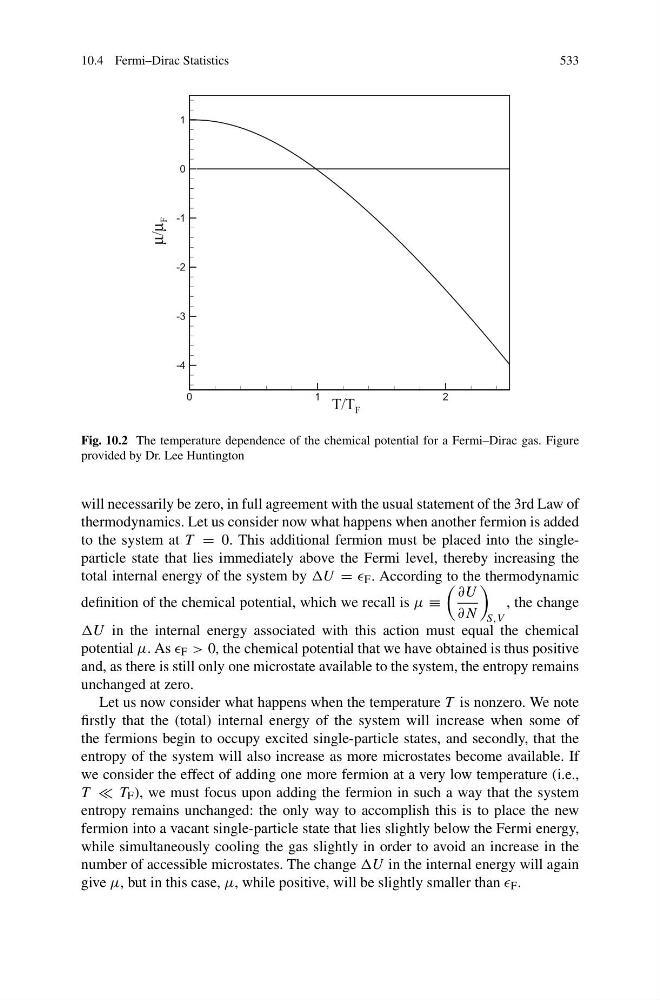
Fig. 10.2 The temperature dependence of the chemical potential for a Fermi–Dirac gas. Figure
provided by Dr. Lee Huntington
will necessarily be zero, in full agreement with the usual statement of the 3rd Law of
thermodynamics. Let us consider now what happens when another fermion is added
to the system at T = 0. This additional fermion must be placed into the singleparticle state that lies immediately above the Fermi level, thereby increasing the
total internal energy of the system by U = F . According to the thermodynamic
definition of the chemical potential, which we recall is μ ≡
∂U
∂N
S,V
, the change
U in the internal energy associated with this action must equal the chemical
potential μ. As F > 0, the chemical potential that we have obtained is thus positive
and, as there is still only one microstate available to the system, the entropy remains
unchanged at zero.
Let us now consider what happens when the temperature T is nonzero. We note
firstly that the (total) internal energy of the system will increase when some of
the fermions begin to occupy excited single-particle states, and secondly, that the
entropy of the system will also increase as more microstates become available. If
we consider the effect of adding one more fermion at a very low temperature (i.e.,
T T F ), we must focus upon adding the fermion in such a way that the system
entropy remains unchanged: the only way to accomplish this is to place the new
fermion into a vacant single-particle state that lies slightly below the Fermi energy,
while simultaneously cooling the gas slightly in order to avoid an increase in the
number of accessible microstates. The change U in the internal energy will again
give μ, but in this case, μ, while positive, will be slightly smaller than F .
533
0
1
2
-4
-3
-2
-1
0
1
T/T F
μ/μ
F
Fig. 10.2 The temperature dependence of the chemical potential for a Fermi–Dirac gas. Figure
provided by Dr. Lee Huntington
will necessarily be zero, in full agreement with the usual statement of the 3rd Law of
thermodynamics. Let us consider now what happens when another fermion is added
to the system at T = 0. This additional fermion must be placed into the singleparticle state that lies immediately above the Fermi level, thereby increasing the
total internal energy of the system by U = F . According to the thermodynamic
definition of the chemical potential, which we recall is μ ≡
∂U
∂N
S,V
, the change
U in the internal energy associated with this action must equal the chemical
potential μ. As F > 0, the chemical potential that we have obtained is thus positive
and, as there is still only one microstate available to the system, the entropy remains
unchanged at zero.
Let us now consider what happens when the temperature T is nonzero. We note
firstly that the (total) internal energy of the system will increase when some of
the fermions begin to occupy excited single-particle states, and secondly, that the
entropy of the system will also increase as more microstates become available. If
we consider the effect of adding one more fermion at a very low temperature (i.e.,
T T F ), we must focus upon adding the fermion in such a way that the system
entropy remains unchanged: the only way to accomplish this is to place the new
fermion into a vacant single-particle state that lies slightly below the Fermi energy,
while simultaneously cooling the gas slightly in order to avoid an increase in the
number of accessible microstates. The change U in the internal energy will again
give μ, but in this case, μ, while positive, will be slightly smaller than F .