

10.4 Fermi–Dirac Statistics
531
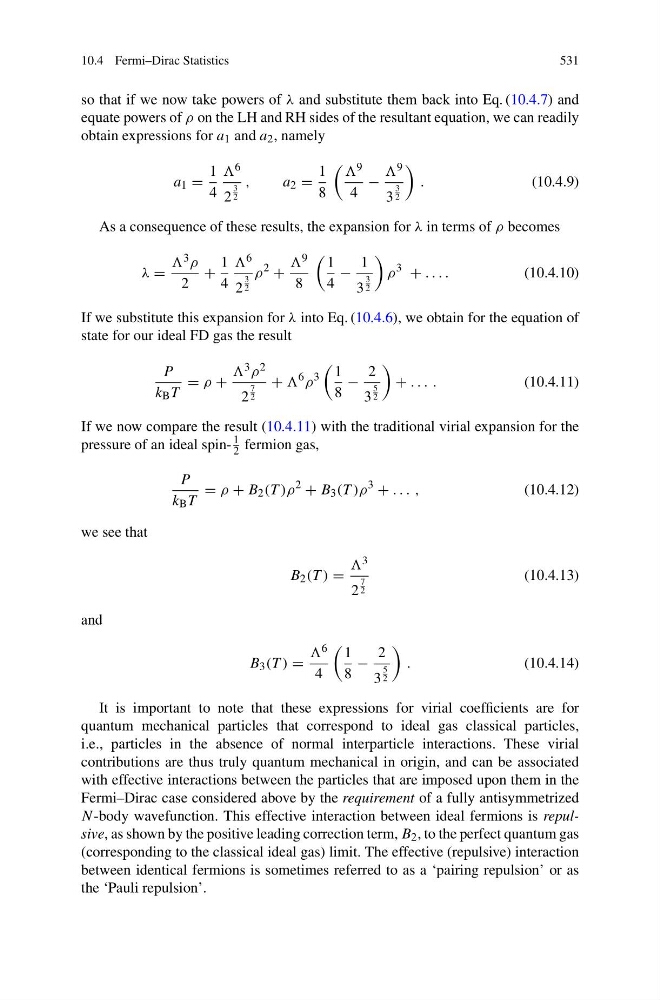
so that if we now take powers of λ and substitute them back into Eq. (10.4.7) and
equate powers of ρ on the LH and RH sides of the resultant equation, we can readily
obtain expressions for a 1 and a 2 , namely
a 1 =
1
4
6
2
3
2
,
a 2 =
1
8
9
4
−
9
3
3
2
.
(10.4.9)
As a consequence of these results, the expansion for λ in terms of ρ becomes
λ =
3 ρ
2
+
1
4
6
2
3
2
ρ
2
+
9
8
1
4
−
1
3
3
2
ρ
3
+ . . . .
(10.4.10)
If we substitute this expansion for λ into Eq. (10.4.6), we obtain for the equation of
state for our ideal FD gas the result
P
k B T
= ρ +
3 ρ 2
2
7
2
+
6 ρ
3
1
8
−
2
3
5
2
+ . . . .
(10.4.11)
If we now compare the result (10.4.11) with the traditional virial expansion for the
pressure of an ideal spin1
2 fermion gas,
P
k B T
= ρ + B 2 (T )ρ
2
+ B 3 (T )ρ
3
+ . . . ,
(10.4.12)
we see that
B 2 (T ) =
3
2
7
2
(10.4.13)
and
B 3 (T ) =
6
4
1
8
−
2
3
5
2
.
(10.4.14)
It is important to note that these expressions for virial coefficients are for
quantum mechanical particles that correspond to ideal gas classical particles,
i.e., particles in the absence of normal interparticle interactions. These virial
contributions are thus truly quantum mechanical in origin, and can be associated
with effective interactions between the particles that are imposed upon them in the
Fermi–Dirac case considered above by the requirement of a fully antisymmetrized
N-body wavefunction. This effective interaction between ideal fermions is repulsive, as shown by the positive leading correction term, B 2 , to the perfect quantum gas
(corresponding to the classical ideal gas) limit. The effective (repulsive) interaction
between identical fermions is sometimes referred to as a ‘pairing repulsion’ or as
the ‘Pauli repulsion’.
531
so that if we now take powers of λ and substitute them back into Eq. (10.4.7) and
equate powers of ρ on the LH and RH sides of the resultant equation, we can readily
obtain expressions for a 1 and a 2 , namely
a 1 =
1
4
6
2
3
2
,
a 2 =
1
8
9
4
−
9
3
3
2
.
(10.4.9)
As a consequence of these results, the expansion for λ in terms of ρ becomes
λ =
3 ρ
2
+
1
4
6
2
3
2
ρ
2
+
9
8
1
4
−
1
3
3
2
ρ
3
+ . . . .
(10.4.10)
If we substitute this expansion for λ into Eq. (10.4.6), we obtain for the equation of
state for our ideal FD gas the result
P
k B T
= ρ +
3 ρ 2
2
7
2
+
6 ρ
3
1
8
−
2
3
5
2
+ . . . .
(10.4.11)
If we now compare the result (10.4.11) with the traditional virial expansion for the
pressure of an ideal spin1
2 fermion gas,
P
k B T
= ρ + B 2 (T )ρ
2
+ B 3 (T )ρ
3
+ . . . ,
(10.4.12)
we see that
B 2 (T ) =
3
2
7
2
(10.4.13)
and
B 3 (T ) =
6
4
1
8
−
2
3
5
2
.
(10.4.14)
It is important to note that these expressions for virial coefficients are for
quantum mechanical particles that correspond to ideal gas classical particles,
i.e., particles in the absence of normal interparticle interactions. These virial
contributions are thus truly quantum mechanical in origin, and can be associated
with effective interactions between the particles that are imposed upon them in the
Fermi–Dirac case considered above by the requirement of a fully antisymmetrized
N-body wavefunction. This effective interaction between ideal fermions is repulsive, as shown by the positive leading correction term, B 2 , to the perfect quantum gas
(corresponding to the classical ideal gas) limit. The effective (repulsive) interaction
between identical fermions is sometimes referred to as a ‘pairing repulsion’ or as
the ‘Pauli repulsion’.