

530
10 Quantum Statistics
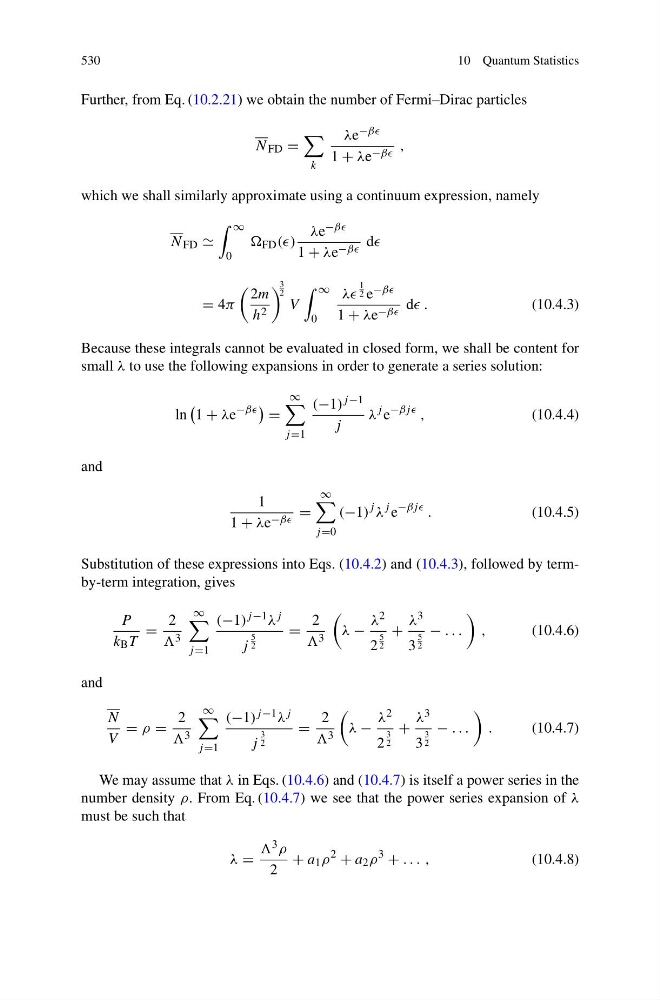
Further, from Eq. (10.2.21) we obtain the number of Fermi–Dirac particles
N FD =
k
λe −ββ
1 + λe −ββ ,
which we shall similarly approximate using a continuum expression, namely
N FD
∞
0
FD (()
λe −ββ
1 + λe −ββ d
= 4π
2m
h 2
3
2
V
∞
0
λλ
1
2 e −ββ
1 + λe −ββ d .
(10.4.3)
Because these integrals cannot be evaluated in closed form, we shall be content for
small λ to use the following expansions in order to generate a series solution:
ln
1 + λe
−ββ
=
∞
j =1
(−1) j −1
j
λ
j e
−βj j ,
(10.4.4)
and
1
1 + λe −ββ =
∞
j =0
(−1)
j λ
j e
−βj j .
(10.4.5)
Substitution of these expressions into Eqs. (10.4.2) and (10.4.3), followed by termby-term integration, gives
P
k B T
=
2
3
∞
j =1
(−1) j −1 λ j
j
5
2
=
2
3
λ −
λ 2
2
5
2
+
λ 3
3
5
2
− . . .
,
(10.4.6)
and
N
V
= ρ =
2
3
∞
j =1
(−1) j −1 λ j
j
3
2
=
2
3
λ −
λ 2
2
3
2
+
λ 3
3
3
2
− . . .
.
(10.4.7)
We may assume that λ in Eqs. (10.4.6) and (10.4.7) is itself a power series in the
number density ρ. From Eq. (10.4.7) we see that the power series expansion of λ
must be such that
λ =
3 ρ
2
+ a 1 ρ
2
+ a 2 ρ
3
+ . . . ,
(10.4.8)
10 Quantum Statistics
Further, from Eq. (10.2.21) we obtain the number of Fermi–Dirac particles
N FD =
k
λe −ββ
1 + λe −ββ ,
which we shall similarly approximate using a continuum expression, namely
N FD
∞
0
FD (()
λe −ββ
1 + λe −ββ d
= 4π
2m
h 2
3
2
V
∞
0
λλ
1
2 e −ββ
1 + λe −ββ d .
(10.4.3)
Because these integrals cannot be evaluated in closed form, we shall be content for
small λ to use the following expansions in order to generate a series solution:
ln
1 + λe
−ββ
=
∞
j =1
(−1) j −1
j
λ
j e
−βj j ,
(10.4.4)
and
1
1 + λe −ββ =
∞
j =0
(−1)
j λ
j e
−βj j .
(10.4.5)
Substitution of these expressions into Eqs. (10.4.2) and (10.4.3), followed by termby-term integration, gives
P
k B T
=
2
3
∞
j =1
(−1) j −1 λ j
j
5
2
=
2
3
λ −
λ 2
2
5
2
+
λ 3
3
5
2
− . . .
,
(10.4.6)
and
N
V
= ρ =
2
3
∞
j =1
(−1) j −1 λ j
j
3
2
=
2
3
λ −
λ 2
2
3
2
+
λ 3
3
3
2
− . . .
.
(10.4.7)
We may assume that λ in Eqs. (10.4.6) and (10.4.7) is itself a power series in the
number density ρ. From Eq. (10.4.7) we see that the power series expansion of λ
must be such that
λ =
3 ρ
2
+ a 1 ρ
2
+ a 2 ρ
3
+ . . . ,
(10.4.8)