

520
10 Quantum Statistics
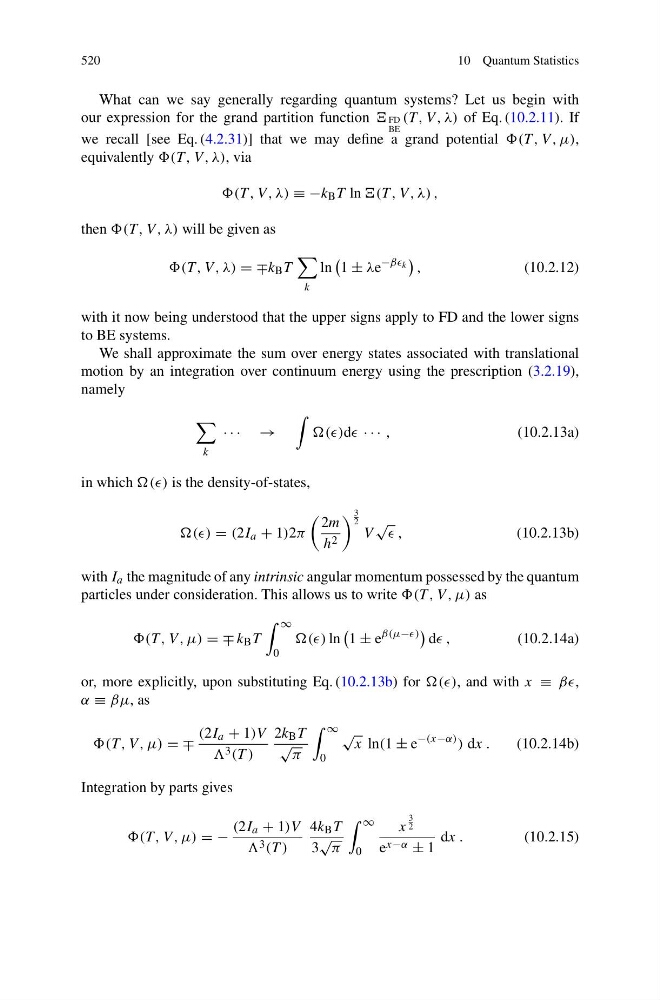
What can we say generally regarding quantum systems? Let us begin with
our expression for the grand partition function FD
BE
(T , V , λ) of Eq. (10.2.11). If
we recall [see Eq. (4.2.31)] that we may define a grand potential , V , μ),
equivalently (T , V , λ), via
(T , V , λ) ≡ −k B T ln (T , V , λ) ,
then , V , λ) will be given as
, V , λ) = ∓k B T
k
ln
1 ± λe
−ββ k
,
(10.2.12)
with it now being understood that the upper signs apply to FD and the lower signs
to BE systems.
We shall approximate the sum over energy states associated with translational
motion by an integration over continuum energy using the prescription (3.2.19),
namely
k
· · · →
· · · ,
(10.2.13a)
in which (() is the density-of-states,
(() = (2I a + 1)2π
2m
h 2
3
2
V
√
,
(10.2.13b)
with I a the magnitude of any intrinsic angular momentum possessed by the quantum
particles under consideration. This allows us to write , V , μ) as
(T , V , μ) = ∓ k B T
∞
0
ln
1 ± e
β(μ−)
d ,
(10.2.14a)
or, more explicitly, upon substituting Eq. (10.2.13b) for and with x ≡ ββ,
α ≡ βμ, as
(T , V , μ) = ∓
(2I a + 1)V
3 (T )
2k B T
√
π
∞
0
√
x ln(1 ± e
−(x−α) ) dx .
(10.2.14b)
Integration by parts gives
, V , μ) = −
(2I a + 1)V
3 (T )
4k B T
3
√
π
∞
0
x
3
2
e x−α ± 1
dx .
(10.2.15)
10 Quantum Statistics
What can we say generally regarding quantum systems? Let us begin with
our expression for the grand partition function FD
BE
(T , V , λ) of Eq. (10.2.11). If
we recall [see Eq. (4.2.31)] that we may define a grand potential , V , μ),
equivalently (T , V , λ), via
(T , V , λ) ≡ −k B T ln (T , V , λ) ,
then , V , λ) will be given as
, V , λ) = ∓k B T
k
ln
1 ± λe
−ββ k
,
(10.2.12)
with it now being understood that the upper signs apply to FD and the lower signs
to BE systems.
We shall approximate the sum over energy states associated with translational
motion by an integration over continuum energy using the prescription (3.2.19),
namely
k
· · · →
· · · ,
(10.2.13a)
in which (() is the density-of-states,
(() = (2I a + 1)2π
2m
h 2
3
2
V
√
,
(10.2.13b)
with I a the magnitude of any intrinsic angular momentum possessed by the quantum
particles under consideration. This allows us to write , V , μ) as
(T , V , μ) = ∓ k B T
∞
0
ln
1 ± e
β(μ−)
d ,
(10.2.14a)
or, more explicitly, upon substituting Eq. (10.2.13b) for and with x ≡ ββ,
α ≡ βμ, as
(T , V , μ) = ∓
(2I a + 1)V
3 (T )
2k B T
√
π
∞
0
√
x ln(1 ± e
−(x−α) ) dx .
(10.2.14b)
Integration by parts gives
, V , μ) = −
(2I a + 1)V
3 (T )
4k B T
3
√
π
∞
0
x
3
2
e x−α ± 1
dx .
(10.2.15)