

10.2 Two Types of Quantum Statistics
519
or, in terms of the chemical potential μ, as
FD (T , V , μ) =
k
(1 + e
β(μ− k ) ) .
(10.2.7b)
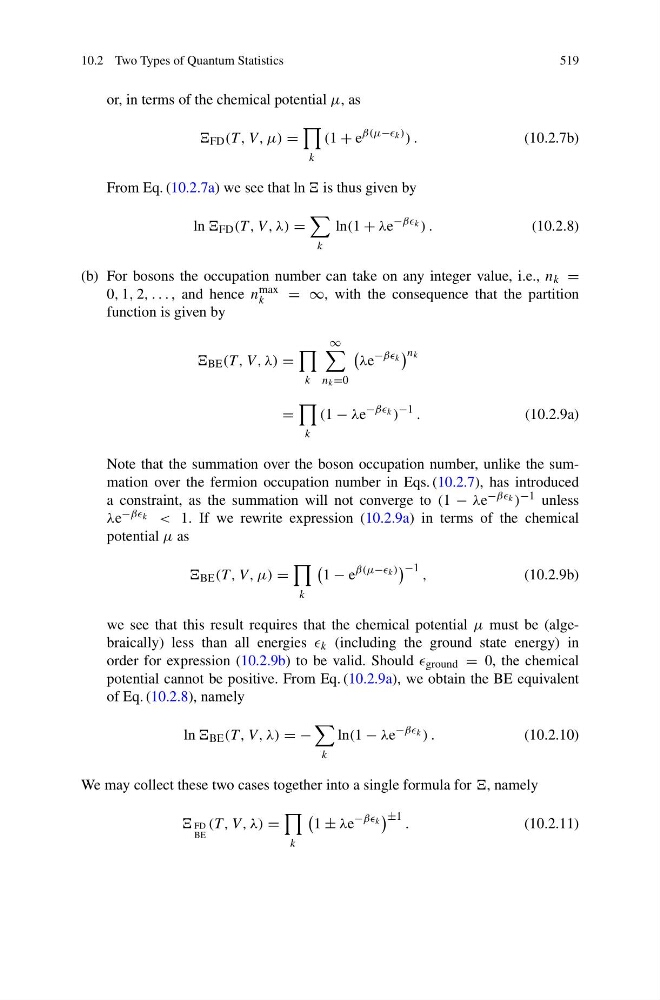
From Eq. (10.2.7a) we see that ln is thus given by
ln FD (T , V , λ) =
k
ln(1 + λe
−ββ k ) .
(10.2.8)
(b) For bosons the occupation number can take on any integer value, i.e., n k =
0, 1, 2, . . . , and hence n max
k
= ∞, with the consequence that the partition
function is given by
BE (T , V , λ) =
k
∞
n k =0
λe
−ββ k
n k
=
k
(1 − λe
−ββ k )
−1 .
(10.2.9a)
Note that the summation over the boson occupation number, unlike the summation over the fermion occupation number in Eqs. (10.2.7), has introduced
a constraint, as the summation will not converge to (1 − λe −ββ k ) −1 unless
λe −ββ k < 1. If we rewrite expression (10.2.9a) in terms of the chemical
potential μ as
BE (T , V , μ) =
k
1 − e
β(μ− k )
−1 ,
(10.2.9b)
we see that this result requires that the chemical potential μ must be (algebraically) less than all energies k (including the ground state energy) in
order for expression (10.2.9b) to be valid. Should ground = 0, the chemical
potential cannot be positive. From Eq. (10.2.9a), we obtain the BE equivalent
of Eq. (10.2.8), namely
ln BE (T , V , λ) = −
k
ln(1 − λe
−ββ k ) .
(10.2.10)
We may collect these two cases together into a single formula for , namely
FD
BE
(T , V , λ) =
k
1 ± λe
−ββ k
±1 .
(10.2.11)
519
or, in terms of the chemical potential μ, as
FD (T , V , μ) =
k
(1 + e
β(μ− k ) ) .
(10.2.7b)
From Eq. (10.2.7a) we see that ln is thus given by
ln FD (T , V , λ) =
k
ln(1 + λe
−ββ k ) .
(10.2.8)
(b) For bosons the occupation number can take on any integer value, i.e., n k =
0, 1, 2, . . . , and hence n max
k
= ∞, with the consequence that the partition
function is given by
BE (T , V , λ) =
k
∞
n k =0
λe
−ββ k
n k
=
k
(1 − λe
−ββ k )
−1 .
(10.2.9a)
Note that the summation over the boson occupation number, unlike the summation over the fermion occupation number in Eqs. (10.2.7), has introduced
a constraint, as the summation will not converge to (1 − λe −ββ k ) −1 unless
λe −ββ k < 1. If we rewrite expression (10.2.9a) in terms of the chemical
potential μ as
BE (T , V , μ) =
k
1 − e
β(μ− k )
−1 ,
(10.2.9b)
we see that this result requires that the chemical potential μ must be (algebraically) less than all energies k (including the ground state energy) in
order for expression (10.2.9b) to be valid. Should ground = 0, the chemical
potential cannot be positive. From Eq. (10.2.9a), we obtain the BE equivalent
of Eq. (10.2.8), namely
ln BE (T , V , λ) = −
k
ln(1 − λe
−ββ k ) .
(10.2.10)
We may collect these two cases together into a single formula for , namely
FD
BE
(T , V , λ) =
k
1 ± λe
−ββ k
±1 .
(10.2.11)