

518
10 Quantum Statistics
incorporate mathematically. We may avoid this problem, however, if we work in
the grand ensemble, in which N can vary. For this reason we shall use the grand
partition function,
, V , μ) =
∞
N =0
e
βμN Z(N, T , V ) ,
(10.2.4)
from this point onwards.
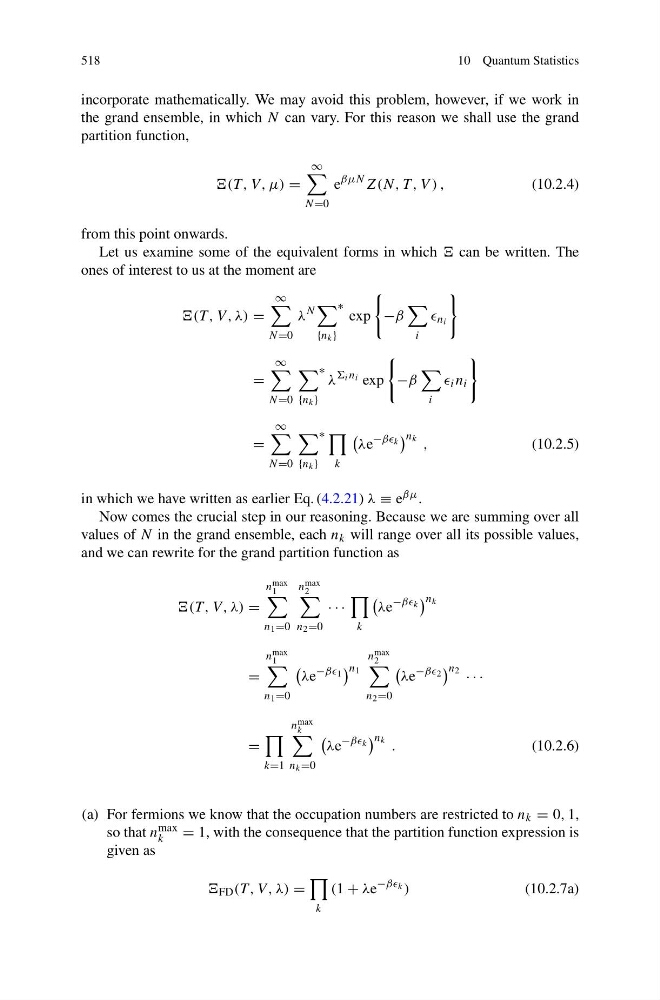
Let us examine some of the equivalent forms in which can be written. The
ones of interest to us at the moment are
, V , λ) =
∞
N =0
λ
N
{n k }
∗
exp
−β
i
n i
=
∞
N =0
{n k }
∗
λ
i n i exp
−β
i
i n i
=
∞
N =0
{n k }
∗
k
λe
−ββ k
n k ,
(10.2.5)
in which we have written as earlier Eq. (4.2.21) λ ≡ e βμ .
Now comes the crucial step in our reasoning. Because we are summing over all
values of N in the grand ensemble, each n k will range over all its possible values,
and we can rewrite for the grand partition function as
, V , λ) =
n max
1
n 1 =0
n max
2
n 2 =0
· · ·
k
λe
−ββ k
n k
=
n max
1
n 1 =0
λe
−ββ 1
n 1
n max
2
n 2 =0
λe
−ββ 2
n 2 · · ·
=
k=1
n max
k
n k =0
λe
−ββ k
n k .
(10.2.6)
(a) For fermions we know that the occupation numbers are restricted to n k = 0, 1,
so that n max
k
= 1, with the consequence that the partition function expression is
given as
FD (T , V , λ) =
k
(1 + λe
−ββ k )
(10.2.7a)
10 Quantum Statistics
incorporate mathematically. We may avoid this problem, however, if we work in
the grand ensemble, in which N can vary. For this reason we shall use the grand
partition function,
, V , μ) =
∞
N =0
e
βμN Z(N, T , V ) ,
(10.2.4)
from this point onwards.
Let us examine some of the equivalent forms in which can be written. The
ones of interest to us at the moment are
, V , λ) =
∞
N =0
λ
N
{n k }
∗
exp
−β
i
n i
=
∞
N =0
{n k }
∗
λ
i n i exp
−β
i
i n i
=
∞
N =0
{n k }
∗
k
λe
−ββ k
n k ,
(10.2.5)
in which we have written as earlier Eq. (4.2.21) λ ≡ e βμ .
Now comes the crucial step in our reasoning. Because we are summing over all
values of N in the grand ensemble, each n k will range over all its possible values,
and we can rewrite for the grand partition function as
, V , λ) =
n max
1
n 1 =0
n max
2
n 2 =0
· · ·
k
λe
−ββ k
n k
=
n max
1
n 1 =0
λe
−ββ 1
n 1
n max
2
n 2 =0
λe
−ββ 2
n 2 · · ·
=
k=1
n max
k
n k =0
λe
−ββ k
n k .
(10.2.6)
(a) For fermions we know that the occupation numbers are restricted to n k = 0, 1,
so that n max
k
= 1, with the consequence that the partition function expression is
given as
FD (T , V , λ) =
k
(1 + λe
−ββ k )
(10.2.7a)