

10.2 Two Types of Quantum Statistics
521
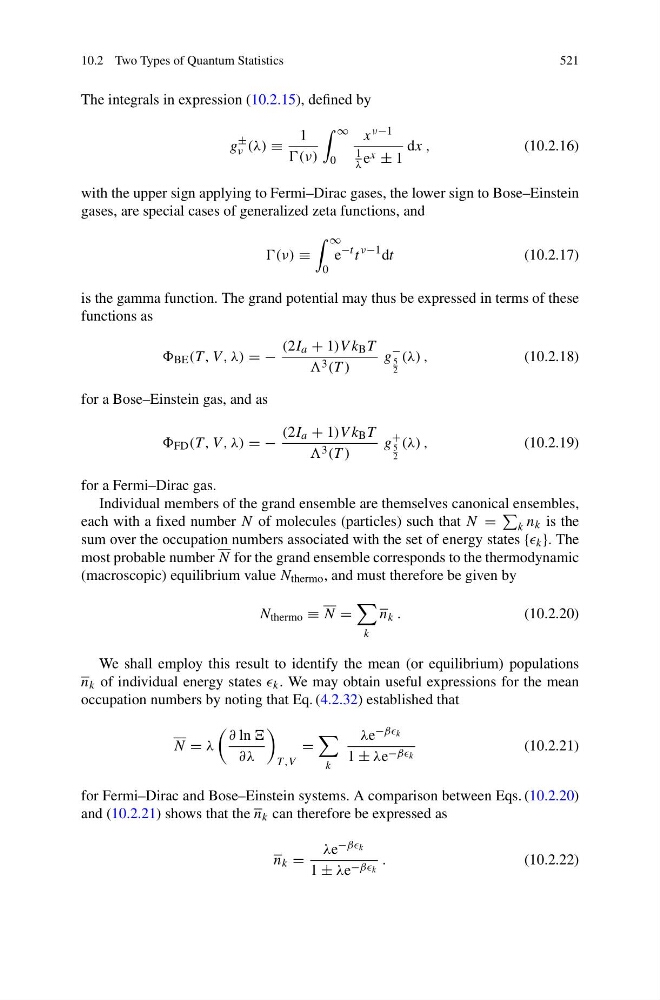
The integrals in expression (10.2.15), defined by
g
±
ν (λ) ≡
1
(ν)
∞
0
x ν−1
1
λ e x ± 1
dx ,
(10.2.16)
with the upper sign applying to Fermi–Dirac gases, the lower sign to Bose–Einstein
gases, are special cases of generalized zeta functions, and
(ν) ≡
∞
0
e
−t t
ν−1 dt
(10.2.17)
is the gamma function. The grand potential may thus be expressed in terms of these
functions as
BE (T , V , λ) = −
(2I a + 1)V k B T
3 (T )
g
−
5
2
(λ) ,
(10.2.18)
for a Bose–Einstein gas, and as
FD (T , V , λ) = −
(2I a + 1)V k B T
3 (T )
g
+
5
2
(λ) ,
(10.2.19)
for a Fermi–Dirac gas.
Individual members of the grand ensemble are themselves canonical ensembles,
each with a fixed number N of molecules (particles) such that N =
k n k is the
sum over the occupation numbers associated with the set of energy states { k }. The
most probable number N for the grand ensemble corresponds to the thermodynamic
(macroscopic) equilibrium value N thermo , and must therefore be given by
N thermo ≡ N =
k
n k .
(10.2.20)
We shall employ this result to identify the mean (or equilibrium) populations
n k of individual energy states k . We may obtain useful expressions for the mean
occupation numbers by noting that Eq. (4.2.32) established that
N = λ
∂ ln
∂λ
T ,V
=
k
λe −ββ k
1 ± λe −ββ k
(10.2.21)
for Fermi–Dirac and Bose–Einstein systems. A comparison between Eqs. (10.2.20)
and (10.2.21) shows that the n k can therefore be expressed as
n k =
λe −ββ k
1 ± λe −ββ k
.
(10.2.22)
521
The integrals in expression (10.2.15), defined by
g
±
ν (λ) ≡
1
(ν)
∞
0
x ν−1
1
λ e x ± 1
dx ,
(10.2.16)
with the upper sign applying to Fermi–Dirac gases, the lower sign to Bose–Einstein
gases, are special cases of generalized zeta functions, and
(ν) ≡
∞
0
e
−t t
ν−1 dt
(10.2.17)
is the gamma function. The grand potential may thus be expressed in terms of these
functions as
BE (T , V , λ) = −
(2I a + 1)V k B T
3 (T )
g
−
5
2
(λ) ,
(10.2.18)
for a Bose–Einstein gas, and as
FD (T , V , λ) = −
(2I a + 1)V k B T
3 (T )
g
+
5
2
(λ) ,
(10.2.19)
for a Fermi–Dirac gas.
Individual members of the grand ensemble are themselves canonical ensembles,
each with a fixed number N of molecules (particles) such that N =
k n k is the
sum over the occupation numbers associated with the set of energy states { k }. The
most probable number N for the grand ensemble corresponds to the thermodynamic
(macroscopic) equilibrium value N thermo , and must therefore be given by
N thermo ≡ N =
k
n k .
(10.2.20)
We shall employ this result to identify the mean (or equilibrium) populations
n k of individual energy states k . We may obtain useful expressions for the mean
occupation numbers by noting that Eq. (4.2.32) established that
N = λ
∂ ln
∂λ
T ,V
=
k
λe −ββ k
1 ± λe −ββ k
(10.2.21)
for Fermi–Dirac and Bose–Einstein systems. A comparison between Eqs. (10.2.20)
and (10.2.21) shows that the n k can therefore be expressed as
n k =
λe −ββ k
1 ± λe −ββ k
.
(10.2.22)