

504
9 Chemical Equilibrium
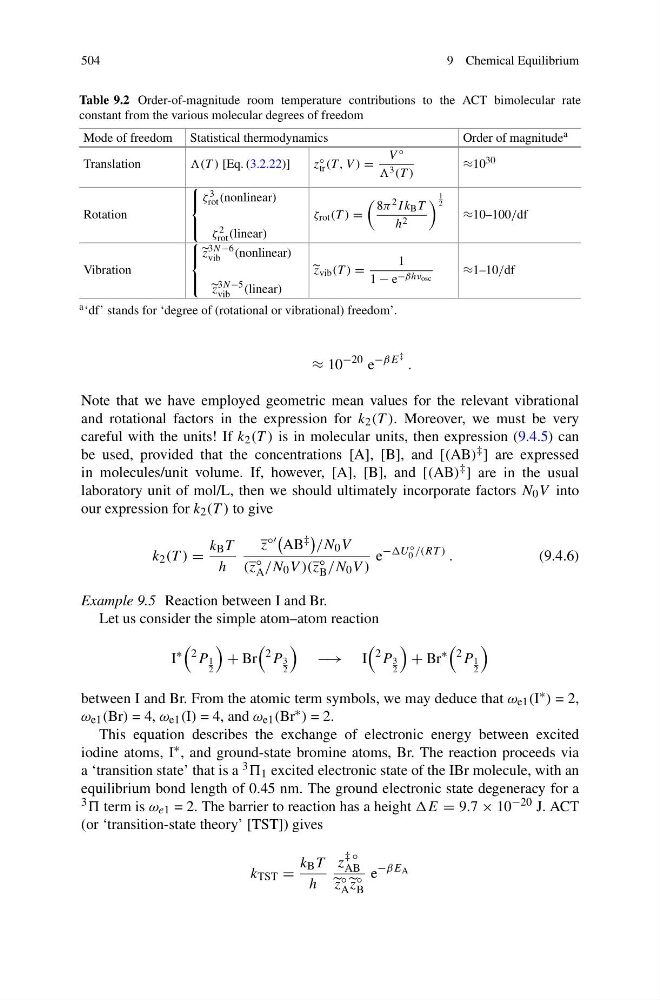
Table 9.2 Order-of-magnitude room temperature contributions to the ACT bimolecular rate
constant from the various molecular degrees of freedom
Mode of freedom Statistical thermodynamics
Order of magnitude a
Translation
(T ) [Eq. (3.2.22)]
z ◦
tr (T , V ) =
V ◦
3 (T )
≈10 30
Rotation
⎧
⎪ ⎨
⎪ ⎩
ζ 3
rot (nonlinear)
ζ 2
rot (linear)
ζ rot (T ) =
8π 2 I k B T
h 2
1
2
≈10–100/df
Vibration
⎧
⎪ ⎨
⎪ ⎩
z
3N −6
vib (nonlinear)
z
3N −5
vib (linear)
z vib (T ) =
1
1 − e −βhνosc
≈1–10/df
a ‘df’ stands for ‘degree of (rotational or vibrational) freedom’.
≈ 10
−20 e
−βE ‡ .
Note that we have employed geometric mean values for the relevant vibrational
and rotational factors in the expression for k 2 (T ). Moreover, we must be very
careful with the units! If k 2 (T ) is in molecular units, then expression (9.4.5) can
be used, provided that the concentrations [A], [B], and [(AB) ‡ ] are expressed
in molecules/unit volume. If, however, [A], [B], and [(AB) ‡ ] are in the usual
laboratory unit of mol/L, then we should ultimately incorporate factors N 0 V into
our expression for k 2 (T ) to give
k 2 (T ) =
k B T
h
z
◦◦
AB
‡
/N 0 V
(z
◦
A /N 0 V )(z
◦
B /N 0 V )
e
−U ◦
0 /(RT ) .
(9.4.6)
Example 9.5 Reaction between I and Br.
Let us consider the simple atom–atom reaction
I
∗
2 P 1
2
+ Br
2 P 3
2
−→ I
2 P 3
2
+ Br
∗
2 P 1
2
between I and Br. From the atomic term symbols, we may deduce that ω e1 (I ∗ ) = 2,
ω e1 (Br) = 4, ω e1 (I) = 4, and ω e1 (Br
∗ ) = 2.
This equation describes the exchange of electronic energy between excited
iodine atoms, I ∗ , and ground-state bromine atoms, Br. The reaction proceeds via
a ‘transition state’ that is a 3 1 excited electronic state of the IBr molecule, with an
equilibrium bond length of 0.45 nm. The ground electronic state degeneracy for a
3 term is ω e1 = 2. The barrier to reaction has a height E = 9.7 × 10 −20 J. ACT
(or ‘transition-state theory’ [TST]) gives
k TST =
k B T
h
z
‡ ◦
AB
z ◦
A z ◦
B
e
−βE A
9 Chemical Equilibrium
Table 9.2 Order-of-magnitude room temperature contributions to the ACT bimolecular rate
constant from the various molecular degrees of freedom
Mode of freedom Statistical thermodynamics
Order of magnitude a
Translation
(T ) [Eq. (3.2.22)]
z ◦
tr (T , V ) =
V ◦
3 (T )
≈10 30
Rotation
⎧
⎪ ⎨
⎪ ⎩
ζ 3
rot (nonlinear)
ζ 2
rot (linear)
ζ rot (T ) =
8π 2 I k B T
h 2
1
2
≈10–100/df
Vibration
⎧
⎪ ⎨
⎪ ⎩
z
3N −6
vib (nonlinear)
z
3N −5
vib (linear)
z vib (T ) =
1
1 − e −βhνosc
≈1–10/df
a ‘df’ stands for ‘degree of (rotational or vibrational) freedom’.
≈ 10
−20 e
−βE ‡ .
Note that we have employed geometric mean values for the relevant vibrational
and rotational factors in the expression for k 2 (T ). Moreover, we must be very
careful with the units! If k 2 (T ) is in molecular units, then expression (9.4.5) can
be used, provided that the concentrations [A], [B], and [(AB) ‡ ] are expressed
in molecules/unit volume. If, however, [A], [B], and [(AB) ‡ ] are in the usual
laboratory unit of mol/L, then we should ultimately incorporate factors N 0 V into
our expression for k 2 (T ) to give
k 2 (T ) =
k B T
h
z
◦◦
AB
‡
/N 0 V
(z
◦
A /N 0 V )(z
◦
B /N 0 V )
e
−U ◦
0 /(RT ) .
(9.4.6)
Example 9.5 Reaction between I and Br.
Let us consider the simple atom–atom reaction
I
∗
2 P 1
2
+ Br
2 P 3
2
−→ I
2 P 3
2
+ Br
∗
2 P 1
2
between I and Br. From the atomic term symbols, we may deduce that ω e1 (I ∗ ) = 2,
ω e1 (Br) = 4, ω e1 (I) = 4, and ω e1 (Br
∗ ) = 2.
This equation describes the exchange of electronic energy between excited
iodine atoms, I ∗ , and ground-state bromine atoms, Br. The reaction proceeds via
a ‘transition state’ that is a 3 1 excited electronic state of the IBr molecule, with an
equilibrium bond length of 0.45 nm. The ground electronic state degeneracy for a
3 term is ω e1 = 2. The barrier to reaction has a height E = 9.7 × 10 −20 J. ACT
(or ‘transition-state theory’ [TST]) gives
k TST =
k B T
h
z
‡ ◦
AB
z ◦
A z ◦
B
e
−βE A