

9.4 Application to Chemical Kinetics
505
=
k B T
h
z IBr
rot z IBr
tr z IBr
el
z I ∗
el z I ∗
tr z Br
el z Br
tr
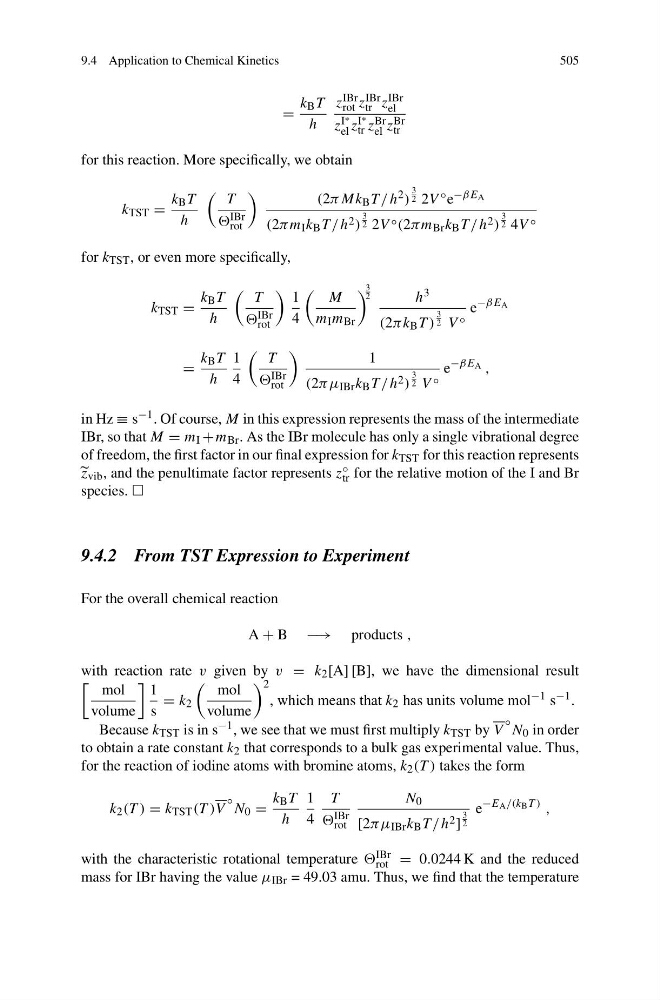
for this reaction. More specifically, we obtain
k TST =
k B T
h
T
IBr
rot
(2πMk B T /h 2 )
3
2 2V ◦ e −βE A
(2πm I k B T /h 2 )
3
2 2V ◦ (2πm Br k B T /h 2 )
3
2 4V ◦
for k TST , or even more specifically,
k TST =
k B T
h
T
IBr
rot
1
4
M
m I m Br
3
2
h 3
(2πk B T )
3
2 V ◦
e
−βE A
=
k B T
h
1
4
T
IBr
rot
1
(2πμ IBr k B T /h 2 )
3
2 V ◦
e
−βE A ,
in Hz ≡ s −1 . Of course, M in this expression represents the mass of the intermediate
IBr, so that M = m I + m Br . As the IBr molecule has only a single vibrational degree
of freedom, the first factor in our final expression for k TST for this reaction represents
z vib , and the penultimate factor represents z ◦
tr for the relative motion of the I and Br
species.
9.4.2 From TST Expression to Experiment
For the overall chemical reaction
A + B −→ products ,
with reaction rate v given by v = k 2 [A] [B], we have the dimensional result
mol
volume
1
s
= k 2
mol
volume
2
, which means that k 2 has units volume mol −1 s −1 .
Because k TST is in s −1 , we see that we must first multiply k TST by V
◦ N 0 in order
to obtain a rate constant k 2 that corresponds to a bulk gas experimental value. Thus,
for the reaction of iodine atoms with bromine atoms, k 2 (T ) takes the form
k 2 (T ) = k TST (T )V
◦ N 0 =
k B T
h
1
4
T
IBr
rot
N 0
[2πμ IBr k B T /h 2 ]
3
2
e
−E A /(k B T ) ,
with the characteristic rotational temperature IBr
rot = 0.0244 K and the reduced
mass for IBr having the value μ IBr = 49.03 amu. Thus, we find that the temperature
505
=
k B T
h
z IBr
rot z IBr
tr z IBr
el
z I ∗
el z I ∗
tr z Br
el z Br
tr
for this reaction. More specifically, we obtain
k TST =
k B T
h
T
IBr
rot
(2πMk B T /h 2 )
3
2 2V ◦ e −βE A
(2πm I k B T /h 2 )
3
2 2V ◦ (2πm Br k B T /h 2 )
3
2 4V ◦
for k TST , or even more specifically,
k TST =
k B T
h
T
IBr
rot
1
4
M
m I m Br
3
2
h 3
(2πk B T )
3
2 V ◦
e
−βE A
=
k B T
h
1
4
T
IBr
rot
1
(2πμ IBr k B T /h 2 )
3
2 V ◦
e
−βE A ,
in Hz ≡ s −1 . Of course, M in this expression represents the mass of the intermediate
IBr, so that M = m I + m Br . As the IBr molecule has only a single vibrational degree
of freedom, the first factor in our final expression for k TST for this reaction represents
z vib , and the penultimate factor represents z ◦
tr for the relative motion of the I and Br
species.
9.4.2 From TST Expression to Experiment
For the overall chemical reaction
A + B −→ products ,
with reaction rate v given by v = k 2 [A] [B], we have the dimensional result
mol
volume
1
s
= k 2
mol
volume
2
, which means that k 2 has units volume mol −1 s −1 .
Because k TST is in s −1 , we see that we must first multiply k TST by V
◦ N 0 in order
to obtain a rate constant k 2 that corresponds to a bulk gas experimental value. Thus,
for the reaction of iodine atoms with bromine atoms, k 2 (T ) takes the form
k 2 (T ) = k TST (T )V
◦ N 0 =
k B T
h
1
4
T
IBr
rot
N 0
[2πμ IBr k B T /h 2 ]
3
2
e
−E A /(k B T ) ,
with the characteristic rotational temperature IBr
rot = 0.0244 K and the reduced
mass for IBr having the value μ IBr = 49.03 amu. Thus, we find that the temperature