

9.4 Application to Chemical Kinetics
503
Notice that no explicit assumptions about the local minimum have been required, as
the reaction coordinate frequency ν rc cancels out from the final expressions, so that
the net result for k 2 (T ) is
k 2 (T ) =
k B T
h
z
◦◦
(AB) ‡
z
◦
tot (A)z
◦
tot (B)
e
−βE ‡ .
(9.4.5)
Let us estimate the values for typical molecules at T = 300 K, bearing in mind
that we are only interested at this time in order-of-magnitude results. For the overall
reaction sequence
A + B (AB)
‡
−→ products ,
we shall consider that each A molecule has N A atoms and that each B molecule has
N B atoms.
If each chemical species involved in the above reaction is a nonlinear molecule,
it will prove convenient for the purpose of obtaining an order-of-magnitude estimate
of the temperature dependence of k 2 (T ) to express the canonical partition functions
for A, B, and (AB) ‡ as
z
◦
tot (A) = z
◦
tr ζ
3
rot z
3N A −6
vib
,
z
◦
tot (B) = z
◦
tr ζ
3
rot z
3N B −6
vib
,
z
◦◦
(AB)
‡
= z
◦
tr ζ
3
rot z
3N A +3N B −7
vib
.
The only significant differences between the translational partition functions for the
three species arise from their different masses appearing in the expression for their
de Broglie wavelengths, as the molar volumes are essentially the same. Of course,
the characteristic vibrational temperatures associated with the various modes of
molecular vibration will differ, but typically by less than an order of magnitude, so
that it makes sense to employ some representative average value for each molecule
in our calculation. Representation of the rotational partition functions is slightly
more complicated, as there will, in principle, be three different moments of inertia
for a nonlinear molecule, as opposed to two equal moments of inertia for a linear
molecule, so that z rot (T ) can be written as the square of two rotational factors ζ rot (T )
for a linear molecule or the product of three (slightly different) rotational factors
ζ rot (T ) for a nonlinear molecule. It will suffice, however, for present purposes of
obtaining an order-of-magnitude estimate of k 2 to treat the ζ rot factors as roughly
independent of the chemical species. Table 9.2 summarizes the relevant information
for our estimate.
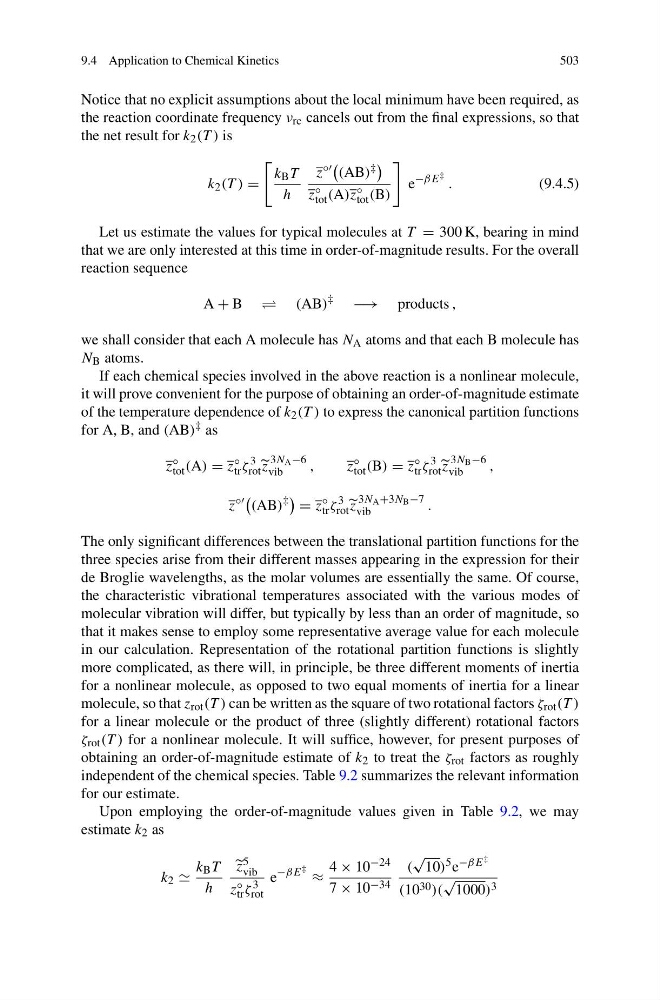
Upon employing the order-of-magnitude values given in Table 9.2, we may
estimate k 2 as
k 2
k B T
h
z 5
vib
z ◦
tr ζ 3
rot
e
−βE ‡ ≈
4 × 10 −24
7 × 10 −34
(
√
10) 5 e −βE ‡
(10 30 )(
√
1000) 3
503
Notice that no explicit assumptions about the local minimum have been required, as
the reaction coordinate frequency ν rc cancels out from the final expressions, so that
the net result for k 2 (T ) is
k 2 (T ) =
k B T
h
z
◦◦
(AB) ‡
z
◦
tot (A)z
◦
tot (B)
e
−βE ‡ .
(9.4.5)
Let us estimate the values for typical molecules at T = 300 K, bearing in mind
that we are only interested at this time in order-of-magnitude results. For the overall
reaction sequence
A + B (AB)
‡
−→ products ,
we shall consider that each A molecule has N A atoms and that each B molecule has
N B atoms.
If each chemical species involved in the above reaction is a nonlinear molecule,
it will prove convenient for the purpose of obtaining an order-of-magnitude estimate
of the temperature dependence of k 2 (T ) to express the canonical partition functions
for A, B, and (AB) ‡ as
z
◦
tot (A) = z
◦
tr ζ
3
rot z
3N A −6
vib
,
z
◦
tot (B) = z
◦
tr ζ
3
rot z
3N B −6
vib
,
z
◦◦
(AB)
‡
= z
◦
tr ζ
3
rot z
3N A +3N B −7
vib
.
The only significant differences between the translational partition functions for the
three species arise from their different masses appearing in the expression for their
de Broglie wavelengths, as the molar volumes are essentially the same. Of course,
the characteristic vibrational temperatures associated with the various modes of
molecular vibration will differ, but typically by less than an order of magnitude, so
that it makes sense to employ some representative average value for each molecule
in our calculation. Representation of the rotational partition functions is slightly
more complicated, as there will, in principle, be three different moments of inertia
for a nonlinear molecule, as opposed to two equal moments of inertia for a linear
molecule, so that z rot (T ) can be written as the square of two rotational factors ζ rot (T )
for a linear molecule or the product of three (slightly different) rotational factors
ζ rot (T ) for a nonlinear molecule. It will suffice, however, for present purposes of
obtaining an order-of-magnitude estimate of k 2 to treat the ζ rot factors as roughly
independent of the chemical species. Table 9.2 summarizes the relevant information
for our estimate.
Upon employing the order-of-magnitude values given in Table 9.2, we may
estimate k 2 as
k 2
k B T
h
z 5
vib
z ◦
tr ζ 3
rot
e
−βE ‡ ≈
4 × 10 −24
7 × 10 −34
(
√
10) 5 e −βE ‡
(10 30 )(
√
1000) 3