

502
9 Chemical Equilibrium
Because of these two principles, the canonical partition function Z(α), defined as
Z(α) ≡
i
ω i e
−βE i (α) ,
represents a ‘weighted counting’ of the number of states of the system. We can
express Z tot (α) in the form that we have earlier been considering, i.e., as
Z tot (α) = Z tr (α)Z rot (α)Z vib (α)Z el (α) .
9.4.1 The ACT Model
In this model, the ‘activated complex’ (AB) ‡ is considered to lie in a small
potential hollow in the reaction coordinate, so that progress along the reaction path
is equivalent to vibrational motion (stretching) along this degree of freedom: the
motion is assigned a ‘mode frequency’ ν rc , in which the subscript ‘rc’ stands for
‘reaction coordinate’. We shall utilize the notation z
◦ that we have developed here
rather than that traditionally employed in the (older) chemical kinetics literature.
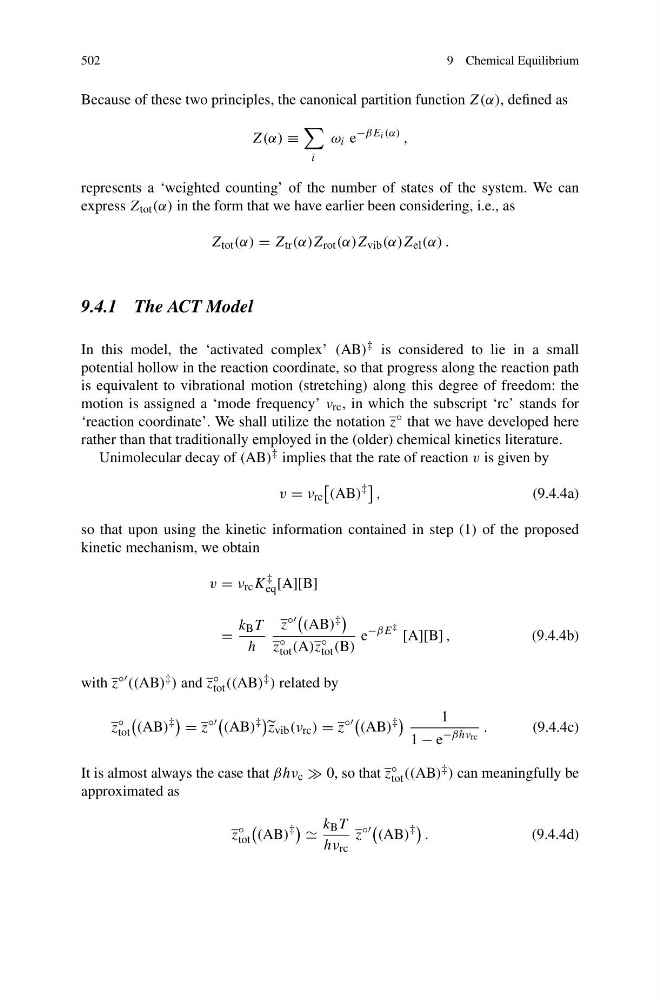
Unimolecular decay of (AB) ‡ implies that the rate of reaction v is given by
v = ν rc
(AB)
‡
,
(9.4.4a)
so that upon using the kinetic information contained in step (1) of the proposed
kinetic mechanism, we obtain
v = ν rc K
‡
eq [A][B]
=
k B T
h
z
◦◦
(AB) ‡
z
◦
tot (A)z
◦
tot (B)
e
−βE ‡ [A][B] ,
(9.4.4b)
with z
◦◦ ((AB) ‡ ) and z
◦
tot ((AB) ‡ ) related by
z
◦
tot
(AB)
‡
= z
◦◦
(AB)
‡
z vib (ν rc ) = z
◦◦
(AB)
‡
1
1 − e
−βhν rc
.
(9.4.4c)
It is almost always the case that βhν c 0, so that z
◦
tot ((AB) ‡ ) can meaningfully be
approximated as
z
◦
tot
(AB)
‡
k B T
hν rc
z
◦◦
(AB)
‡
.
(9.4.4d)
9 Chemical Equilibrium
Because of these two principles, the canonical partition function Z(α), defined as
Z(α) ≡
i
ω i e
−βE i (α) ,
represents a ‘weighted counting’ of the number of states of the system. We can
express Z tot (α) in the form that we have earlier been considering, i.e., as
Z tot (α) = Z tr (α)Z rot (α)Z vib (α)Z el (α) .
9.4.1 The ACT Model
In this model, the ‘activated complex’ (AB) ‡ is considered to lie in a small
potential hollow in the reaction coordinate, so that progress along the reaction path
is equivalent to vibrational motion (stretching) along this degree of freedom: the
motion is assigned a ‘mode frequency’ ν rc , in which the subscript ‘rc’ stands for
‘reaction coordinate’. We shall utilize the notation z
◦ that we have developed here
rather than that traditionally employed in the (older) chemical kinetics literature.
Unimolecular decay of (AB) ‡ implies that the rate of reaction v is given by
v = ν rc
(AB)
‡
,
(9.4.4a)
so that upon using the kinetic information contained in step (1) of the proposed
kinetic mechanism, we obtain
v = ν rc K
‡
eq [A][B]
=
k B T
h
z
◦◦
(AB) ‡
z
◦
tot (A)z
◦
tot (B)
e
−βE ‡ [A][B] ,
(9.4.4b)
with z
◦◦ ((AB) ‡ ) and z
◦
tot ((AB) ‡ ) related by
z
◦
tot
(AB)
‡
= z
◦◦
(AB)
‡
z vib (ν rc ) = z
◦◦
(AB)
‡
1
1 − e
−βhν rc
.
(9.4.4c)
It is almost always the case that βhν c 0, so that z
◦
tot ((AB) ‡ ) can meaningfully be
approximated as
z
◦
tot
(AB)
‡
k B T
hν rc
z
◦◦
(AB)
‡
.
(9.4.4d)