

38
2 Macroscopic Thermodynamics
Moreover, as the heat transfer process only approaches reversibility for temperature
differences that exceed T by infinitesimal amounts, thereby requiring exceedingly
long times to effect the transfer of a finite amount of heat energy Q, reversible heat
flow processes are necessarily quasistatic.
We may therefore conclude that essentially all isothermal changes are irreversible
due to the irreversible nature of the system-surroundings interaction (i.e., thermal
contact) that typically enables the transfer of heat between a system and its surroundings. Our expression for S, when coupled with the Second Law requirement
that S ≥ 0, also clearly establishes that heat flows spontaneously from higher to
lower temperatures, and may only be transferred reversibly should the temperature
of the surroundings precisely match that of the thermodynamic system. 4
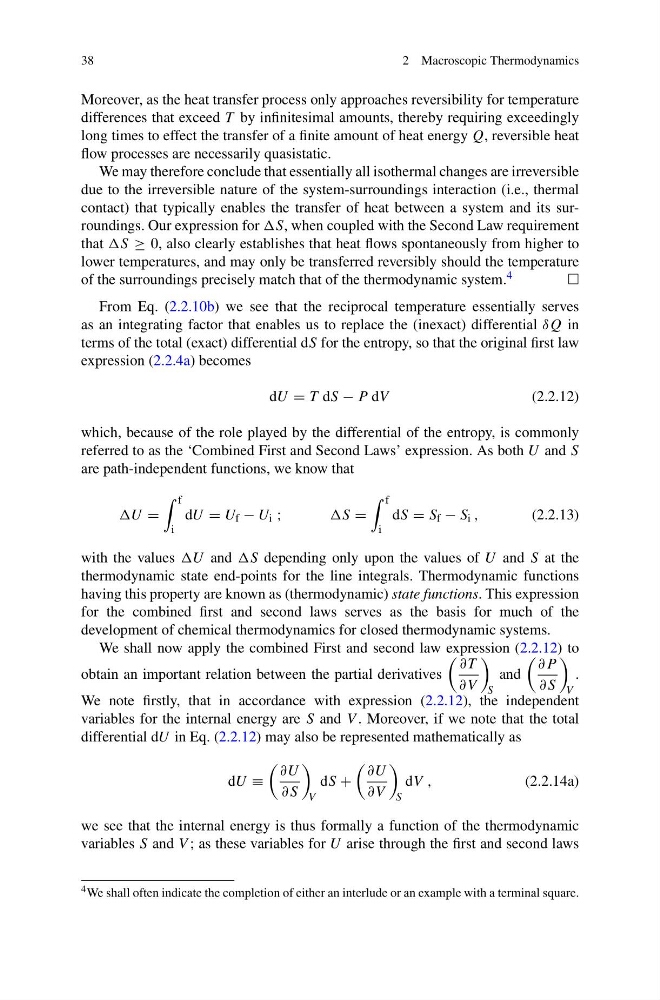
From Eq. (2.2.10b) we see that the reciprocal temperature essentially serves
as an integrating factor that enables us to replace the (inexact) differential δQ in
terms of the total (exact) differential dS for the entropy, so that the original first law
expression (2.2.4a) becomes
dU = T dS − P dV
(2.2.12)
which, because of the role played by the differential of the entropy, is commonly
referred to as the ‘Combined First and Second Laws’ expression. As both U and S
are path-independent functions, we know that
U =
f
i
dU = U f − U i ;
S =
f
i
dS = S f − S i ,
(2.2.13)
with the values U and S depending only upon the values of U and S at the
thermodynamic state end-points for the line integrals. Thermodynamic functions
having this property are known as (thermodynamic) state functions. This expression
for the combined first and second laws serves as the basis for much of the
development of chemical thermodynamics for closed thermodynamic systems.
We shall now apply the combined First and second law expression (2.2.12) to
obtain an important relation between the partial derivatives
∂T
∂V
S
and
∂P
∂S
V
.
We note firstly, that in accordance with expression (2.2.12), the independent
variables for the internal energy are S and V . Moreover, if we note that the total
differential dU in Eq. (2.2.12) may also be represented mathematically as
dU ≡
∂U
∂S
V
dS +
∂U
∂V
S
dV ,
(2.2.14a)
we see that the internal energy is thus formally a function of the thermodynamic
variables S and V ; as these variables for U arise through the first and second laws
4 We shall often indicate the completion of either an interlude or an example with a terminal square.
2 Macroscopic Thermodynamics
Moreover, as the heat transfer process only approaches reversibility for temperature
differences that exceed T by infinitesimal amounts, thereby requiring exceedingly
long times to effect the transfer of a finite amount of heat energy Q, reversible heat
flow processes are necessarily quasistatic.
We may therefore conclude that essentially all isothermal changes are irreversible
due to the irreversible nature of the system-surroundings interaction (i.e., thermal
contact) that typically enables the transfer of heat between a system and its surroundings. Our expression for S, when coupled with the Second Law requirement
that S ≥ 0, also clearly establishes that heat flows spontaneously from higher to
lower temperatures, and may only be transferred reversibly should the temperature
of the surroundings precisely match that of the thermodynamic system. 4
From Eq. (2.2.10b) we see that the reciprocal temperature essentially serves
as an integrating factor that enables us to replace the (inexact) differential δQ in
terms of the total (exact) differential dS for the entropy, so that the original first law
expression (2.2.4a) becomes
dU = T dS − P dV
(2.2.12)
which, because of the role played by the differential of the entropy, is commonly
referred to as the ‘Combined First and Second Laws’ expression. As both U and S
are path-independent functions, we know that
U =
f
i
dU = U f − U i ;
S =
f
i
dS = S f − S i ,
(2.2.13)
with the values U and S depending only upon the values of U and S at the
thermodynamic state end-points for the line integrals. Thermodynamic functions
having this property are known as (thermodynamic) state functions. This expression
for the combined first and second laws serves as the basis for much of the
development of chemical thermodynamics for closed thermodynamic systems.
We shall now apply the combined First and second law expression (2.2.12) to
obtain an important relation between the partial derivatives
∂T
∂V
S
and
∂P
∂S
V
.
We note firstly, that in accordance with expression (2.2.12), the independent
variables for the internal energy are S and V . Moreover, if we note that the total
differential dU in Eq. (2.2.12) may also be represented mathematically as
dU ≡
∂U
∂S
V
dS +
∂U
∂V
S
dV ,
(2.2.14a)
we see that the internal energy is thus formally a function of the thermodynamic
variables S and V ; as these variables for U arise through the first and second laws
4 We shall often indicate the completion of either an interlude or an example with a terminal square.