

2.2 An Introduction to Thermodynamics
39
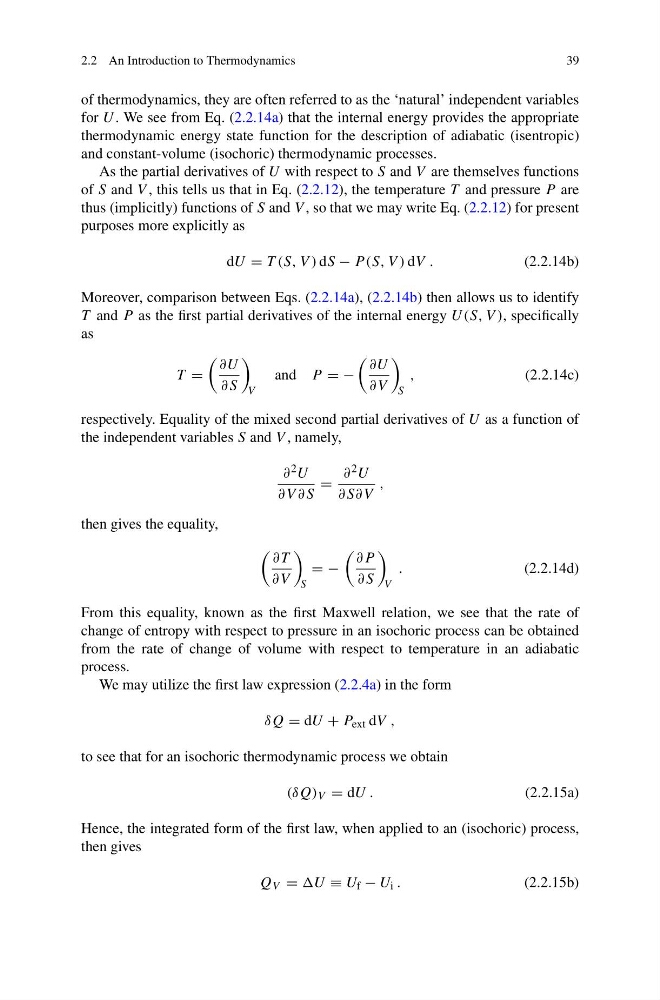
of thermodynamics, they are often referred to as the ‘natural’ independent variables
for U . We see from Eq. (2.2.14a) that the internal energy provides the appropriate
thermodynamic energy state function for the description of adiabatic (isentropic)
and constant-volume (isochoric) thermodynamic processes.
As the partial derivatives of U with respect to S and V are themselves functions
of S and V , this tells us that in Eq. (2.2.12), the temperature T and pressure P are
thus (implicitly) functions of S and V , so that we may write Eq. (2.2.12) for present
purposes more explicitly as
dU = T (S, V ) dS − P (S, V ) dV .
(2.2.14b)
Moreover, comparison between Eqs. (2.2.14a), (2.2.14b) then allows us to identify
T and P as the first partial derivatives of the internal energy U(S, V ), specifically
as
T =
∂U
∂S
V
and P = −
∂U
∂V
S
,
(2.2.14c)
respectively. Equality of the mixed second partial derivatives of U as a function of
the independent variables S and V , namely,
∂ 2 U
∂V ∂S
=
∂ 2 U
∂S∂V
,
then gives the equality,
∂T
∂V
S
= −
∂P
∂S
V
.
(2.2.14d)
From this equality, known as the first Maxwell relation, we see that the rate of
change of entropy with respect to pressure in an isochoric process can be obtained
from the rate of change of volume with respect to temperature in an adiabatic
process.
We may utilize the first law expression (2.2.4a) in the form
δQ = dU + P ext dV ,
to see that for an isochoric thermodynamic process we obtain
(δQ) V = dU .
(2.2.15a)
Hence, the integrated form of the first law, when applied to an (isochoric) process,
then gives
Q V = U ≡ U f − U i .
(2.2.15b)
39
of thermodynamics, they are often referred to as the ‘natural’ independent variables
for U . We see from Eq. (2.2.14a) that the internal energy provides the appropriate
thermodynamic energy state function for the description of adiabatic (isentropic)
and constant-volume (isochoric) thermodynamic processes.
As the partial derivatives of U with respect to S and V are themselves functions
of S and V , this tells us that in Eq. (2.2.12), the temperature T and pressure P are
thus (implicitly) functions of S and V , so that we may write Eq. (2.2.12) for present
purposes more explicitly as
dU = T (S, V ) dS − P (S, V ) dV .
(2.2.14b)
Moreover, comparison between Eqs. (2.2.14a), (2.2.14b) then allows us to identify
T and P as the first partial derivatives of the internal energy U(S, V ), specifically
as
T =
∂U
∂S
V
and P = −
∂U
∂V
S
,
(2.2.14c)
respectively. Equality of the mixed second partial derivatives of U as a function of
the independent variables S and V , namely,
∂ 2 U
∂V ∂S
=
∂ 2 U
∂S∂V
,
then gives the equality,
∂T
∂V
S
= −
∂P
∂S
V
.
(2.2.14d)
From this equality, known as the first Maxwell relation, we see that the rate of
change of entropy with respect to pressure in an isochoric process can be obtained
from the rate of change of volume with respect to temperature in an adiabatic
process.
We may utilize the first law expression (2.2.4a) in the form
δQ = dU + P ext dV ,
to see that for an isochoric thermodynamic process we obtain
(δQ) V = dU .
(2.2.15a)
Hence, the integrated form of the first law, when applied to an (isochoric) process,
then gives
Q V = U ≡ U f − U i .
(2.2.15b)