

2.2 An Introduction to Thermodynamics
37
is sometimes more colourfully expressed as the ‘principle of no free lunch’. The
thermodynamic state function entropy, S, is the major player in this law, and is
often expressed in the form of an inequality as
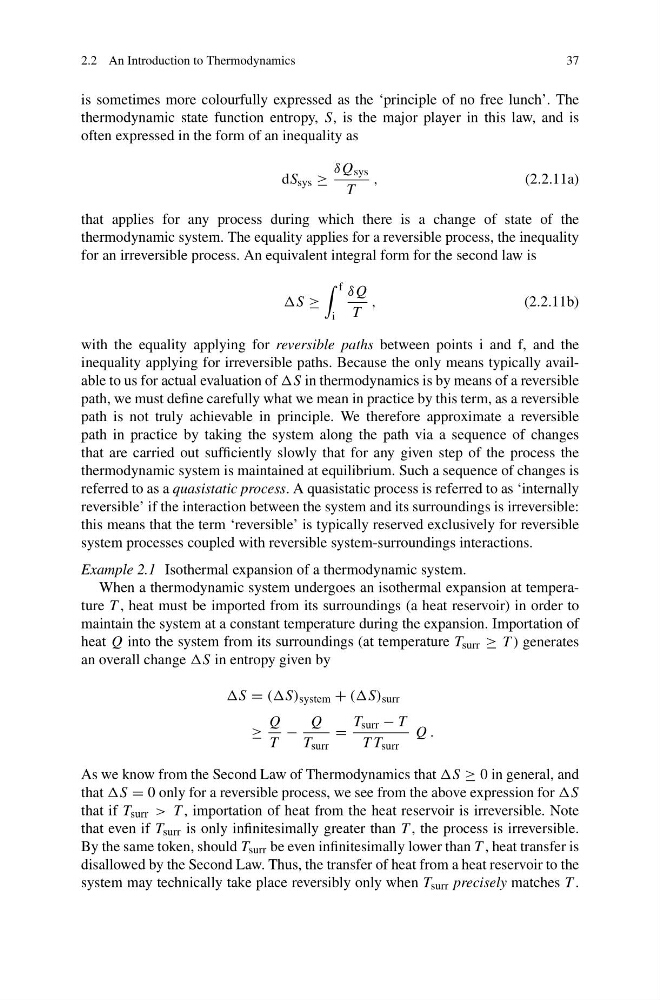
dS sys ≥
δQ sys
T
,
(2.2.11a)
that applies for any process during which there is a change of state of the
thermodynamic system. The equality applies for a reversible process, the inequality
for an irreversible process. An equivalent integral form for the second law is
S ≥
f
i
δQ
T
,
(2.2.11b)
with the equality applying for reversible paths between points i and f, and the
inequality applying for irreversible paths. Because the only means typically available to us for actual evaluation of S in thermodynamics is by means of a reversible
path, we must define carefully what we mean in practice by this term, as a reversible
path is not truly achievable in principle. We therefore approximate a reversible
path in practice by taking the system along the path via a sequence of changes
that are carried out sufficiently slowly that for any given step of the process the
thermodynamic system is maintained at equilibrium. Such a sequence of changes is
referred to as a quasistatic process. A quasistatic process is referred to as ‘internally
reversible’ if the interaction between the system and its surroundings is irreversible:
this means that the term ‘reversible’ is typically reserved exclusively for reversible
system processes coupled with reversible system-surroundings interactions.
Example 2.1 Isothermal expansion of a thermodynamic system.
When a thermodynamic system undergoes an isothermal expansion at temperature T , heat must be imported from its surroundings (a heat reservoir) in order to
maintain the system at a constant temperature during the expansion. Importation of
heat Q into the system from its surroundings (at temperature T surr ≥ T ) generates
an overall change S in entropy given by
S = ((S) system + ((S) surr
≥
Q
T
−
Q
T surr
=
T surr − T
T T surr
Q .
As we know from the Second Law of Thermodynamics that S ≥ 0 in general, and
that S = 0 only for a reversible process, we see from the above expression for S
that if T surr > T , importation of heat from the heat reservoir is irreversible. Note
that even if T surr is only infinitesimally greater than T , the process is irreversible.
By the same token, should T surr be even infinitesimally lower than T , heat transfer is
disallowed by the Second Law. Thus, the transfer of heat from a heat reservoir to the
system may technically take place reversibly only when T surr precisely matches T .
37
is sometimes more colourfully expressed as the ‘principle of no free lunch’. The
thermodynamic state function entropy, S, is the major player in this law, and is
often expressed in the form of an inequality as
dS sys ≥
δQ sys
T
,
(2.2.11a)
that applies for any process during which there is a change of state of the
thermodynamic system. The equality applies for a reversible process, the inequality
for an irreversible process. An equivalent integral form for the second law is
S ≥
f
i
δQ
T
,
(2.2.11b)
with the equality applying for reversible paths between points i and f, and the
inequality applying for irreversible paths. Because the only means typically available to us for actual evaluation of S in thermodynamics is by means of a reversible
path, we must define carefully what we mean in practice by this term, as a reversible
path is not truly achievable in principle. We therefore approximate a reversible
path in practice by taking the system along the path via a sequence of changes
that are carried out sufficiently slowly that for any given step of the process the
thermodynamic system is maintained at equilibrium. Such a sequence of changes is
referred to as a quasistatic process. A quasistatic process is referred to as ‘internally
reversible’ if the interaction between the system and its surroundings is irreversible:
this means that the term ‘reversible’ is typically reserved exclusively for reversible
system processes coupled with reversible system-surroundings interactions.
Example 2.1 Isothermal expansion of a thermodynamic system.
When a thermodynamic system undergoes an isothermal expansion at temperature T , heat must be imported from its surroundings (a heat reservoir) in order to
maintain the system at a constant temperature during the expansion. Importation of
heat Q into the system from its surroundings (at temperature T surr ≥ T ) generates
an overall change S in entropy given by
S = ((S) system + ((S) surr
≥
Q
T
−
Q
T surr
=
T surr − T
T T surr
Q .
As we know from the Second Law of Thermodynamics that S ≥ 0 in general, and
that S = 0 only for a reversible process, we see from the above expression for S
that if T surr > T , importation of heat from the heat reservoir is irreversible. Note
that even if T surr is only infinitesimally greater than T , the process is irreversible.
By the same token, should T surr be even infinitesimally lower than T , heat transfer is
disallowed by the Second Law. Thus, the transfer of heat from a heat reservoir to the
system may technically take place reversibly only when T surr precisely matches T .