

9.3 Four Extended Examples
493
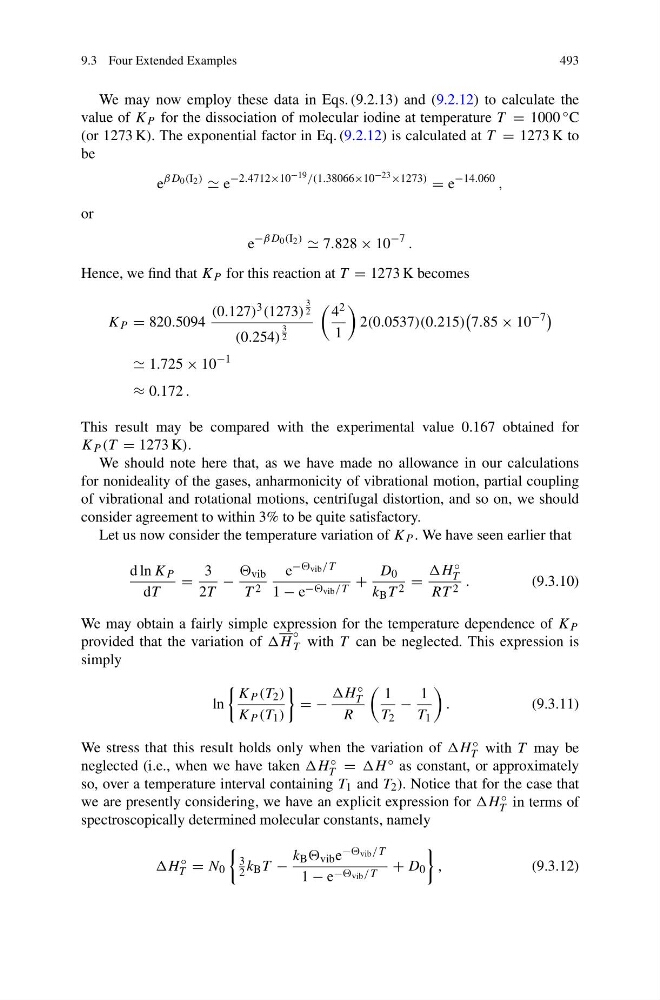
We may now employ these data in Eqs. (9.2.13) and (9.2.12) to calculate the
value of K P for the dissociation of molecular iodine at temperature T = 1000 ◦ C
(or 1273 K). The exponential factor in Eq. (9.2.12) is calculated at T = 1273 K to
be
e
βD 0 (I 2 )
e
−2.4712×10 −19 /(1.38066×10 −23 ×1273)
= e
−14.060 ,
or
e
−βD 0 (I 2 )
7.828 × 10
−7 .
Hence, we find that K P for this reaction at T = 1273 K becomes
K P = 820.5094
(0.127) 3 (1273)
3
2
(0.254)
3
2
4 2
1
2(0.0537)(0.215)
7.85 × 10
−7
1.725 × 10
−1
≈ 0.172 .
This result may be compared with the experimental value 0.167 obtained for
K P (T = 1273 K).
We should note here that, as we have made no allowance in our calculations
for nonideality of the gases, anharmonicity of vibrational motion, partial coupling
of vibrational and rotational motions, centrifugal distortion, and so on, we should
consider agreement to within 3% to be quite satisfactory.
Let us now consider the temperature variation of K P . We have seen earlier that
d ln K P
dT
=
3
2T
−
vib
T 2
e − vib /T
1 − e − vib /T +
D 0
k B T 2 =
H ◦
T
RT 2 .
(9.3.10)
We may obtain a fairly simple expression for the temperature dependence of K P
provided that the variation of H
◦
T with T can be neglected. This expression is
simply
ln
K P (T 2 )
K P (T 1 )
= −
H ◦
T
R
1
T 2
−
1
T 1
.
(9.3.11)
We stress that this result holds only when the variation of H ◦
T with T may be
neglected (i.e., when we have taken H ◦
T = H ◦ as constant, or approximately
so, over a temperature interval containing T 1 and T 2 ). Notice that for the case that
we are presently considering, we have an explicit expression for H ◦
T in terms of
spectroscopically determined molecular constants, namely
H
◦
T = N 0
3
2 k B T −
k B vib e − vib /T
1 − e − vib /T + D 0
,
(9.3.12)
493
We may now employ these data in Eqs. (9.2.13) and (9.2.12) to calculate the
value of K P for the dissociation of molecular iodine at temperature T = 1000 ◦ C
(or 1273 K). The exponential factor in Eq. (9.2.12) is calculated at T = 1273 K to
be
e
βD 0 (I 2 )
e
−2.4712×10 −19 /(1.38066×10 −23 ×1273)
= e
−14.060 ,
or
e
−βD 0 (I 2 )
7.828 × 10
−7 .
Hence, we find that K P for this reaction at T = 1273 K becomes
K P = 820.5094
(0.127) 3 (1273)
3
2
(0.254)
3
2
4 2
1
2(0.0537)(0.215)
7.85 × 10
−7
1.725 × 10
−1
≈ 0.172 .
This result may be compared with the experimental value 0.167 obtained for
K P (T = 1273 K).
We should note here that, as we have made no allowance in our calculations
for nonideality of the gases, anharmonicity of vibrational motion, partial coupling
of vibrational and rotational motions, centrifugal distortion, and so on, we should
consider agreement to within 3% to be quite satisfactory.
Let us now consider the temperature variation of K P . We have seen earlier that
d ln K P
dT
=
3
2T
−
vib
T 2
e − vib /T
1 − e − vib /T +
D 0
k B T 2 =
H ◦
T
RT 2 .
(9.3.10)
We may obtain a fairly simple expression for the temperature dependence of K P
provided that the variation of H
◦
T with T can be neglected. This expression is
simply
ln
K P (T 2 )
K P (T 1 )
= −
H ◦
T
R
1
T 2
−
1
T 1
.
(9.3.11)
We stress that this result holds only when the variation of H ◦
T with T may be
neglected (i.e., when we have taken H ◦
T = H ◦ as constant, or approximately
so, over a temperature interval containing T 1 and T 2 ). Notice that for the case that
we are presently considering, we have an explicit expression for H ◦
T in terms of
spectroscopically determined molecular constants, namely
H
◦
T = N 0
3
2 k B T −
k B vib e − vib /T
1 − e − vib /T + D 0
,
(9.3.12)