

494
9 Chemical Equilibrium
and that over the temperature range 800–1300 K, H ◦
T varies by no more than 1%,
so that taking it to be constant does not introduce a large error into our calculation
of K P .
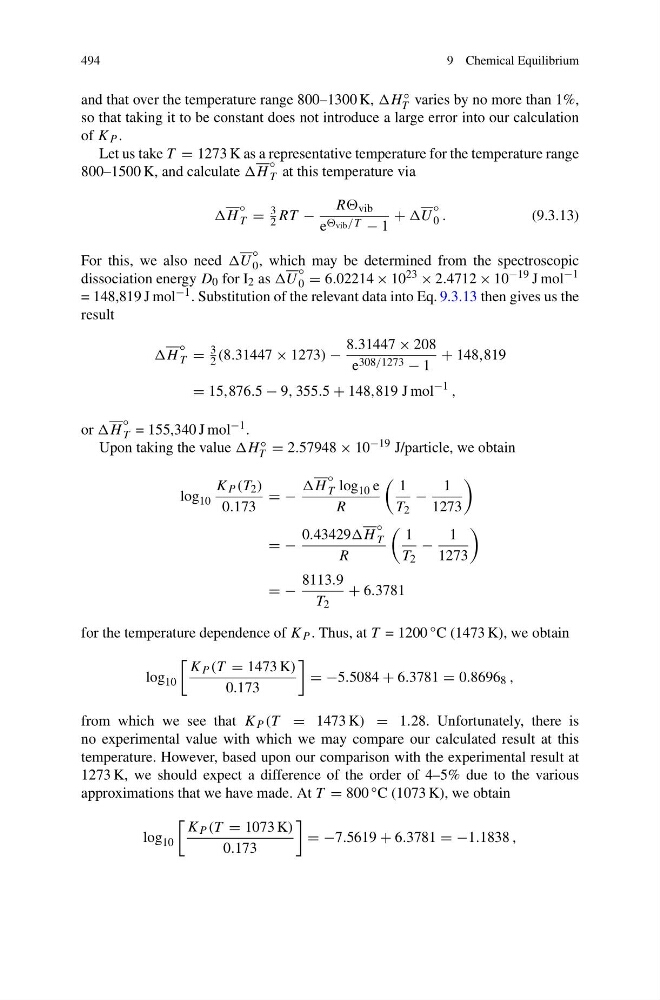
Let us take T = 1273 K as a representative temperature for the temperature range
800–1500 K, and calculate H
◦
T at this temperature via
H
◦
T =
3
2 RT −
RR vib
e vib /T − 1
+ U
◦
0 .
(9.3.13)
For this, we also need U
◦
0 , which may be determined from the spectroscopic
dissociation energy D 0 for I 2 as U
◦
0 = 6.02214 × 10 23 × 2.4712 × 10 −19 J mol
−1
= 148,819 J mol −1 . Substitution of the relevant data into Eq. 9.3.13 then gives us the
result
H
◦
T =
3
2 (8.31447 × 1273) −
8.31447 × 208
e 308/1273 − 1
+ 148,819
= 15,876.5 − 9, 355.5 + 148,819 J mol
−1 ,
or H
◦
T = 155,340 J mol −1 .
Upon taking the value H ◦
T = 2.57948 × 10 −19 J/particle, we obtain
log 10
K P (T 2 )
0.173
= −
H
◦
T log 10 e
R
1
T 2
−
1
1273
= −
0.43429H
◦
T
R
1
T 2
−
1
1273
= −
8113.9
T 2
+ 6.3781
for the temperature dependence of K P . Thus, at T = 1200 ◦ C (1473 K), we obtain
log 10
K P (T = 1473 K)
0.173
= −5.5084 + 6.3781 = 0.8696 8 ,
from which we see that K P (T = 1473 K) = 1.28. Unfortunately, there is
no experimental value with which we may compare our calculated result at this
temperature. However, based upon our comparison with the experimental result at
1273 K, we should expect a difference of the order of 4–5% due to the various
approximations that we have made. At T = 800 ◦ C (1073 K), we obtain
log 10
K P (T = 1073 K)
0.173
= −7.5619 + 6.3781 = −1.1838 ,
9 Chemical Equilibrium
and that over the temperature range 800–1300 K, H ◦
T varies by no more than 1%,
so that taking it to be constant does not introduce a large error into our calculation
of K P .
Let us take T = 1273 K as a representative temperature for the temperature range
800–1500 K, and calculate H
◦
T at this temperature via
H
◦
T =
3
2 RT −
RR vib
e vib /T − 1
+ U
◦
0 .
(9.3.13)
For this, we also need U
◦
0 , which may be determined from the spectroscopic
dissociation energy D 0 for I 2 as U
◦
0 = 6.02214 × 10 23 × 2.4712 × 10 −19 J mol
−1
= 148,819 J mol −1 . Substitution of the relevant data into Eq. 9.3.13 then gives us the
result
H
◦
T =
3
2 (8.31447 × 1273) −
8.31447 × 208
e 308/1273 − 1
+ 148,819
= 15,876.5 − 9, 355.5 + 148,819 J mol
−1 ,
or H
◦
T = 155,340 J mol −1 .
Upon taking the value H ◦
T = 2.57948 × 10 −19 J/particle, we obtain
log 10
K P (T 2 )
0.173
= −
H
◦
T log 10 e
R
1
T 2
−
1
1273
= −
0.43429H
◦
T
R
1
T 2
−
1
1273
= −
8113.9
T 2
+ 6.3781
for the temperature dependence of K P . Thus, at T = 1200 ◦ C (1473 K), we obtain
log 10
K P (T = 1473 K)
0.173
= −5.5084 + 6.3781 = 0.8696 8 ,
from which we see that K P (T = 1473 K) = 1.28. Unfortunately, there is
no experimental value with which we may compare our calculated result at this
temperature. However, based upon our comparison with the experimental result at
1273 K, we should expect a difference of the order of 4–5% due to the various
approximations that we have made. At T = 800 ◦ C (1073 K), we obtain
log 10
K P (T = 1073 K)
0.173
= −7.5619 + 6.3781 = −1.1838 ,