

492
9 Chemical Equilibrium
H
◦
T = U
◦
T + RT
=
3
2 RT −
RR vib
e vib /T − 1
+ U
◦
0 .
(9.3.7)
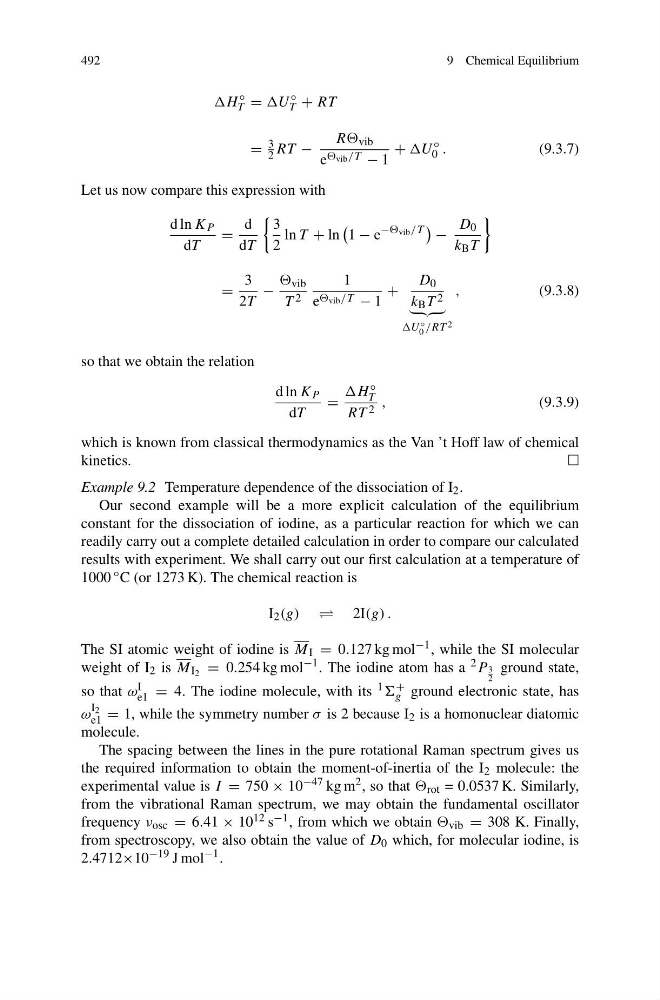
Let us now compare this expression with
d ln K P
dT
=
d
dT
3
2
ln T + ln
1 − e
− vib /T
−
D 0
k B T
=
3
2T
−
vib
T 2
1
e vib /T − 1
+
D 0
k B T 2
U ◦
0 /RT 2
,
(9.3.8)
so that we obtain the relation
d ln K P
dT
=
H ◦
T
RT 2 ,
(9.3.9)
which is known from classical thermodynamics as the Van ’t Hoff law of chemical
kinetics.
Example 9.2 Temperature dependence of the dissociation of I 2 .
Our second example will be a more explicit calculation of the equilibrium
constant for the dissociation of iodine, as a particular reaction for which we can
readily carry out a complete detailed calculation in order to compare our calculated
results with experiment. We shall carry out our first calculation at a temperature of
1000 ◦ C (or 1273 K). The chemical reaction is
I 2 (g) 2I(g) .
The SI atomic weight of iodine is M I = 0.127 kg mol
−1 , while the SI molecular
weight of I 2 is M I 2 = 0.254 kg mol
−1 . The iodine atom has a 2 P 3
2
ground state,
so that ω I
e1 = 4. The iodine molecule, with its 1 +
g ground electronic state, has
ω
I 2
e1 = 1, while the symmetry number σ is 2 because I 2 is a homonuclear diatomic
molecule.
The spacing between the lines in the pure rotational Raman spectrum gives us
the required information to obtain the moment-of-inertia of the I 2 molecule: the
experimental value is I = 750 × 10 −47 kg m 2 , so that rot = 0.0537 K. Similarly,
from the vibrational Raman spectrum, we may obtain the fundamental oscillator
frequency ν osc = 6.41 × 10 12 s −1 , from which we obtain vib = 308 K. Finally,
from spectroscopy, we also obtain the value of D 0 which, for molecular iodine, is
2.4712×10 −19 J mol
−1 .
9 Chemical Equilibrium
H
◦
T = U
◦
T + RT
=
3
2 RT −
RR vib
e vib /T − 1
+ U
◦
0 .
(9.3.7)
Let us now compare this expression with
d ln K P
dT
=
d
dT
3
2
ln T + ln
1 − e
− vib /T
−
D 0
k B T
=
3
2T
−
vib
T 2
1
e vib /T − 1
+
D 0
k B T 2
U ◦
0 /RT 2
,
(9.3.8)
so that we obtain the relation
d ln K P
dT
=
H ◦
T
RT 2 ,
(9.3.9)
which is known from classical thermodynamics as the Van ’t Hoff law of chemical
kinetics.
Example 9.2 Temperature dependence of the dissociation of I 2 .
Our second example will be a more explicit calculation of the equilibrium
constant for the dissociation of iodine, as a particular reaction for which we can
readily carry out a complete detailed calculation in order to compare our calculated
results with experiment. We shall carry out our first calculation at a temperature of
1000 ◦ C (or 1273 K). The chemical reaction is
I 2 (g) 2I(g) .
The SI atomic weight of iodine is M I = 0.127 kg mol
−1 , while the SI molecular
weight of I 2 is M I 2 = 0.254 kg mol
−1 . The iodine atom has a 2 P 3
2
ground state,
so that ω I
e1 = 4. The iodine molecule, with its 1 +
g ground electronic state, has
ω
I 2
e1 = 1, while the symmetry number σ is 2 because I 2 is a homonuclear diatomic
molecule.
The spacing between the lines in the pure rotational Raman spectrum gives us
the required information to obtain the moment-of-inertia of the I 2 molecule: the
experimental value is I = 750 × 10 −47 kg m 2 , so that rot = 0.0537 K. Similarly,
from the vibrational Raman spectrum, we may obtain the fundamental oscillator
frequency ν osc = 6.41 × 10 12 s −1 , from which we obtain vib = 308 K. Finally,
from spectroscopy, we also obtain the value of D 0 which, for molecular iodine, is
2.4712×10 −19 J mol
−1 .