

9.3 Four Extended Examples
491
Δ
Δ
°
Δ
Δ
°
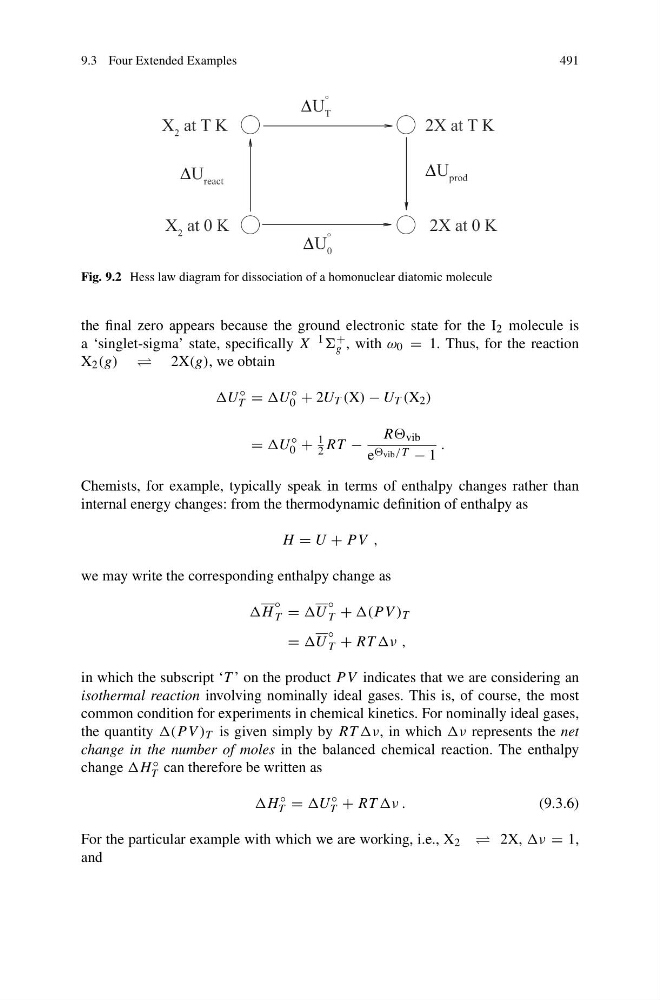
Fig. 9.2 Hess law diagram for dissociation of a homonuclear diatomic molecule
the final zero appears because the ground electronic state for the I 2 molecule is
a ‘singlet-sigma’ state, specifically X 1 +
g , with ω 0 = 1. Thus, for the reaction
X 2 (g) 2X(g), we obtain
U
◦
T = U
◦
0 + 2U T (X) − U T (X 2 )
= U
◦
0 +
1
2 RT −
RR vib
e vib /T − 1
.
Chemists, for example, typically speak in terms of enthalpy changes rather than
internal energy changes: from the thermodynamic definition of enthalpy as
H = U + P V ,
we may write the corresponding enthalpy change as
H
◦
T = U
◦
T + V ) T
= U
◦
T + RT Tν ,
in which the subscript ‘T ’ on the product P V indicates that we are considering an
isothermal reaction involving nominally ideal gases. This is, of course, the most
common condition for experiments in chemical kinetics. For nominally ideal gases,
the quantity V ) T is given simply by RT Tν, in which ν represents the net
change in the number of moles in the balanced chemical reaction. The enthalpy
change H ◦
T can therefore be written as
H
◦
T = U
◦
T + RT Tν .
(9.3.6)
For the particular example with which we are working, i.e., X 2 2X, ν = 1,
and
491
Δ
Δ
°
Δ
Δ
°
Fig. 9.2 Hess law diagram for dissociation of a homonuclear diatomic molecule
the final zero appears because the ground electronic state for the I 2 molecule is
a ‘singlet-sigma’ state, specifically X 1 +
g , with ω 0 = 1. Thus, for the reaction
X 2 (g) 2X(g), we obtain
U
◦
T = U
◦
0 + 2U T (X) − U T (X 2 )
= U
◦
0 +
1
2 RT −
RR vib
e vib /T − 1
.
Chemists, for example, typically speak in terms of enthalpy changes rather than
internal energy changes: from the thermodynamic definition of enthalpy as
H = U + P V ,
we may write the corresponding enthalpy change as
H
◦
T = U
◦
T + V ) T
= U
◦
T + RT Tν ,
in which the subscript ‘T ’ on the product P V indicates that we are considering an
isothermal reaction involving nominally ideal gases. This is, of course, the most
common condition for experiments in chemical kinetics. For nominally ideal gases,
the quantity V ) T is given simply by RT Tν, in which ν represents the net
change in the number of moles in the balanced chemical reaction. The enthalpy
change H ◦
T can therefore be written as
H
◦
T = U
◦
T + RT Tν .
(9.3.6)
For the particular example with which we are working, i.e., X 2 2X, ν = 1,
and