

490
9 Chemical Equilibrium
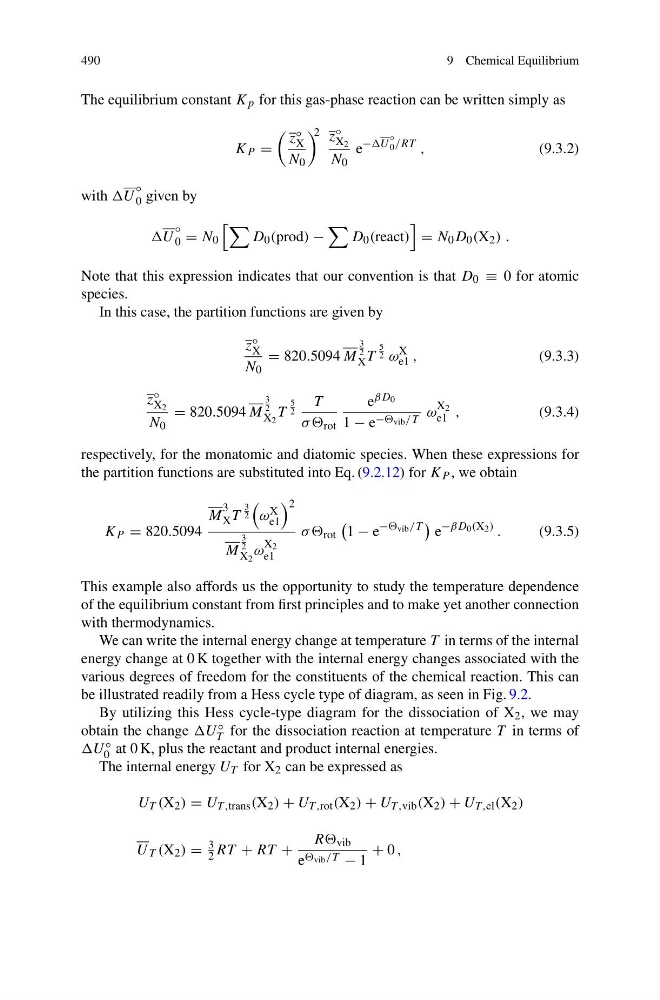
The equilibrium constant K p for this gas-phase reaction can be written simply as
K P =
z
◦
X
N 0
2 z
◦
X 2
N 0
e
−U
◦
0 /RT ,
(9.3.2)
with U
◦
0 given by
U
◦
0 = N 0
D 0 (prod) −
D 0 (react)
= N 0 D 0 (X 2 ) .
Note that this expression indicates that our convention is that D 0 ≡ 0 for atomic
species.
In this case, the partition functions are given by
z
◦
X
N 0
= 820.5094 M
3
2
X T
5
2 ω
X
e1 ,
(9.3.3)
z
◦
X 2
N 0
= 820.5094 M
3
2
X 2
T
5
2
T
σ σ rot
e βD 0
1 − e − vib /T ω
X 2
e1 ,
(9.3.4)
respectively, for the monatomic and diatomic species. When these expressions for
the partition functions are substituted into Eq. (9.2.12) for K P , we obtain
K P = 820.5094
M
3
X T
3
2
ω X
e1
2
M
3
2
X 2
ω
X 2
e1
σ σ rot
1 − e
− vib /T
e
−βD 0 (X 2 ) .
(9.3.5)
This example also affords us the opportunity to study the temperature dependence
of the equilibrium constant from first principles and to make yet another connection
with thermodynamics.
We can write the internal energy change at temperature T in terms of the internal
energy change at 0 K together with the internal energy changes associated with the
various degrees of freedom for the constituents of the chemical reaction. This can
be illustrated readily from a Hess cycle type of diagram, as seen in Fig. 9.2.
By utilizing this Hess cycle-type diagram for the dissociation of X 2 , we may
obtain the change U ◦
T for the dissociation reaction at temperature T in terms of
U ◦
0 at 0 K, plus the reactant and product internal energies.
The internal energy U T for X 2 can be expressed as
U T (X 2 ) = U T ,trans (X 2 ) + U T ,rot (X 2 ) + U T ,vib (X 2 ) + U T ,el (X 2 )
U T (X 2 ) =
3
2 RT + RT +
RR vib
e vib /T − 1
+ 0 ,
9 Chemical Equilibrium
The equilibrium constant K p for this gas-phase reaction can be written simply as
K P =
z
◦
X
N 0
2 z
◦
X 2
N 0
e
−U
◦
0 /RT ,
(9.3.2)
with U
◦
0 given by
U
◦
0 = N 0
D 0 (prod) −
D 0 (react)
= N 0 D 0 (X 2 ) .
Note that this expression indicates that our convention is that D 0 ≡ 0 for atomic
species.
In this case, the partition functions are given by
z
◦
X
N 0
= 820.5094 M
3
2
X T
5
2 ω
X
e1 ,
(9.3.3)
z
◦
X 2
N 0
= 820.5094 M
3
2
X 2
T
5
2
T
σ σ rot
e βD 0
1 − e − vib /T ω
X 2
e1 ,
(9.3.4)
respectively, for the monatomic and diatomic species. When these expressions for
the partition functions are substituted into Eq. (9.2.12) for K P , we obtain
K P = 820.5094
M
3
X T
3
2
ω X
e1
2
M
3
2
X 2
ω
X 2
e1
σ σ rot
1 − e
− vib /T
e
−βD 0 (X 2 ) .
(9.3.5)
This example also affords us the opportunity to study the temperature dependence
of the equilibrium constant from first principles and to make yet another connection
with thermodynamics.
We can write the internal energy change at temperature T in terms of the internal
energy change at 0 K together with the internal energy changes associated with the
various degrees of freedom for the constituents of the chemical reaction. This can
be illustrated readily from a Hess cycle type of diagram, as seen in Fig. 9.2.
By utilizing this Hess cycle-type diagram for the dissociation of X 2 , we may
obtain the change U ◦
T for the dissociation reaction at temperature T in terms of
U ◦
0 at 0 K, plus the reactant and product internal energies.
The internal energy U T for X 2 can be expressed as
U T (X 2 ) = U T ,trans (X 2 ) + U T ,rot (X 2 ) + U T ,vib (X 2 ) + U T ,el (X 2 )
U T (X 2 ) =
3
2 RT + RT +
RR vib
e vib /T − 1
+ 0 ,