

9.3 Four Extended Examples
489
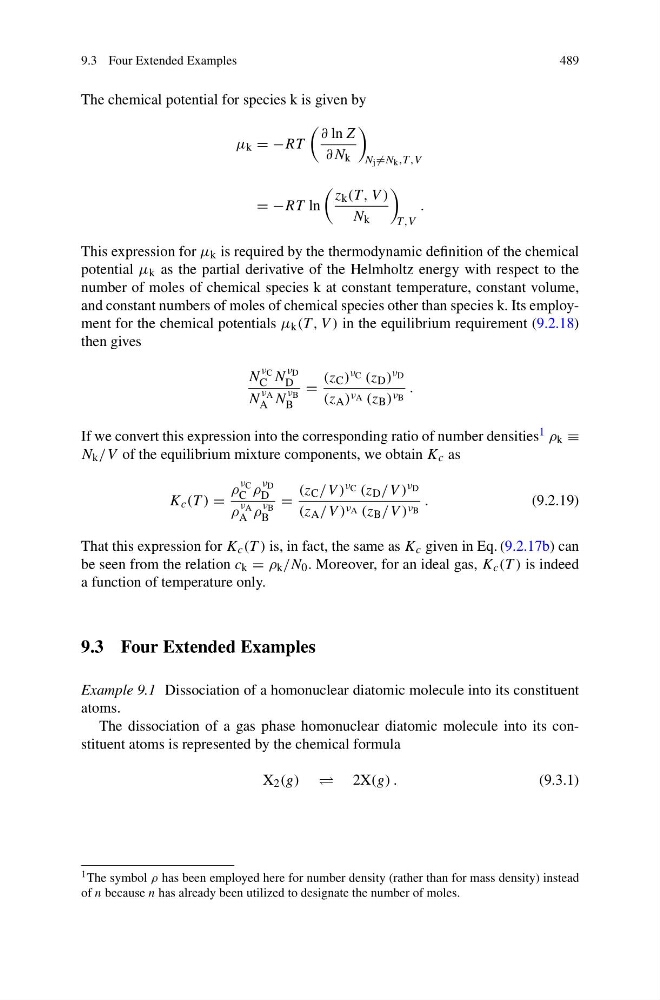
The chemical potential for species k is given by
μ k = −RT
∂ ln Z
∂N k
N j =N k ,T ,V
= −RT ln
z k (T , V )
N k
T ,V
.
This expression for μ k is required by the thermodynamic definition of the chemical
potential μ k as the partial derivative of the Helmholtz energy with respect to the
number of moles of chemical species k at constant temperature, constant volume,
and constant numbers of moles of chemical species other than species k. Its employment for the chemical potentials μ k (T , V ) in the equilibrium requirement (9.2.18)
then gives
N
ν C
C N
ν D
D
N
ν A
A N
ν B
B
=
(z C ) ν C (z D ) ν D
(z A ) ν A (z B ) ν B
.
If we convert this expression into the corresponding ratio of number densities 1 ρ k ≡
N k /V of the equilibrium mixture components, we obtain K c as
K c (T ) =
ρ
ν C
C ρ
ν D
D
ρ
ν A
A ρ
ν B
B
=
(z C /V ) ν C (z D /V ) ν D
(z A /V ) ν A (z B /V ) ν B
.
(9.2.19)
That this expression for K c (T ) is, in fact, the same as K c given in Eq. (9.2.17b) can
be seen from the relation c k = ρ k /N 0 . Moreover, for an ideal gas, K c (T ) is indeed
a function of temperature only.
9.3 Four Extended Examples
Example 9.1 Dissociation of a homonuclear diatomic molecule into its constituent
atoms.
The dissociation of a gas phase homonuclear diatomic molecule into its constituent atoms is represented by the chemical formula
X 2 (g) 2X(g) .
(9.3.1)
1 The symbol ρ has been employed here for number density (rather than for mass density) instead
of n because n has already been utilized to designate the number of moles.
489
The chemical potential for species k is given by
μ k = −RT
∂ ln Z
∂N k
N j =N k ,T ,V
= −RT ln
z k (T , V )
N k
T ,V
.
This expression for μ k is required by the thermodynamic definition of the chemical
potential μ k as the partial derivative of the Helmholtz energy with respect to the
number of moles of chemical species k at constant temperature, constant volume,
and constant numbers of moles of chemical species other than species k. Its employment for the chemical potentials μ k (T , V ) in the equilibrium requirement (9.2.18)
then gives
N
ν C
C N
ν D
D
N
ν A
A N
ν B
B
=
(z C ) ν C (z D ) ν D
(z A ) ν A (z B ) ν B
.
If we convert this expression into the corresponding ratio of number densities 1 ρ k ≡
N k /V of the equilibrium mixture components, we obtain K c as
K c (T ) =
ρ
ν C
C ρ
ν D
D
ρ
ν A
A ρ
ν B
B
=
(z C /V ) ν C (z D /V ) ν D
(z A /V ) ν A (z B /V ) ν B
.
(9.2.19)
That this expression for K c (T ) is, in fact, the same as K c given in Eq. (9.2.17b) can
be seen from the relation c k = ρ k /N 0 . Moreover, for an ideal gas, K c (T ) is indeed
a function of temperature only.
9.3 Four Extended Examples
Example 9.1 Dissociation of a homonuclear diatomic molecule into its constituent
atoms.
The dissociation of a gas phase homonuclear diatomic molecule into its constituent atoms is represented by the chemical formula
X 2 (g) 2X(g) .
(9.3.1)
1 The symbol ρ has been employed here for number density (rather than for mass density) instead
of n because n has already been utilized to designate the number of moles.