

486
9 Chemical Equilibrium
The result (9.2.12) is the final outcome of our derivation. When taken together
with expression (9.2.7b) for the molecular partition functions, it represents a
working formula from which we may actually compute equilibrium constants for
chemical reactions from a knowledge of the energy states of individual molecules.
As such, it represents one of the triumphs of modern statistical thermodynamics
and provides an intimate connection between the microscopic atomic and molecular
world that is probed by spectroscopy and the macroscopic world of chemically
reacting bulk matter that is studied in the field of chemical kinetics.
9.2.1 Some Practical Matters
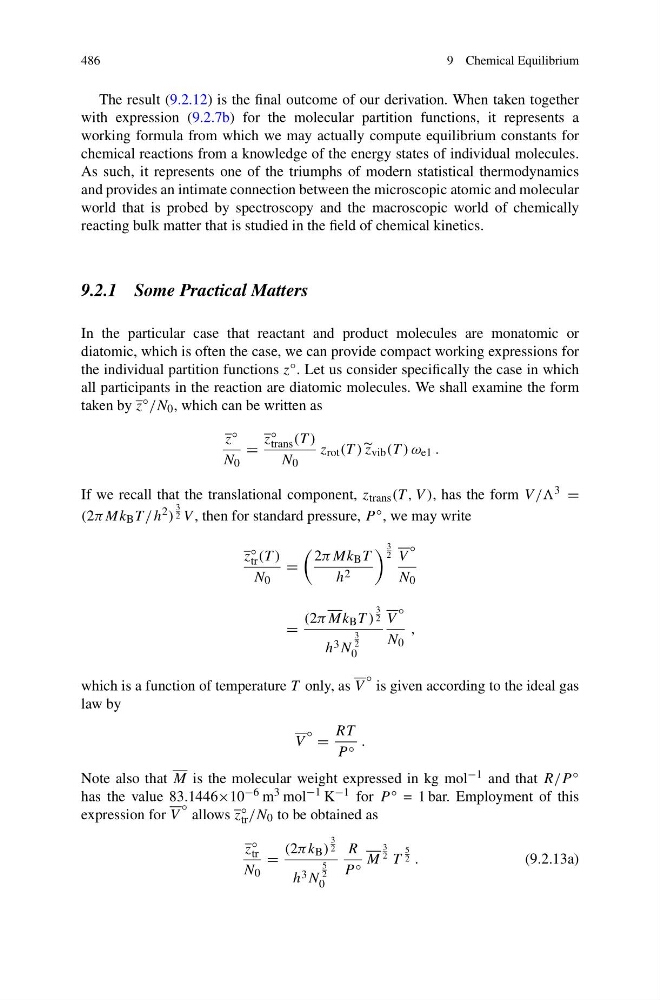
In the particular case that reactant and product molecules are monatomic or
diatomic, which is often the case, we can provide compact working expressions for
the individual partition functions z ◦ . Let us consider specifically the case in which
all participants in the reaction are diatomic molecules. We shall examine the form
taken by z
◦ /N 0 , which can be written as
z
◦
N 0
=
z
◦
trans (T )
N 0
z rot (T ) z vib (T ) ω e1 .
If we recall that the translational component, z trans (T , V ), has the form V // 3 =
(2πMk B T /h 2 )
3
2 V , then for standard pressure, P ◦ , we may write
z
◦
tr (T )
N 0
=
2πMk B T
h 2
3
2 V
◦
N 0
=
(2π Mk B T )
3
2
h 3 N
3
2
0
V
◦
N 0
,
which is a function of temperature T only, as V
◦ is given according to the ideal gas
law by
V
◦ =
RT
P ◦ .
Note also that M is the molecular weight expressed in kg mol −1 and that R/P ◦
has the value 83.1446×10 −6 m 3 mol
−1 K −1 for P ◦ = 1 bar. Employment of this
expression for V
◦ allows z
◦
tr /N 0 to be obtained as
z
◦
tr
N 0
=
(2πk B )
3
2
h 3 N
5
2
0
R
P ◦ M
3
2 T
5
2 .
(9.2.13a)
9 Chemical Equilibrium
The result (9.2.12) is the final outcome of our derivation. When taken together
with expression (9.2.7b) for the molecular partition functions, it represents a
working formula from which we may actually compute equilibrium constants for
chemical reactions from a knowledge of the energy states of individual molecules.
As such, it represents one of the triumphs of modern statistical thermodynamics
and provides an intimate connection between the microscopic atomic and molecular
world that is probed by spectroscopy and the macroscopic world of chemically
reacting bulk matter that is studied in the field of chemical kinetics.
9.2.1 Some Practical Matters
In the particular case that reactant and product molecules are monatomic or
diatomic, which is often the case, we can provide compact working expressions for
the individual partition functions z ◦ . Let us consider specifically the case in which
all participants in the reaction are diatomic molecules. We shall examine the form
taken by z
◦ /N 0 , which can be written as
z
◦
N 0
=
z
◦
trans (T )
N 0
z rot (T ) z vib (T ) ω e1 .
If we recall that the translational component, z trans (T , V ), has the form V // 3 =
(2πMk B T /h 2 )
3
2 V , then for standard pressure, P ◦ , we may write
z
◦
tr (T )
N 0
=
2πMk B T
h 2
3
2 V
◦
N 0
=
(2π Mk B T )
3
2
h 3 N
3
2
0
V
◦
N 0
,
which is a function of temperature T only, as V
◦ is given according to the ideal gas
law by
V
◦ =
RT
P ◦ .
Note also that M is the molecular weight expressed in kg mol −1 and that R/P ◦
has the value 83.1446×10 −6 m 3 mol
−1 K −1 for P ◦ = 1 bar. Employment of this
expression for V
◦ allows z
◦
tr /N 0 to be obtained as
z
◦
tr
N 0
=
(2πk B )
3
2
h 3 N
5
2
0
R
P ◦ M
3
2 T
5
2 .
(9.2.13a)