

9.2 Derivation of the Expression for K P
487
Upon utilizing the values, h = 6.62607015 × 10 −34 J s for the Planck constant,
k B = 1.380649×10 −23 J K −1 for the Boltzmann constant, N 0 = 6.02214076×10 23
mol
−1 for the Avogadro number, and R 0.0831446 dm
3 bar K −1 mol
−1 for the
universal gas constant, the collection of fundamental constants can be evaluated
once and for all, to give 820.5094 in SI units, so that the translational partition
function is given by
z
◦
tr
N 0
= 820.5094M
3
2 T
5
2 .
(9.2.13b)
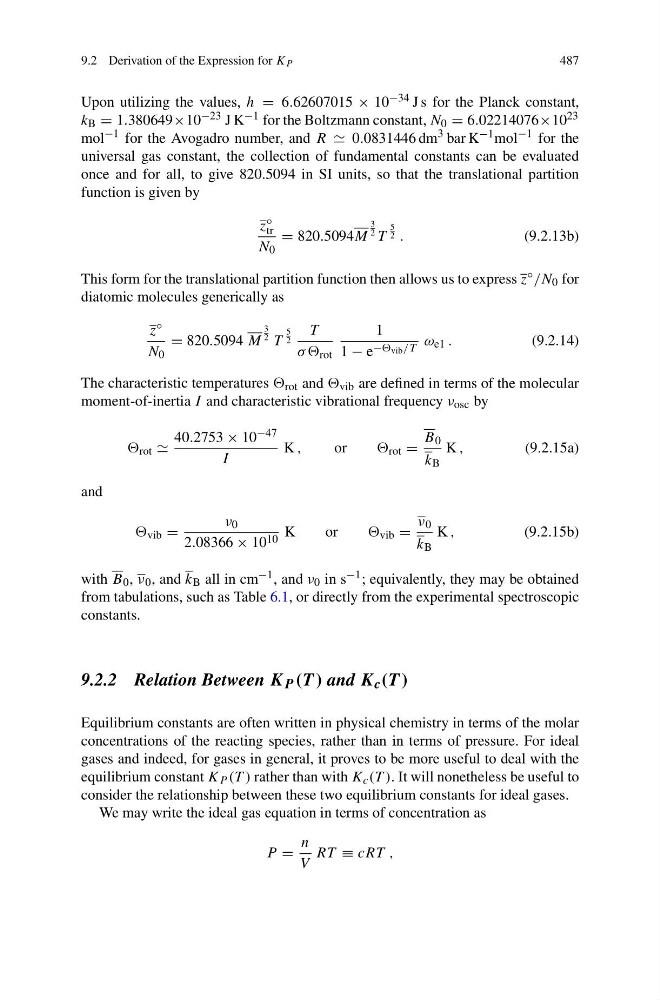
This form for the translational partition function then allows us to express z
◦ /N 0 for
diatomic molecules generically as
z
◦
N 0
= 820.5094 M
3
2 T
5
2
T
σ σ rot
1
1 − e − vib /T ω e1 .
(9.2.14)
The characteristic temperatures rot and vib are defined in terms of the molecular
moment-of-inertia I and characteristic vibrational frequency ν osc by
rot
40.2753 × 10 −47
I
K ,
or
rot =
B 0
k B
K ,
(9.2.15a)
and
vib =
ν 0
2.08366 × 10 10 K
or
vib =
ν 0
k B
K ,
(9.2.15b)
with B 0 , ν 0 , and k B all in cm −1 , and ν 0 in s −1 ; equivalently, they may be obtained
from tabulations, such as Table 6.1, or directly from the experimental spectroscopic
constants.
9.2.2 Relation Between K P (T ) and K c (T )
Equilibrium constants are often written in physical chemistry in terms of the molar
concentrations of the reacting species, rather than in terms of pressure. For ideal
gases and indeed, for gases in general, it proves to be more useful to deal with the
equilibrium constant K P (T ) rather than with K c (T ). It will nonetheless be useful to
consider the relationship between these two equilibrium constants for ideal gases.
We may write the ideal gas equation in terms of concentration as
P =
n
V
RT ≡ cRT ,
487
Upon utilizing the values, h = 6.62607015 × 10 −34 J s for the Planck constant,
k B = 1.380649×10 −23 J K −1 for the Boltzmann constant, N 0 = 6.02214076×10 23
mol
−1 for the Avogadro number, and R 0.0831446 dm
3 bar K −1 mol
−1 for the
universal gas constant, the collection of fundamental constants can be evaluated
once and for all, to give 820.5094 in SI units, so that the translational partition
function is given by
z
◦
tr
N 0
= 820.5094M
3
2 T
5
2 .
(9.2.13b)
This form for the translational partition function then allows us to express z
◦ /N 0 for
diatomic molecules generically as
z
◦
N 0
= 820.5094 M
3
2 T
5
2
T
σ σ rot
1
1 − e − vib /T ω e1 .
(9.2.14)
The characteristic temperatures rot and vib are defined in terms of the molecular
moment-of-inertia I and characteristic vibrational frequency ν osc by
rot
40.2753 × 10 −47
I
K ,
or
rot =
B 0
k B
K ,
(9.2.15a)
and
vib =
ν 0
2.08366 × 10 10 K
or
vib =
ν 0
k B
K ,
(9.2.15b)
with B 0 , ν 0 , and k B all in cm −1 , and ν 0 in s −1 ; equivalently, they may be obtained
from tabulations, such as Table 6.1, or directly from the experimental spectroscopic
constants.
9.2.2 Relation Between K P (T ) and K c (T )
Equilibrium constants are often written in physical chemistry in terms of the molar
concentrations of the reacting species, rather than in terms of pressure. For ideal
gases and indeed, for gases in general, it proves to be more useful to deal with the
equilibrium constant K P (T ) rather than with K c (T ). It will nonetheless be useful to
consider the relationship between these two equilibrium constants for ideal gases.
We may write the ideal gas equation in terms of concentration as
P =
n
V
RT ≡ cRT ,