

9.2 Derivation of the Expression for K P
485
ν
ν
ν
ν
ν
ν
ν
ν
Δε
°
0
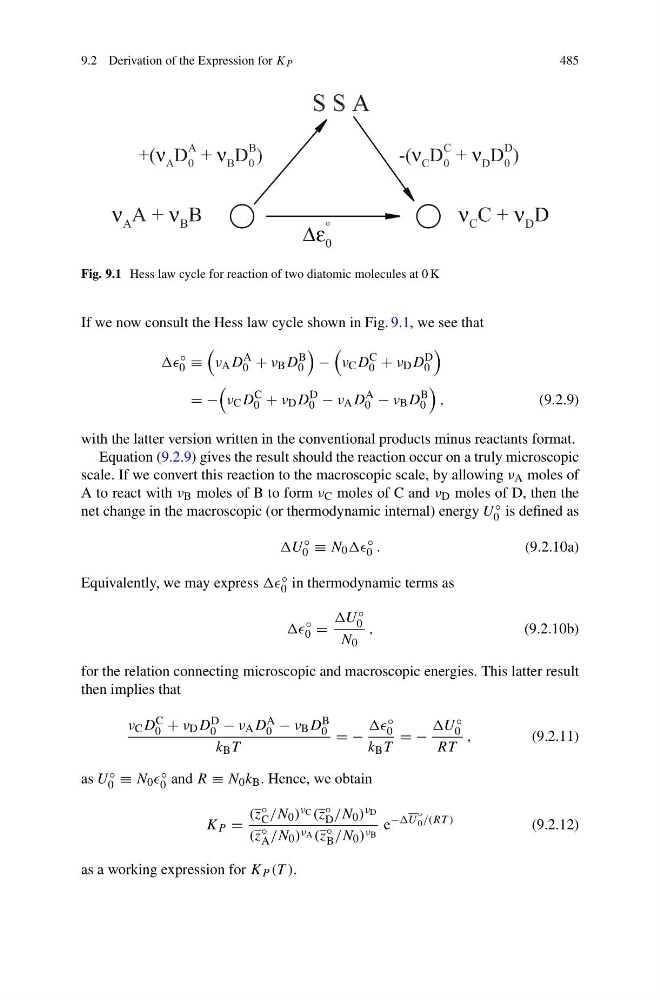
Fig. 9.1 Hess law cycle for reaction of two diatomic molecules at 0 K
If we now consult the Hess law cycle shown in Fig. 9.1, we see that
◦
0 ≡
ν A D
A
0 + ν B D
B
0
−
ν C D
C
0 + ν D D
D
0
= −
ν C D
C
0 + ν D D
D
0 − ν A D
A
0 − ν B D
B
0
,
(9.2.9)
with the latter version written in the conventional products minus reactants format.
Equation (9.2.9) gives the result should the reaction occur on a truly microscopic
scale. If we convert this reaction to the macroscopic scale, by allowing ν A moles of
A to react with ν B moles of B to form ν C moles of C and ν D moles of D, then the
net change in the macroscopic (or thermodynamic internal) energy U ◦
0 is defined as
U
◦
0 ≡ N 0
◦
0 .
(9.2.10a)
Equivalently, we may express ◦
0 in thermodynamic terms as
◦
0 =
U ◦
0
N 0
,
(9.2.10b)
for the relation connecting microscopic and macroscopic energies. This latter result
then implies that
ν C D C
0 + ν D D D
0 − ν A D A
0 − ν B D B
0
k B T
= −
◦
0
k B T
= −
U ◦
0
RT
,
(9.2.11)
as U ◦
0 ≡ N 0 ◦
0 and R ≡ N 0 k B . Hence, we obtain
K P =
(z
◦
C /N 0 ) ν C (z
◦
D /N 0 ) ν D
(z
◦
A /N 0 ) ν A (z
◦
B /N 0 ) ν B
e
−U
◦
0 /(RT )
(9.2.12)
as a working expression for K P (T ).
485
ν
ν
ν
ν
ν
ν
ν
ν
Δε
°
0
Fig. 9.1 Hess law cycle for reaction of two diatomic molecules at 0 K
If we now consult the Hess law cycle shown in Fig. 9.1, we see that
◦
0 ≡
ν A D
A
0 + ν B D
B
0
−
ν C D
C
0 + ν D D
D
0
= −
ν C D
C
0 + ν D D
D
0 − ν A D
A
0 − ν B D
B
0
,
(9.2.9)
with the latter version written in the conventional products minus reactants format.
Equation (9.2.9) gives the result should the reaction occur on a truly microscopic
scale. If we convert this reaction to the macroscopic scale, by allowing ν A moles of
A to react with ν B moles of B to form ν C moles of C and ν D moles of D, then the
net change in the macroscopic (or thermodynamic internal) energy U ◦
0 is defined as
U
◦
0 ≡ N 0
◦
0 .
(9.2.10a)
Equivalently, we may express ◦
0 in thermodynamic terms as
◦
0 =
U ◦
0
N 0
,
(9.2.10b)
for the relation connecting microscopic and macroscopic energies. This latter result
then implies that
ν C D C
0 + ν D D D
0 − ν A D A
0 − ν B D B
0
k B T
= −
◦
0
k B T
= −
U ◦
0
RT
,
(9.2.11)
as U ◦
0 ≡ N 0 ◦
0 and R ≡ N 0 k B . Hence, we obtain
K P =
(z
◦
C /N 0 ) ν C (z
◦
D /N 0 ) ν D
(z
◦
A /N 0 ) ν A (z
◦
B /N 0 ) ν B
e
−U
◦
0 /(RT )
(9.2.12)
as a working expression for K P (T ).