

484
9 Chemical Equilibrium
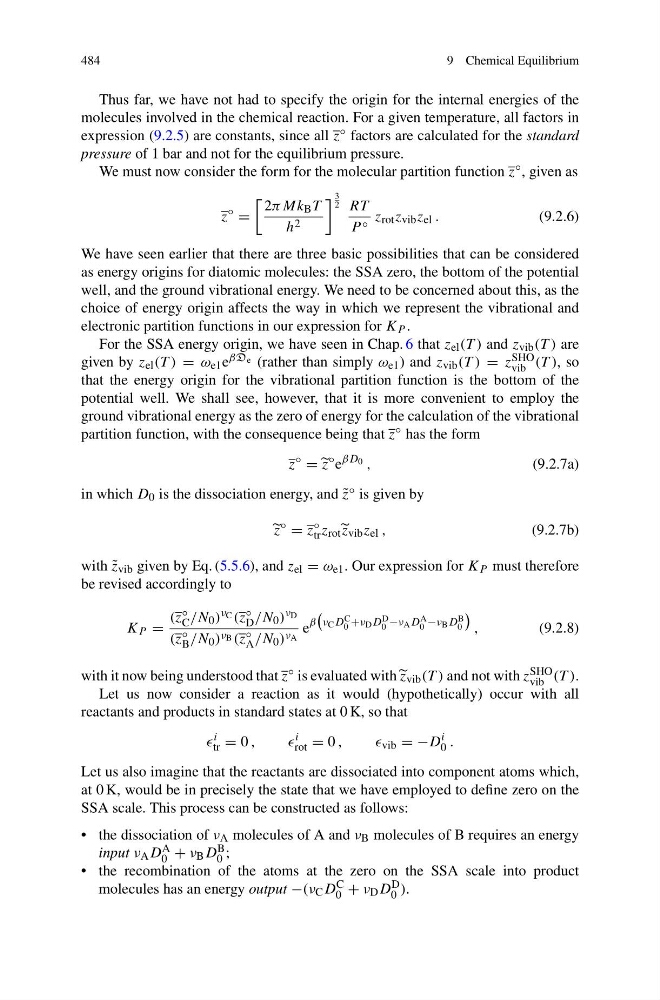
Thus far, we have not had to specify the origin for the internal energies of the
molecules involved in the chemical reaction. For a given temperature, all factors in
expression (9.2.5) are constants, since all z
◦ factors are calculated for the standard
pressure of 1 bar and not for the equilibrium pressure.
We must now consider the form for the molecular partition function z
◦ , given as
z
◦
=
2πMk B T
h 2
3
2 RT
P ◦ z rot z vib z el .
(9.2.6)
We have seen earlier that there are three basic possibilities that can be considered
as energy origins for diatomic molecules: the SSA zero, the bottom of the potential
well, and the ground vibrational energy. We need to be concerned about this, as the
choice of energy origin affects the way in which we represent the vibrational and
electronic partition functions in our expression for K P .
For the SSA energy origin, we have seen in Chap. 6 that z el (T ) and z vib (T ) are
given by z el (T ) = ω e1 e βD e (rather than simply ω e1 ) and z vib (T ) = z SHO
vib (T ), so
that the energy origin for the vibrational partition function is the bottom of the
potential well. We shall see, however, that it is more convenient to employ the
ground vibrational energy as the zero of energy for the calculation of the vibrational
partition function, with the consequence being that z
◦ has the form
z
◦
= z
◦ e
βD 0 ,
(9.2.7a)
in which D 0 is the dissociation energy, and ˜
z ◦ is given by
z
◦
= z
◦
tr z rot z vib z el ,
(9.2.7b)
with ˜
z vib given by Eq. (5.5.6), and z el = ω e1 . Our expression for K P must therefore
be revised accordingly to
K P =
(z
◦
C /N 0 ) ν C (z
◦
D /N 0 ) ν D
(z
◦
B /N 0 ) ν B (z
◦
A /N 0 ) ν A
e
β
ν C D C
0 +ν D D D
0 −ν A D A
0 −ν B D B
0
,
(9.2.8)
with it now being understood that z
◦ is evaluated with z vib (T ) and not with z SHO
vib (T ).
Let us now consider a reaction as it would (hypothetically) occur with all
reactants and products in standard states at 0 K, so that
i
tr = 0 ,
,
i
rot = 0 ,
, vib = −D
i
0 .
Let us also imagine that the reactants are dissociated into component atoms which,
at 0 K, would be in precisely the state that we have employed to define zero on the
SSA scale. This process can be constructed as follows:
• the dissociation of ν A molecules of A and ν B molecules of B requires an energy
input ν A D A
0 + ν B D B
0 ;
• the recombination of the atoms at the zero on the SSA scale into product
molecules has an energy output −(ν C D C
0 + ν D D D
0 ).
9 Chemical Equilibrium
Thus far, we have not had to specify the origin for the internal energies of the
molecules involved in the chemical reaction. For a given temperature, all factors in
expression (9.2.5) are constants, since all z
◦ factors are calculated for the standard
pressure of 1 bar and not for the equilibrium pressure.
We must now consider the form for the molecular partition function z
◦ , given as
z
◦
=
2πMk B T
h 2
3
2 RT
P ◦ z rot z vib z el .
(9.2.6)
We have seen earlier that there are three basic possibilities that can be considered
as energy origins for diatomic molecules: the SSA zero, the bottom of the potential
well, and the ground vibrational energy. We need to be concerned about this, as the
choice of energy origin affects the way in which we represent the vibrational and
electronic partition functions in our expression for K P .
For the SSA energy origin, we have seen in Chap. 6 that z el (T ) and z vib (T ) are
given by z el (T ) = ω e1 e βD e (rather than simply ω e1 ) and z vib (T ) = z SHO
vib (T ), so
that the energy origin for the vibrational partition function is the bottom of the
potential well. We shall see, however, that it is more convenient to employ the
ground vibrational energy as the zero of energy for the calculation of the vibrational
partition function, with the consequence being that z
◦ has the form
z
◦
= z
◦ e
βD 0 ,
(9.2.7a)
in which D 0 is the dissociation energy, and ˜
z ◦ is given by
z
◦
= z
◦
tr z rot z vib z el ,
(9.2.7b)
with ˜
z vib given by Eq. (5.5.6), and z el = ω e1 . Our expression for K P must therefore
be revised accordingly to
K P =
(z
◦
C /N 0 ) ν C (z
◦
D /N 0 ) ν D
(z
◦
B /N 0 ) ν B (z
◦
A /N 0 ) ν A
e
β
ν C D C
0 +ν D D D
0 −ν A D A
0 −ν B D B
0
,
(9.2.8)
with it now being understood that z
◦ is evaluated with z vib (T ) and not with z SHO
vib (T ).
Let us now consider a reaction as it would (hypothetically) occur with all
reactants and products in standard states at 0 K, so that
i
tr = 0 ,
,
i
rot = 0 ,
, vib = −D
i
0 .
Let us also imagine that the reactants are dissociated into component atoms which,
at 0 K, would be in precisely the state that we have employed to define zero on the
SSA scale. This process can be constructed as follows:
• the dissociation of ν A molecules of A and ν B molecules of B requires an energy
input ν A D A
0 + ν B D B
0 ;
• the recombination of the atoms at the zero on the SSA scale into product
molecules has an energy output −(ν C D C
0 + ν D D D
0 ).